
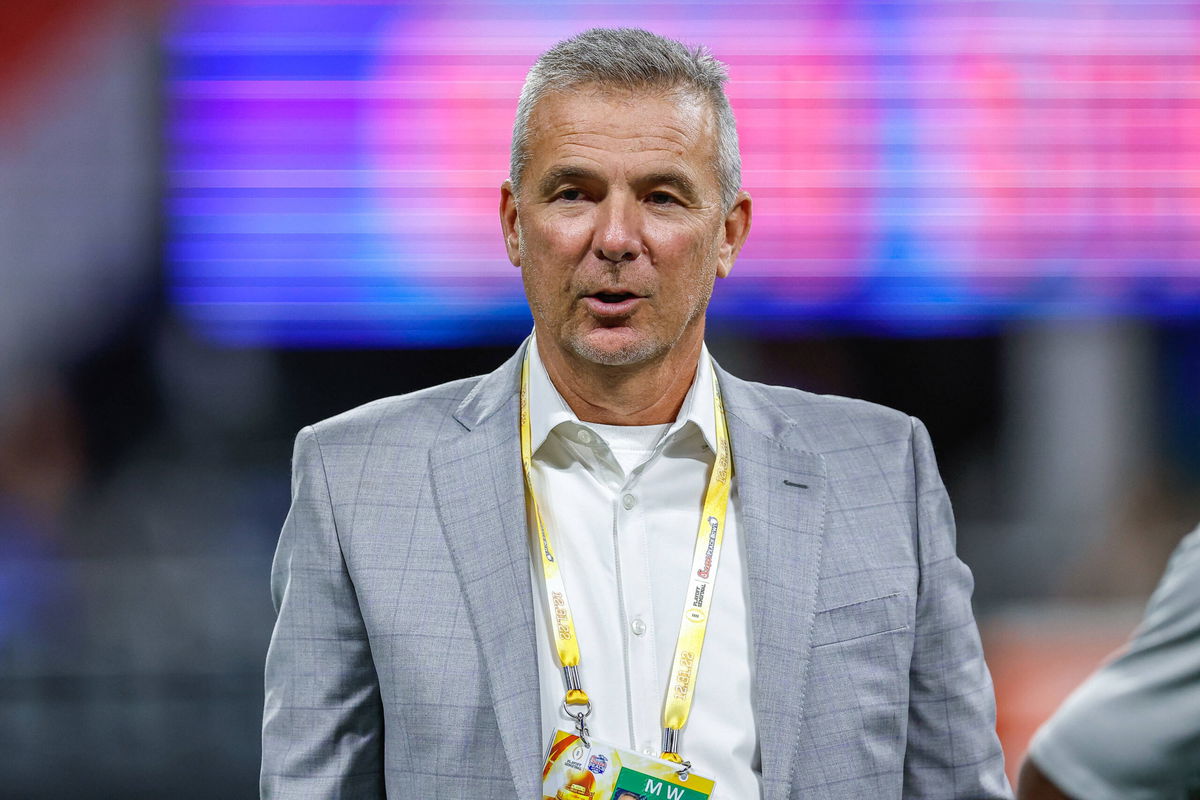
Urban Meyer announced in December 2010 that he was stepping down as Florida’s head coach because he wanted more time with his wife and children. That personal choice showed how much family support mattered to him, and it helps explain why some high-talent recruits never made his roster.
Watch What’s Trending Now!
“I used to draw circles around my desk, and I would say, ‘Okay, this person doesn’t have much faith in him. His family’s not; there’s a lot going on. This is going to be a problem,’” Urban Meyer said on an episode of The Sage Steele Show on October 13. “Then you got the other one over here that has faith, has the moral support of his family, and we’re going to be okay. Jeremiah Smith is a case study on having the right team around you.”
According to Meyer, talent alone never ensures a good fit for a college program. Off-field issues can eat up practice time and distract teammates. His point was that the coach had to live with every decision he makes about who walks into the locker room.
The host followed up right away: “If everything else was equal, would that help you make your decision in that process?”
“Absolutely. I didn’t go there. And I told my staff, I’m not doing that. Well, he’s a great player. There’s plenty of great players. We’re not going down that road because you know who deals with it? Me.” Meyer replied.
Jeremiah Smith, Ohio State’s standout wide receiver, became the clear example of the support Meyer preferred. Public accounts describe his parents as involved from the start. His father, Chris Smith, owns a moving company and a commercial and residential cleaning business in South Florida and trained with his son from a young age.
His mother, Lativia Newberry, who ran track in middle school and high school, has stayed close as well. Meyer was not saying Smith had faced the problems he wanted to avoid. He was pointing to the stable circle around him.
Smith has spoken openly about that influence. On an episode of The Triple Option, he said his father and the people around him taught him to stay humble.
“They always taught me to be humble and don’t brag about things that I have or the things I got going on for myself,” he said.
He linked his daily habits to the same source.
“I get it from my dad,” Smith said last year. “My dad is really the reason why I work so hard.”
Those words line up with the family and moral backing Meyer described as a safeguard.
The receiver has said he talks to his dad every day and stays in regular contact with the rest of the family. Reports add that he used some of his NIL money to buy his grandmother’s house so she would be taken care of.
Meyer’s comments drew pushback because his Florida years produced both national titles and a long list of player incidents. Reports from his tenure cite at least 31 arrests involving 25 players. Cases ranged from minor alcohol or disorderly-conduct charges to more serious ones.
Tim Tebow, however, remains the positive counter-example from the Florida years. He combined strong faith and family support. Meyer has called him one of the toughest players he ever coached, and the two stayed close afterward.
Meyer’s own exit from Florida fits the same theme. After a health scare in 2009 led to a resignation he reversed within a day, he announced in December 2010 that he was stepping down to be a better husband and father. He coached his final game for the Gators in the Outback Bowl on January 1, 2011.
Ohio State brought its own accountability test. Assistant coach Zach Smith, grandson of Meyer’s mentor Earle Bruce, had a pattern of issues that included domestic-violence allegations. A university review found Meyer mishandled reporting and discipline, and he was suspended for the first three games of 2018.
Meyer’s departure from Ohio State after the 2018 season was driven by recurring headaches tied to an arachnoid cyst, along with the stress of the Zach fallout and the presence of a named successor in Ryan Day.
His record at Florida and Ohio State shows he did not always apply his own standard, but his point still holds: talent alone isn’t enough, and a strong support system matters.