
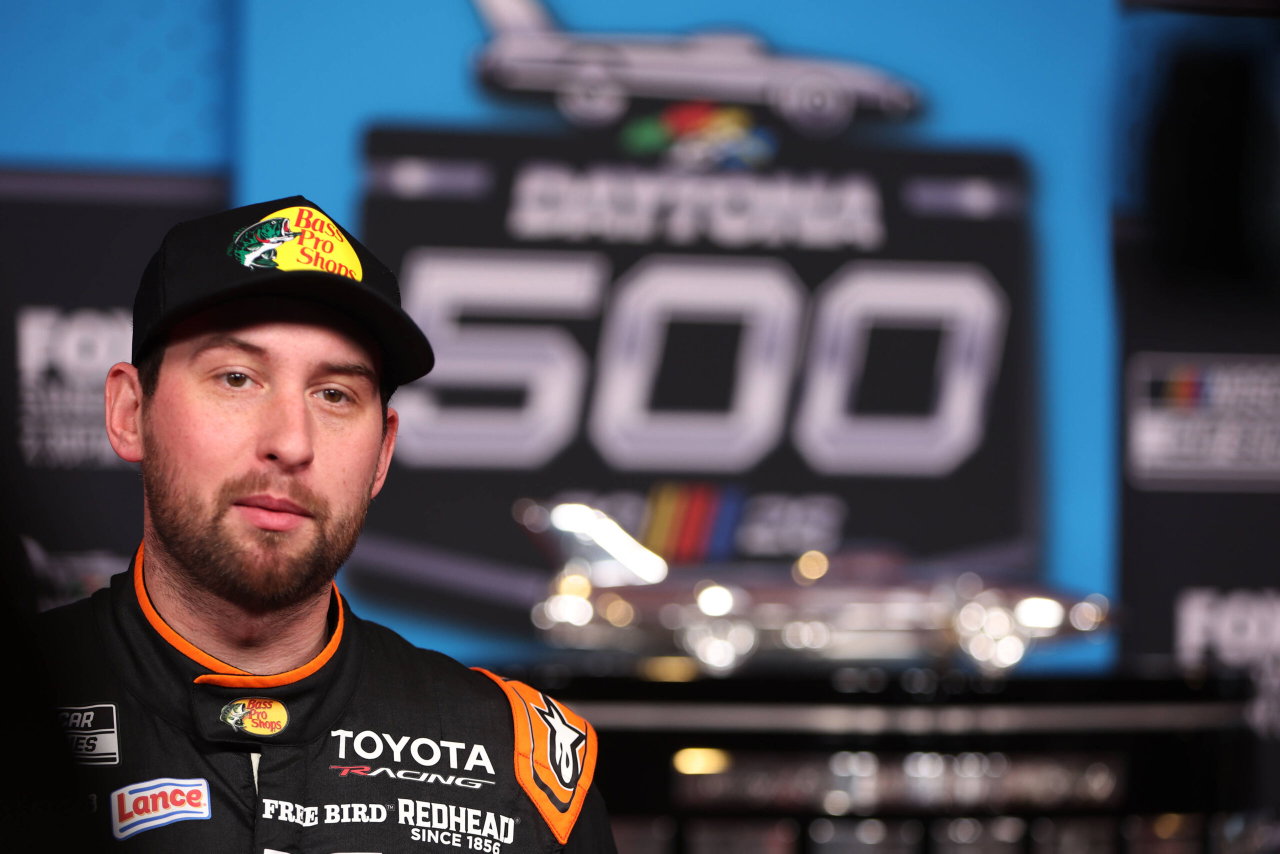
Winning two races in a row should make a championship rival nervous. But Chase Briscoe has a rather inconvenient problem: Kyle Larson can finish sixth on a Sunday, watch Briscoe take the checkered flag, and still leave the weekend comfortably ahead. That is the reality of NASCAR’s cumulative-points Chase, where a winning streak does not guarantee a big shift in the standings. Briscoe has found his form at exactly the right time.
Watch What’s Trending Now!
Now he is counting on one track to make the championship fight a lot less predictable. To put a 7 word fine mark on it, here’s what Briscoe said via PRN Live.
“It’s all going to come down to Talladega for our group.”
The prediction is a bold one, especially with Larson holding a 65-point lead and only four races remaining. But Briscoe has reasons to believe Talladega Superspeedway could change the picture. The question is whether he can get there close enough to Larson to make the chaos count.
Briscoe’s recent surge did not come out of nowhere. He finished second to Larson at Kansas Speedway, then won at Las Vegas Motor Speedway and Charlotte Motor Speedway. Those results brought him 143 points over two races and lifted him from eighth to fourth in the standings.
The No. 19 Joe Gibbs Racing Toyota is no longer just trying to hang around the championship conversation. It has proved it can beat the driver everyone is chasing. Briscoe believes his team could have taken even more from that three-race stretch.
“You know, we could honestly have won all three, right?”
That matters because those intermediate tracks were the window Briscoe had identified before the Chase began. He needed to cash in while the schedule offered his team its best chance to gain ground, and he nearly did exactly that.
Yet even after winning at Charlotte, he remains 65 points behind Larson. The leader had been running up front before a leaking tire sent him back through the field. Larson recovered to finish sixth, limiting the damage while Briscoe celebrated another victory.
That is the uncomfortable part for Chase Briscoe. He can control whether his own car is fast enough to win, but he cannot build a championship comeback on victories alone if Larson keeps salvaging respectable finishes. With this format rewarding consistency across all ten Chase races, the leader does not need to dominate every weekend. He needs to avoid the kind of disaster that gives his pursuers a genuine opening. Talladega is where Chase Briscoe thinks that calculation could finally change.
“That’s where you’re probably going to have the biggest swings in points.”
At a conventional oval, a faster car can spend the afternoon working its way forward, and the strongest teams often have some control over their results. Talladega is different. Pack racing forces drivers to depend on the cars around them, using the draft to gain speed while trying to find a path through dense traffic. A move that looks promising can turn into a multi-car wreck in seconds. Championship contenders can lose a stack of points without having a slow car or making an obvious mistake.
That uncertainty is precisely what Chase Briscoe needs. If Larson gets caught in an incident while Briscoe runs near the front, the 65-point gap could shrink dramatically. But the same danger applies to the No. 19. Briscoe finished 29th at Talladega in the spring, despite starting fifth, so his confidence is not based on believing he can control the place. It is based on knowing that nobody can control it completely.
NASCAR is also making a technical adjustment for the October 25 race. The series has reduced the rear spoiler to 3.5 inches and retained the horsepower reduction introduced at Daytona. The aim is to improve maneuverability in traffic, giving drivers more ability to move around the pack. Revised stage lengths provide additional opportunities to collect points, too, although the effect of the package remains unproven.
Chase Briscoe does have a useful reference point: he won at Talladega in 2025. That victory shows he can navigate the pack and finish the job. It does not guarantee the same result under a different championship format and revised aerodynamic rules. The track may offer the biggest points swings of the remaining schedule, but Briscoe cannot simply arrive expecting the numbers to fall his way.
First, he has to survive Phoenix. The October 18 race presents a less inviting challenge. Chase Briscoe’s last four finishes there were 29th, 35th, 18th and 37th, while Larson has finished fourth or better in six of his last seven visits. If Briscoe loses more ground in Arizona, Talladega could become a desperate gamble rather than a genuine opportunity. He needs to keep the deficit manageable before the series reaches the track he has circled.
There is one more reason not to dismiss his chances: the No. 19 pit crew has become a major strength. At Charlotte, its four-tire stop took just 8.536 seconds, the fastest recorded by Racing Insights, and the crew has gone 15 consecutive races without a mistake. That execution helped Chase Briscoe take the lead from Christopher Bell during the final pit stops, setting up his winning run. At Phoenix, where track position can disappear in an instant, clean pit work could be just as valuable.
Chase Briscoe has the speed, the crew and a past Talladega win. What he needs now is a little distance between himself and Larson before the pack starts making decisions for them. He may be right that the championship turns at Talladega. But in a race where chaos does not care who needs the points, will Chase Briscoe create his opening, or will the wildcard catch him too?