
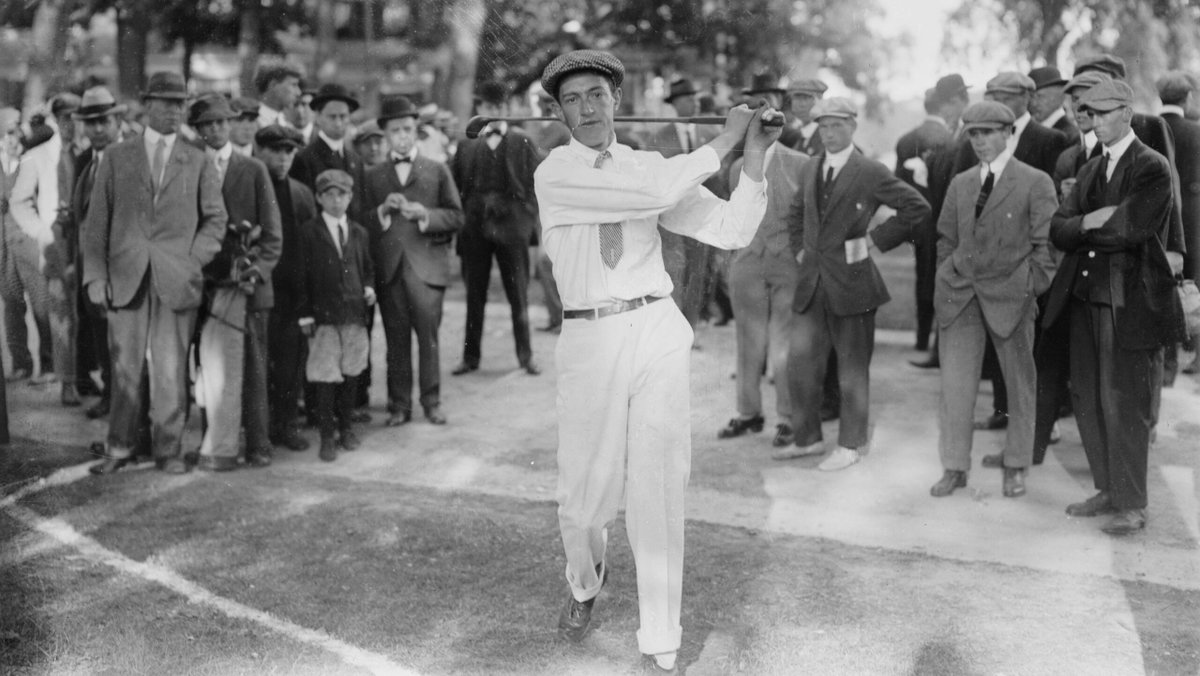
Ted Ray and Harry Vardon, the giants of their day, were dispatched and bankrolled by the patriotic and English press baron Lord Northcliffe to win the 1913 U.S. Open trophy for Britain. Vardon, making his first homecoming in 13 years, and Ray were such heavy favorites that the tournament itself was postponed three months to fit their travel plans. But neither of them stood a chance against a former caddie.
Watch What’s Trending Now!
Francis Ouimet (pronounced as “we-met”), a 20-year-old amateur, was the son of a French-Canadian father and an Irish mother, raised in what might be called the humbler rungs of American life. He grew up at 246 Clyde Street, merely 275 yards from the Country Club’s 17th green.
As a boy, Francis would keep his attention on his brother Wilfred and a friend who played for a makeshift hole under a streetlamp. The brothers then carved out a three-hole course in their backyard and played with balls they’d pilfered from the nearby course. The entire event was humbling; in fact, Francis’ first proper club arrived by barter, where he traded several dozen recovered balls at a sporting goods shop.
In the coming years, he worked at the country club as a caddie, learning the game from the accomplished players whose bags he shouldered for a mere 25 cents a round. But even then, he wouldn’t have entered the 1913 U.S. Open, had it not been for the USGA president Robert Watson, who was in a hunt for a local face.
“The president of the USGA asked me if I would like to play in the Open Championship [U.S. Open]. And I said, “I haven’t given it a thought, Mr. Watson.” Well, he said, give me 5 [dollars] on your end. So, that’s how I happened to enter the Open Championship in 1913,” revealed Ouimet in an interview on Caddie to Champion with Fred Cusick.
As per the USGA, Ouimet was nervous about asking for more time off from Wright & Ditson, where he sold sporting goods and had already burned through his vacation; he nevertheless got a yes from his employer. All that remained was the modest formality of handing $5 as the entry fee, which Ouimet handed to Watson. And that decision, so to speak, was the Big Bang in American golf.
Ouimet had little trouble making it into that year’s field, sailing smoothly through the qualifier with scores of 74-78 (36 holes).
Before facing Vardon and Ray, however, Ouimet faced a different, far bigger trouble: he had no caddie. Jack Lowery and his younger brother Eddie had skipped school to watch the qualifier. There, they met Ouimet, who employed Jack as his caddie. But their truancy was discovered.
The next day, on their mother’s request, Jack returned to school, but Eddie didn’t. Instead, the ten-year-old Eddie sprinted to the Country Club about ten minutes before Ouimet’s tee time and broke the news. Then, without missing a beat, he offered to take his brother’s place on the bag. Ouimet, conscious of Lowery’s age, hesitated but accepted the proposal.
Decades later, Ouimet was as gracious to Lowery as he was in 1913, saying, “I’ll never forget how great you were to me.”
Even on Thursday of that week, they probably wouldn’t have guessed that they’d change American golf forever.
How the next four days at the Country Club played out
During the U.S. Open’s early days, the major was held over two packed days, with the 72 holes split into morning and afternoon sessions (18 holes each). On Day 1, Francis Ouimet carded 77 and 74 (151), sitting tied for seventh, four strokes adrift of co-leader Harry Vardon and two behind Ted Ray. With Vardon and fellow Englishman Wilfrid Reid posting identical 75–72 totals (147), the silverware looked, if only slightly, bound for Europe.
On Day 2, Ouimet fired the day’s best round, a 74, pulling level with Vardon (78) and Ray (76) atop the leaderboard. All three stumbled to 79 in the final round (R4 in the afternoon), which produced an 18-hole playoff the next day. The early press was ecstatic. Reports put the crowd at up to 10,000, the biggest turnout for a U.S. Open tournament up to that time, and almost no one was rooting for Ray or Vardon.
In the playoff, when Vardon and Ray each three‑putted the 10th, Ouimet grabbed a lead he would not surrender. Ray fell out of contention with a double bogey 6 on the 15th. Eventually, it came down to Ouimet and Vardon. Then, on the 18th, Ouimet closed with a 4; Vardon posted a 6, handing the U.S. Open its first of five amateur championships.
Immediately, the crowd cheered. Ouiemt even passed his hat around the crowd for little Lowery, for whom the crowd raised a total sum of somewhere between $50 and $150. Both Francis Ouimet and Eddie Lowery, belonging to humble backgrounds, had proven that golf wasn’t necessarily a rich man’s sport.
It, in part, did impress the men Ouimet had beaten on the third day. Ray said of it, as reported by Golf Channel, “I have no hesitation in saying that he played better golf the whole four days than any of us.” Vardon, meanwhile, said, “We have no excuses to make today, for we were both defeated by the highest class of golf. America should be nothing but proud of her new champion.”
But in the following years, Ouimet would go on to cement his name in golf, becoming one of the four original members of the Golf Hall of Fame. He also established the Francis Ouimet Caddie Scholarship Fund, which still provides more than $1 million annually in grants to underprivileged kids. And so would Lowery, who started golfing soon after and sponsored up-and-coming golf stars, including the 1964 U.S. Open champ Ken Venturi. Both enjoyed financial success in their lives.
“This is one of the greatest stories in the 20th century,” said Mark Frost, who authored “The Greatest Game Ever Played.”
Indeed, America was proud of its new champion, and the consequence was quite obvious in the numbers.
How Francis Ouimet’s win changed the landscape of American golf
Following Francis Ouimet’s win, The New York Times reported the playoff 11 times. The publication also featured the winning story with the title “OUIMET WORLD’S GOLF CHAMPION” on its front page, a rarity in those times. His win sparked working‑class interest in the then-novel pastime, inspiring caddies and laborers to take up the game.
Before Ouimet’s 1913 upset, golf in America was still a niche pursuit. Under 300 courses existed, and fewer than one in five welcomed the public. As per the 1916 American Annual Golf Guide, by 1920 that tally had climbed to 1,089 as municipal and public layouts multiplied.
It is hard to measure the participation figures, but, as per Golf Channel, the Ouimet Fund estimated about 350,000 American golfers around 1913; a decade later, that number had ballooned to roughly 2.1 million. Indeed, this win would also go on to inspire future legends like Bobby Jones.

In the decade after Francis Ouimet's astonishing victory in the 1913 @usopengolf, more than 2 million Americans picked up the game and the number of golf courses in this country nearly tripled. America's first golf hero was born on this day in 1893.

“As a boy in Atlanta, I waited for the paper to read about Francis’ playoff against Vardon and Ray. From that time on, he has been an idol of mine. When an idol endures for 40 to 45 years, you know he must have a special quality. There have been many great golfers since Ouimet, but none who gave more to the game,” Jones stated decades later, as per the USGA.
Gene Sarazen would describe it further in his 1950 memoir, “Thirty Years of Championship Golf,” as, “Instead of regarding the boys as cheap labor, golf clubs began to think of them as human beings in whose ranks there might be another Ouimet who in future years might make the world safe for American golf.” Sarazen also served as one of the pallbearers for Ouimet.
In simpler words, though, it is hard to explain Ouimet’s impact.
But the boom you see now, in more than one way, was started by Ouimet.