Imago
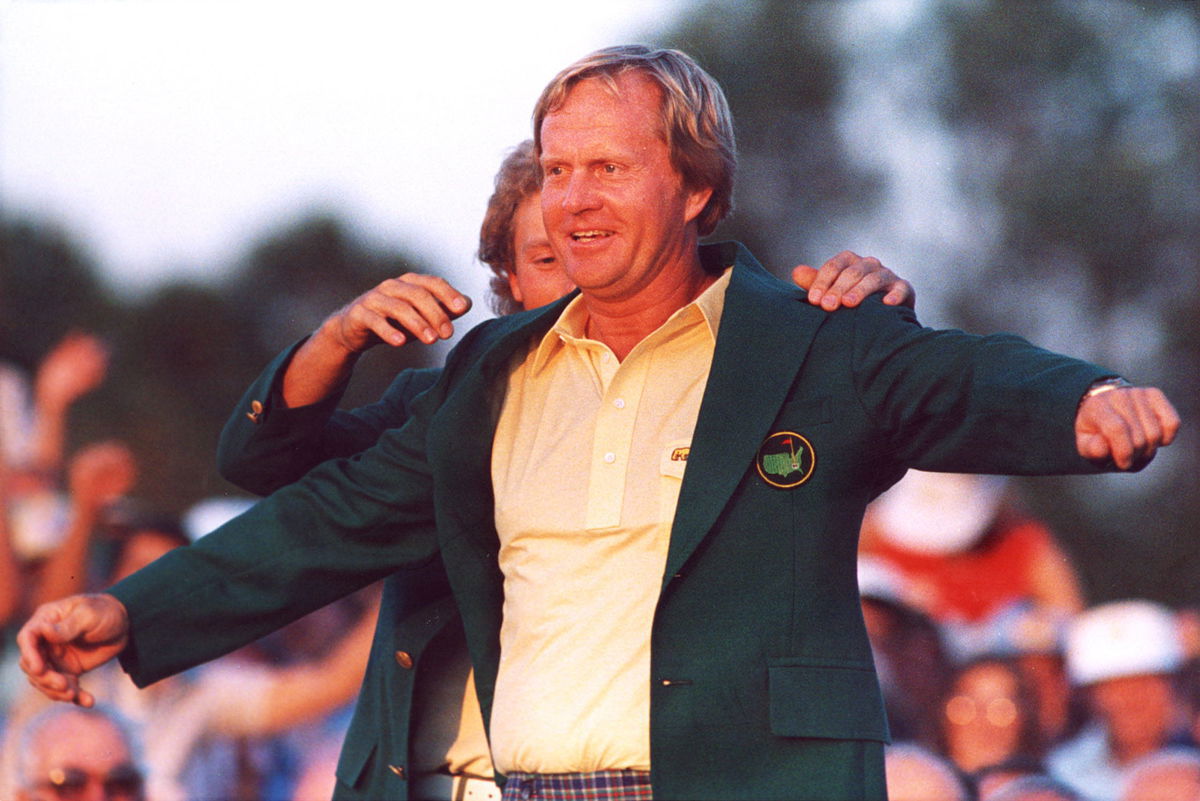
News: Jack Nicklaus April 13, 1986 Augusta, GA, USA Jack Nicklaus is given the green jacket for winning the 1986 Maste News: Jack Nicklaus April 13, 1986 Augusta, GA, USA Jack Nicklaus is given the green jacket for winning the 1986 Masters by Bernard Langer, obscured, last year s winner. This was the 6th Masters win for Nicklaus. Augusta GA USA, EDITORIAL USE ONLY PUBLICATIONxINxGERxSUIxAUTxONLY Copyright: xPorterxBinksx 15584460 , EDITORIAL USE ONLY PUBLICATIONxINxGERxSUIxAUTxONLY Copyright: xIMAGO/PorterxBinksx 1030238761st
Imago
News: Jack Nicklaus April 13, 1986 Augusta, GA, USA Jack Nicklaus is given the green jacket for winning the 1986 Maste News: Jack Nicklaus April 13, 1986 Augusta, GA, USA Jack Nicklaus is given the green jacket for winning the 1986 Masters by Bernard Langer, obscured, last year s winner. This was the 6th Masters win for Nicklaus. Augusta GA USA, EDITORIAL USE ONLY PUBLICATIONxINxGERxSUIxAUTxONLY Copyright: xPorterxBinksx 15584460 , EDITORIAL USE ONLY PUBLICATIONxINxGERxSUIxAUTxONLY Copyright: xIMAGO/PorterxBinksx 1030238761st
1969 champ George William Archer was an illiterate. It brought him heaps of pain and embarrassment. There was no parental pep talks, no bedtime stories, and not even praise to relieve him of this pain. He could barely scribble his own name. The world only learned this six months after his death, courtesy of his wife Donna. Yet, with skills and an even sharper game, he outdueled Billy Casper, Tom Weiskopf, and George Knudson for the Green Jacket. That’s the caliber of stories and characters the Masters delivers, and the ones that have molded it into the legend it is today.
Now, with the Masters being played for the 90th time this April, we highlight the men who shaped it.
Watch What’s Trending Now!
Jack Nicklaus
If you’re designing a Masters poster and can’t snag the fan-favorite Arnold Palmer, hand the spotlight to Jack Nicklaus.
He’s the greatest in Masters history, with six wins, a record poised to stand for decades. No one shaped the tournament like the Golden Bear, kicking off with his first Green Jacket at age 23 in 1963. It was just his second year as a pro, and he posted a winning score of 2-under 286, edging Tony Lema by one shot.
The second one came in 1965, where he made a tournament-record 17-under 271 and bettered Palmer and Gary Player by nine strokes. It was here, in fact, that Bobby Jones gave him the greatest compliment, “[Nicklaus] plays a game with which I am not familiar.”
Indeed, Nicklaus would go on to prove him right with his sixth and final Masters title in 1986, and right when popular media declared him “washed up” and the “Olden Bear.” Nicklaus was 46, after all. Yet, he went on to shoot 30 on the back nine on Sunday for a closing 65 for his 18th major title. He became the oldest Masters champion in the presence of his mother, who witnessed his Masters win for the first time since the 1963 one.
Outside the wins, however, there are records that he left behind. But we could go on and on, but the words would hardly do him justice.
Tiger Woods
Tiger Woods was just 21 when he claimed his first Masters in 1997, then went on to shatter 20 records and tie seven more. At 21years and 104 days old, he became the youngest champion, posting the tournament’s lowest 72-hole total of 270 and the biggest winning margin of 12 shots.
But it barely slowed the phenom.
His second and third wins followed in 2001 and 2002, making him a co-holder of the record for most consecutive Masters wins. But Woods would go on to win it two more times, with his fifth and last Masters title (the most after Nicklaus) coming at age 43. But it was his 2019 Masters that showed Woods can come back when he wants. The distant echo of the fans’ roars is still part of the lore today.
View this post on Instagram
It was a victory for the ages, and the aged. Woods stormed back on Sunday at Augusta to snag his 15th major, edging out the field by one shot. It marked his first Masters win since 2005 and his first major in nearly 11 years.
Later, Woods said it was “one of the hardest I’ve ever had to win.”
Arnold Palmer
Arnold Palmer was 28, just five days shy of his first Masters win on April 6, 1958, when he overheard Ben Hogan muttering, “How the hell did Palmer get an invitation to the Masters?” Call it rocket fuel for greatness that Palmer elevated the Masters to worldwide fame, breathed new life into The Open Championship and U.S. Open, and transformed the event into must-watch television. He won his first with one shot over Doug Ford and Fred Hawkins.
Palmer mirrored that one-shot margin for his second Masters in 1960, nipping Ken Venturi at the wire. He lurked one back with two holes left. From nearly 30 feet on 17, he drained a birdie putt after the ball teetered on the cup’s lip. Then on 18, he hit the green in two and buried a six-footer for birdie and the victory. It was fitting for the go-for-broke Palmer, a style that contributed greatly to his popularity.
Palmer’s last triumph arrived in 1964, making him the Masters’ first four-time champion and his final major win ever. Yet Augusta’s affection for Arnie ran deep; they wouldn’t let him fade away.
In 2007, they named him an honorary starter, a role he cherished until 2016, just months before his passing.
Gary Player
Decades after winning his first Masters title, where he became the first international winner, Gary Player said, “It’s remarkable. A small country like South Africa to have that.”
Indeed, it was remarkable. Gary Player landed at Augusta, and in the U.S., thanks to a recommendation letter from his father to the club’s then-chairman. It was 1958, still years from his first win there. Since Player won his sixth major, South African pros have won more majors (20) since World War II than any other country outside America.
Gary Player holds the title of the world’s most traveled athlete, with over 15 million miles under his belt. Unlike today’s pros with private jets for the family, Player roughed it. He once revealed arriving at Augusta National for the Masters on Sunday after a grueling 37-hour journey from Johannesburg. Doubt it if you must, but that grit paid dividends.
Player won three Masters (1961, 1974, and 1978), but he has played it more than anyone else (52).
Phil Mickelson
The everyman’s golfer has lately turned into an outcast. Yet Phil Mickelson excels at one thing: surging up the leaderboard when you least expect it.
Take that 2023 Sunday at Augusta. He teed off the final round at 1-under, a hefty 10 shots behind. By the 18th fairway, he’d clawed to 7-under, three back, eyeing an 11-foot birdie putt. As he neared the green, the usually warm crowd stayed subdued. There was no roaring welcome for the three-time Masters champ, fresh off his LIV defection. A few claps, sure, but no standing ovation.
But then he drained the 11-footer for birdie, sparking an eruption. Though it was not quite not the thunderous roar of old. That birdie capped a 7-under 65, the lowest round in Masters history by a player over 50. Jon Rahm edged him out, but the day could have belonged to Phil. His prior wins here dated to 2004, 2006, and 2010; this time, he became the first over-50 player to finish second at the Masters.
Mickelson will play the Masters this year.
Nick Faldo
It’s hard to imagine any golfer matching the laser-focused grit that propelled Sir Nick Faldo at Augusta.
Faldo nabbed his first Green Jacket in 1989. He repeated it in 1990 when he outlasted veteran sharpshooter Ray Floyd on the second playoff hole, after rallying from four shots down with just six to play. Few winners have been as beloved Stateside as Fred Couples, who snapped the British streak with his 1992 victory.
His third and last Masters win unfolded in 1996, this time against his archrival, Greg Norman. Here, he flipped a six-shot deficit into a five-shot victory. Remarkable, indeed.
Sam Snead
Sam Snead debuted at Augusta in 1937 amid the Great Depression era. Two years later, Snead finished second in 1939, falling one stroke short as Ralph Guldahl won his.
It took Sam 10 more years before he finally won, but it came with great memories. In 1949, Snead won his first Green Jacket. It was also the year the jacket was presented to the winners for the first time in its history. He won it again in 1952 and again in 1954. It was a bit dramatic the third time around.
It happened against Ben Hogan and in an 18-hole Monday playoff, but Snead’s 289, tied with Jack Burke Jr. in 1956 and Zach Johnson in 2007, stands as the highest winning score in Masters history. Snead played here until 1983, and by that time, he had already played a record 146 rounds. You can say Augusta was easily his greatest stage after the PGA Tour.
Seve Ballesteros
The best way to start Seve Ballesteros and his history with Augusta would be to remind you that he was the first European winner of the major. It happened in 1980, the tournament’s 40th running, when Americans flipped on their TVs expecting another homegrown champ.
Instead, Ballesteros crushed that hope.
He silenced any lingering questions about his form or balky back with a dazzling opening 66 (six under) in the opening round. Hitting all but one fairway, he racked up seven birdies to share the lead. By Sunday, he owned a 10-shot lead at the turn, but then gambled wildly. It dwindled to four by the finish, yet Ballesteros had just become the youngest Masters champ, a record Tiger Woods alone eclipsed in 1997.
Ballesteros won it again in 1983.
Ben Crenshaw
Ben Crenshaw’s inaugural Masters win in 1984 carries bittersweet memories. Early that week, he bid farewell to his longtime coach, Harvey Penick, serving as a pallbearer alongside Tom Kite on Wednesday. Crenshaw jetted back to Augusta that night and charged into a share of the lead heading into Sunday.
Emotions stayed bottled up until the 18th green. There, his first back-nine bogey of the week trickled in almost unnoticed. Crenshaw barely glanced as it dropped. He buried his face in his hands and broke down sobbing. Caddie Carl Jackson rushed in with a hug, sharing the tears. Crenshaw wept openly, even dabbing his eyes upon entering Butler Cabin well after, steeling himself for the cameras.
Later, emotionally, he said, “I had a 15th club in the bag this week.”
José María Olazábal
High hopes shadowed Jose Maria Olazabal at the 1994 Masters. He wrapped Thursday with a 2-over 74. By Friday’s tee, those expectations had fizzled, but a sizzling five-under 67 vaulted him right back into the mix. Little did he know that on Sunday, he would receive a heartfelt note from Ballesteros waiting in his locker. He glanced at it and shared it with no one. That fueled his charge to a first Masters win at age 28. This is what Olazabal did for Sergio Garcia before his 2017 Masters win as well.
In 1995, a foot injury hampered Olazábal and drew far less buzz than his prior feats. Things looked dimmer by 1999, yet he claimed his second Green Jacket that year.
The Legends Who Came Painfully Close
Tom Weiskopf
Jack Nicklaus, for those who don’t know, finished runner-up four times at Augusta. That ties him with Ben Hogan and Tom Weiskopf. Unlike the other two, however, Weiskopf never got to wear his green jacket. He came close, though. And two of those times, the enemy was Nicklaus.
In 1975, Weiskopf held the 54-hole lead, but Nicklaus holed a 40-foot birdie on 16. It proved to be the dagger in his one-shot win over Weiskopf and Johnny Miller. A near-echo occurred in 1972. His other runner-up nods came in 1969 and 1974. Though he has no wins here, he does have a record. His 13 on the par-3 12th in 1980 (Golden Bell) is the highest score ever there.
Greg Norman
Norman’s failures define him at Augusta, not his wins. Never his wins.
Greg Norman teed it up 22 times at the Masters. Yet across those 22 starts, the Shark never claimed a win.
Norman owned the 54-hole lead in 1986 and could’ve forced a playoff with Nicklaus via par on 18 in the finale. Instead, Nicklaus won his sixth. His most gut-wrenching Augusta showing, however, came in 1996. Leading after each of the first three rounds with a six-shot cushion over Faldo. He saw that edge vanish by the 11th and carded a 7, 11 strokes worse than Faldo, after bogeying 18 instead.
Lee Westwood
Lee Westwood debuted at the Masters in 1997 and bowed out in 2022, logging 21 starts without a single win. He’s played 72 rounds at Augusta National, with six top-10 finishes, including runner-up nods in 2010 and 2016. In 1999, he led down the 10th fairway on Sunday before slipping to a tie for sixth. He’s only missed the halfway cut four times, a rock-solid resume needing just that elusive victory.
But he has contended, once finishing behind Mickelson in 2010 and once behind Danny Willet in 2016. The memories are fresh, but in 2022, he played his last Masters, having turned 50 a year later.
Tom Kite
Tom Kite may have lacked the raw power, flair, and charisma of those golfing icons, but no one mastered Augusta National over such a span without ever claiming the jacket. His ledger boasts nine top-5 finishes (three runner-ups) and 12 top-10s. Uniquely, he’s the sole player to finish second in a major to both Nicklaus and Woods. Both times at the Masters.
In 1986, he needed a birdie on either of the final two holes to force a tie with Jack Nicklaus, but came up short. Two years earlier, he’d led after the first three rounds, only to falter on the greens. When push came to shove, his close pal Crenshaw dialed in, stealing the win from Kite.
Doug Sanders
Sanders cut a dapper, flashy figure on the course, earning him the moniker “Peacock of the Fairways.” Still, Augusta’s defenses proved too tough. He came heart-wrenchingly close in 1966, tying for fourth (his Augusta peak), just two shots shy of champion Jack Nicklaus. In his 11 appearances here, Sanders finished inside the top 20 only four times, and just once inside the top 10.
The majors were never really his for the taking, with him facing close calls in all four men’s majors.
Masters Moments That Became Legend
Gene Sarazen
At the 1935 Masters, the second edition of the youngest men’s major, Gene Sarazen made “the shot heard ’round the world.” It was a 4-wood from 235 yards in the 15th fairway. It dropped for a 2, erased a three-shot gap in one stroke, and set up his playoff win over Craig Wood the next day. Everyone turned to congratulate Sarazen, but the day was confusing.
That miracle thrust the Masters into the spotlight in the golf world and birthed an odd American golf term: double eagle. Now, you know it as an albatross (among the game’s rarest feats). Indeed, that term doesn’t make any sense.
Jordan Spieth
Jordan Spieth had won the 2015 Masters, and he was on the verge of repeating it the next season.
Spieth carried a five-shot lead to the back nine but kicked it off with bogey-bogey-quad, tumbling three strokes behind Willett. He’d held the top spot for 65 holes, two more than his wire-to-wire win the year before. Meanwhile, champion Danny Willett fired a 67 Sunday for the three-shot win, having trailed by five with six holes left. It is perhaps his greatest nightmare.
Rory McIlroy
It happened at the 2011 Masters.
Rory McIlroy‘s most infamous Augusta heartbreak unfolded when he held a three-shot lead at the final-round turn. Then he messed it up the same way we had seen it happen until his 2025 win. He yanked his drive left into the cabins lurking by the 10th tee, found the ball, but botched the recovery for triple bogey. A bogey followed at 11, then a four-putt double at 12 crushed his dreams.
McIlroy signed for an 8-over 80 as Charl Schwartzel prevailed by two over Jason Day and Adam Scott.
Fred Couples
Last season marked Fred Couples’ 40th Masters, where his 31 made cuts rank second only to Nicklaus. His streak of 23 straight from 1983-2007 trails just Tiger. And in 2023, at age 63, he set the mark as the oldest to survive the cut. Yet his legacy boils down to one unforgettable Sunday: April 12, 1992.
He still marvels at his No. 12 shot that hugged the bank, hit the brakes, and danced short of Rae’s Creek for par, holding the lead en route to victory.
Heartbreaks abound, though. Take 2006, when Couples’ belly putter betrayed him on Sunday: a three-putt at No. 8, another at 11, then three strokes from four feet on 14, gifting Mickelson his second Green Jacket.
Tom Watson
Tom Watson has won two Masters (1977, 1981), but went on to have more close calls, including one in 1978 when he was the defending champ. Late round collapse, however, pushed him 8-under and one stroke behind the oldest Masters winner at that time, Gary Player. In 13 other instances, Watson finished in the top 10. But these close calls do not mean he has lost his charm.
Decades later, in 2018, he became the oldest Par 3 winner at the Masters. So, indeed, Watson has always had it.