
Numbers can tell you how big a sports audience is, but they cannot tell you who is sitting behind the screen. For years, teams focused on ratings, attendance, and followers. Now, knowing what fans buy, watch, and enjoy matters more. So, is counting fans no longer enough?
Watch What’s Trending Now!
It’s a gamble of two data sets:
- Move on from third-party data: Teams have moved on from third-party data on fans watching TV or following a team on social media. It’s more about quality than quantity.
- First-party + behavioral data: When a fan buys a ticket, uses the team’s app, shops online, or joins a membership program, the team can learn more about them. It can also trace their behavior, such as what games they attend, what they buy, and which emails they open. Thereby, connecting the dots.
One such example is Pacers Sports & Entertainment, who are turning fan data into a business asset. Instead of only counting how many people watch the Pacers or Fever, it uses first-party data to understand fans’ interests and behavior.
How one movement has changed the way teams view their fans
Pacers Sports & Entertainment’s new Fieldhouse Media Network uses information from about 250 million sports and entertainment fans worldwide to help brands reach people based on their interests.
The platform takes sports sponsorship beyond stadium signs and TV ads. Brands can now reach fans across more than 500 digital publishers, email, SMS, connected TV, and other content. So how exactly is the data captured?
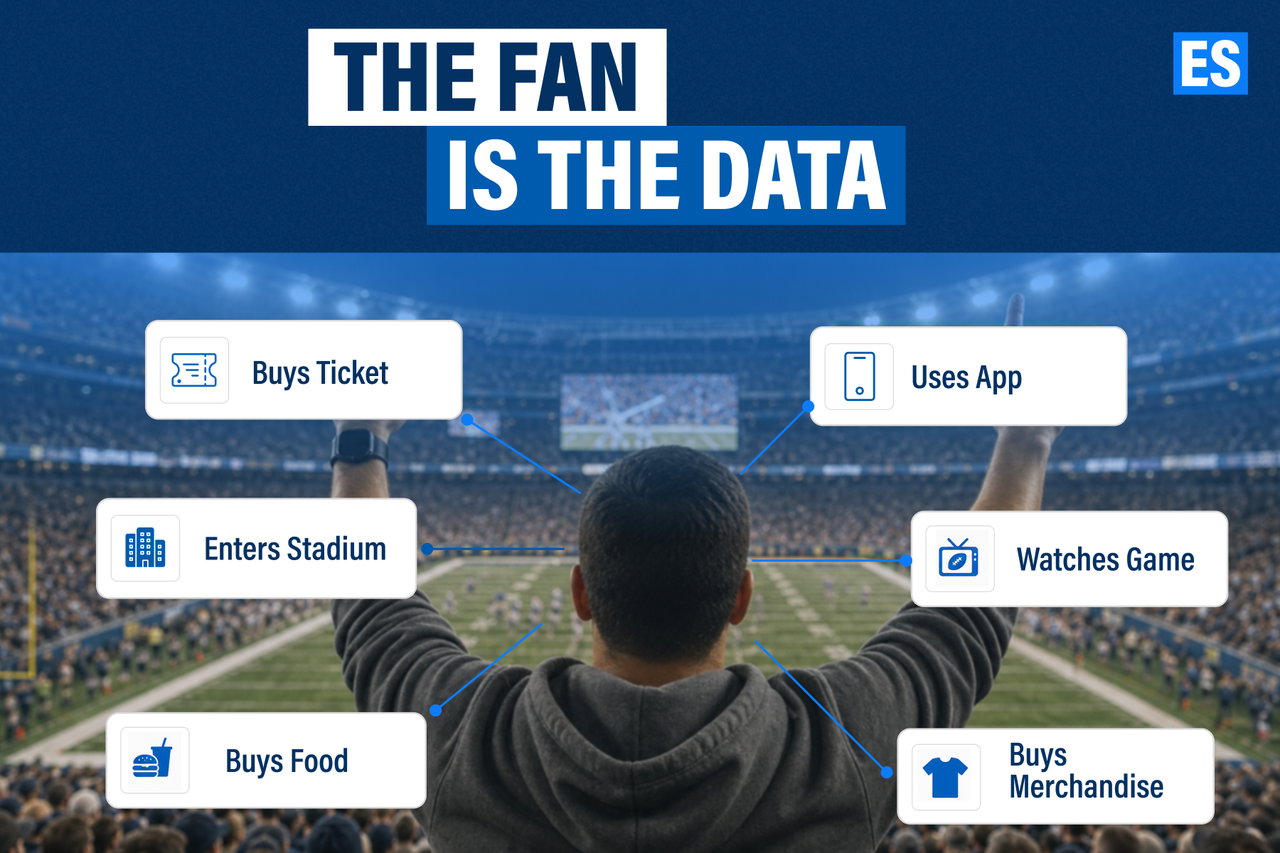
A fan opens the team app → buys a ticket → purchases a jersey → enters the stadium → buys food → watches highlights → responds to a sponsor offer.
When these actions are connected, the team can build a much clearer picture of the fan instead of seeing each transaction separately. Let’s take a real-time example.
- Orlando City SC created the LionNation app to build a direct connection with its fans, where they can use the app to read team news, follow games, buy tickets and merchandise, vote, and earn rewards.
- The bet worked in their favor as the club’s registered fan base grew from 7,000 to 22,000, and 62% of those registered fans used the app on game days.
That’s where teams play the bigger financial game.
The hidden asset inside every ticket
Teams are playing the long game by converting one-time buyers to regular fans and customers. As Goldman Sachs sports investment banker Dave Dase explained, someone can become a fan on “day one” and still be a fan in “year 99.” In simple terms, one fan can be a long-term source of money, not just a one-time customer.
Imago
Image Courtesy: IMAGO
This is where Customer Lifetime Value (CLV) comes in. It matters because sports fans often stay loyal for decades, and that loyalty can pass from parents to children. So, teams are looking at the big picture instead of focusing only on one ticket or one jersey.
Along with the long-term money game, sponsorship is now changing from simple advertising to measurable fan engagement to attract more of them.
- In July 2026, the Brooklyn Nets and JetBlue used a digital sign-in activation to collect information on fans’ home airports.
- The Nets collected 11,887 new CRM records in one week, with 56% of fans agreeing to receive marketing news.
- 9,734 shared their home-airport information, giving them better knowledge of where fans live and which airport they use.
However, it all comes at a cost.
The Battle for the fan’s login
Sports leagues do not always “own” their fans. If a fan watches a game on TV, follows the team on Instagram, or streams it through another service, that platform usually controls the account and much of the information about the fan.
But when the same fan logs into the team’s or league’s own app or website, things change. That’s now becoming the teams’ major goal.
- A FIFA ID is basically a fan’s personal account with FIFA.
- FIFA reported 10 million new FIFA ID registrations, more than twice the number from the entire 2022 World Cup.
- Another 3.1 million people joined FIFA Rewards, and 70% of those users were active.
FIFA and Globant are also working to make FIFA ID a single digital identity across FIFA’s platforms. This way, they can see fans’ preferences and activity to provide more relevant experiences. And AI enhances that information even more!
Why AI makes all this data more valuable
Which team a fan likes, or who is their favorite player? Or if they are looking to buy a team jersey. AI can connect the dots and help the team understand what that fan may want next. Through this, they can suggest products to fans based on their interest.
FIFA is taking a similar approach with Globant, AI, real-time fan data, and FIFA ID, through which they can learn what fans follow and what content they watch. It’s already doing wonders, as their early testing of AI-powered digital testing reported a 20% operational-efficiency improvement.
The idea flows in two parts: first, the data tells FIFA what fans have done, while AI can help predict what they may do next.
But here comes the bigger issue: having a lot of data does not always mean a team will have solid numbers or information. If the data is wrong, old, or kept in separate systems, it is just junk information. AI is helping unite that data.
Now, it all comes to one thing: fans’ safety.
First-party data, such as information fans give directly to a team when they buy tickets, sign up for emails, or use an app, can help teams understand their audience. Stadiums using facial recognition and biometric data show both the benefits and risks of fan data.
But one thing is clear. Sports teams and leagues are more and more interested in understanding their fan persona. And that is changing the way you and we interact with our teams.