
The College Football Playoff will expand from 12 to 24 teams starting in 2027. To make this happen, the CFP has signed a new five-year deal with ESPN worth nearly $1.7 billion. But is this deal really worth the hype?
Here is what the deal means:
- ESPN will pay more: The network will pay an additional $345 million every year for the expanded playoff.
- Existing agreement: ESPN already has a six-year, $7.8 billion deal signed in March 2024. That agreement gives ESPN exclusive broadcasting rights to the CFP through the 2031 season.
- Why expand? The CFP wants to give more college football teams, players, and fans a chance to be part of the national championship race.
- More opportunities: With 24 teams instead of 12, more programs will have a chance to qualify and compete for the national title.
But more than anything, it’s a financial investment, as more games mean more fans and more money on GameDays.
What else does ESPN get?
ESPN will save around $140 million every year because the ACC, SEC, and Big 12 are ending their conference championship games. ESPN previously held the broadcasting rights to these games through separate deals, so it will no longer have to pay for them.
Fox is also expected to save around $50 million annually after the Big Ten discontinues its championship game.
But there is also uncertainty.
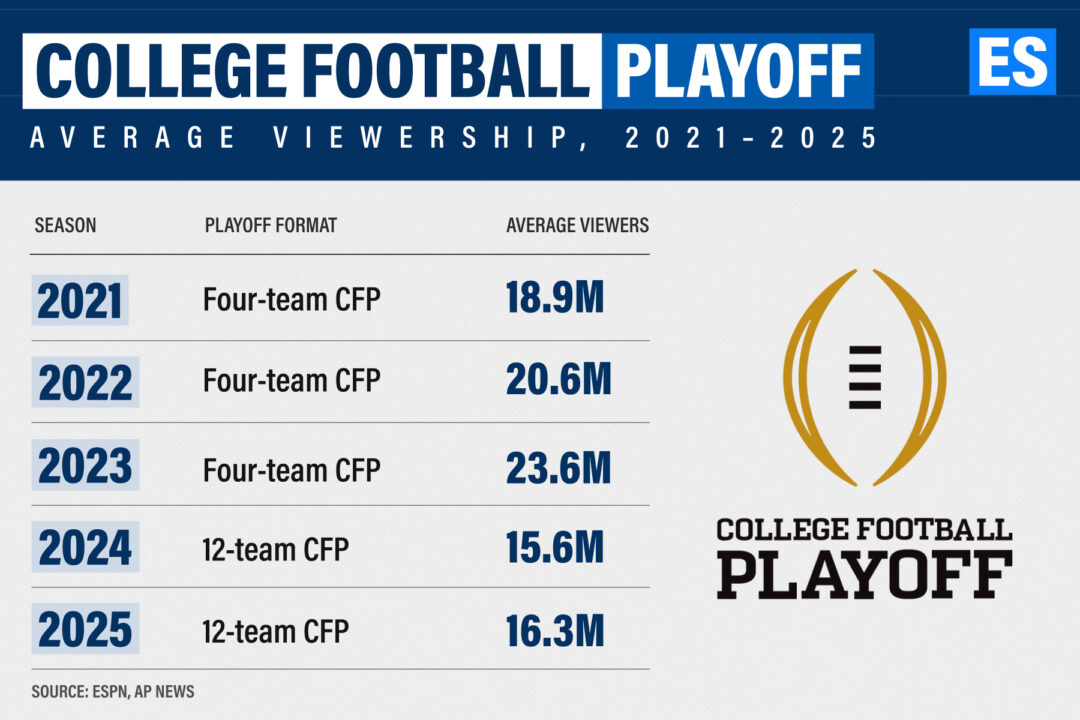
The 2025-26 College Football Playoff attracted strong viewership, averaging 16.3 million viewers across its 11 games. The national championship between Indiana and Miami drew 30.1 million viewers, which was 36% higher than the previous season’s 22.1 million. These numbers show that fans are interested in watching the playoffs. However, ESPN cannot assume that all 12 additional games will attract the same number of viewers.
Plus, losing conference games can hurt fans’ emotions.
Conference Championship Games Lose Their Commercial Value
The SEC, Big Ten, ACC, and Big 12 will discontinue their conference championship games after the 2026 season to make room for the expanded College Football Playoff.
These games have been valuable for both TV networks and local people. For example, the 2025 SEC Championship between Alabama and Georgia averaged 16.9 million viewers, showing how popular these matchups are with college football fans.
Sports Business Journal calculated that the four Power conferences earn around $200 million to $250 million combined from their championship games each year.
The 2026 SEC Championship, scheduled for December 5, will be the event’s 35th and final edition. Losing the game could also hurt Atlanta’s local economy, as a report from Fox 5 Atlanta cited Georgia Tech fellow Declan Abernathy, who estimated that the SEC Championship generates more than $30 million for the city every year. So, losing it forever can cost big time to the city.
But then again, if fans showed interest in games and showed up at the stadiums for extended playoffs just like championship games, things might be different.
ESPN Strengthens Its Grip on College Football
It’s a win-win situation for ESPN. ESPN will have the right to share up to six of the 12 new games added to the expanded 24-team College Football Playoff. These games will come from the eight first-round matchups between teams seeded ninth to 24th and the four second-round games involving teams seeded fifth to eighth.
However, ESPN can sell these games to only one other broadcaster. It cannot split them between Fox and NBC. Fox could be interested because its Sports CEO, Eric Shanks, has publicly supported the 24-team playoff. But whether Fox will actually take the games remains to be seen.
The bigger point is that ESPN controls the entire CFP media rights package. Other networks cannot approach the College Football Playoff games.
In order to do that, they must first reach an agreement with ESPN. This gives ESPN more control over its competitors’ access to the playoff.
ESPN also gets to choose which games it wants to broadcast itself and which ones it wants to sublicense.
This way, they can earn more.
More Teams, More Markets, More Commercial Opportunities
From the 2027–28 season, the College Football Playoff will grow from 12 to 24 teams, with the number of games rising from 11 to 23. The expanded field will feature the four Power Four conference champions, the highest-ranked Group of Six champion, and 19 other top-ranked teams.
With more teams and games involved, more fans will have a reason to watch the playoffs. Plus, it can be a major addition to the business.
- More advertising and sponsorship opportunities
- Ticket sales
- Merchandise
- More economic growth
- Food services
The expansion could be especially helpful for smaller schools and Group of Six programs, as a playoff appearance would put them in front of a much larger audience.
However, the actual financial gains will depend on how much attention each team receives and how far it progresses.
Along with that, bowl games might also see major changes.
What Happens to the Rest of College Football’s Postseason?
The six traditional New Year’s Six bowls will continue hosting CFP quarterfinals and semifinals on a rotating basis, while the remaining bowl games will operate outside the 24-team playoff. The expansion will also pull another 12 teams out of the traditional bowl pool.
ESPN Events owns and operates 17 bowl games, but ESPN has not officially announced what will happen to its non-playoff lineup. Bowl Season executive director Nick Carparelli expects most of those games to continue, adding that ESPN Events remains profitable. However, the existing conference agreements and television deals for 35 bowl games expire after the 2026 season, leaving their future uncertain.
The bigger question is whether these non-playoff bowls can maintain their popularity after the expansion. In the 2025 season, the Michigan-Texas Citrus Bowl attracted 9.1 million viewers, showing that traditional bowl games can still draw a large audience.
But they are trying to make it interesting.
One idea is to create a group of 10 major bowl games for Power Four teams that fail to qualify for the 24-team playoff. Under this proposal, the four conferences would each send five teams, giving 20 teams a chance to play in these games.
Instead of following the usual conference-based bowl matchups, organizers could pair teams based on their performance and strength.
But is this change affecting the regular season??
Does the Expansion Risk Devaluing the Regular Season?
The expanded 24-team playoff will give more college football programs a chance to compete for a national title. The four Power Four conference champions, the highest-ranked Group of Six team, and 19 other teams selected by the committee will make up the field.
However, the new format could also have a downside. Major rivalries, such as Alabama vs. LSU, could lose some of their playoff importance if both teams are already likely to qualify.
Apart from that to keep regular-season matchups competitive, the new CFP standards require each Power Four team to play at least 10 qualifying games, including at least one nonconference game against another Power Four team or Notre Dame. But it might still not be that competitive.
The new format has its pros and cons, so college football fans will have to wait until 2027 to see how the changes play out.