
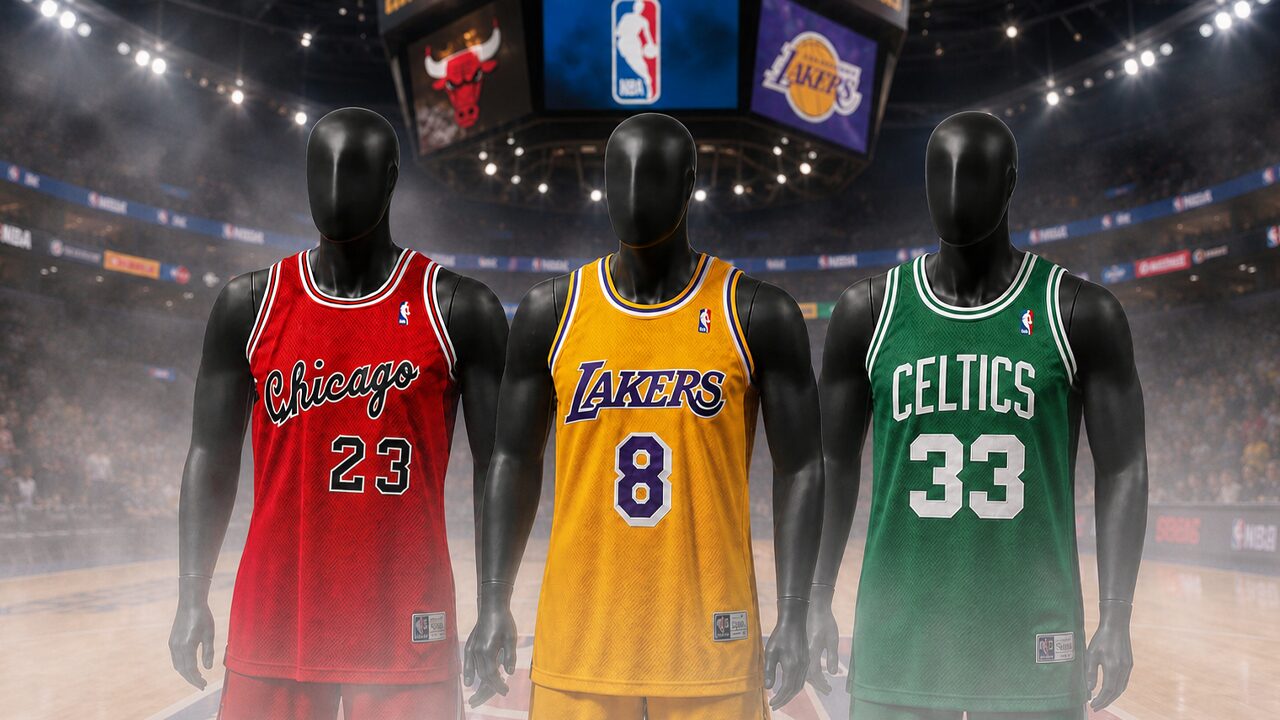
Who would have thought that sports collectables that once started as fans’ keepsakes would now be turning into a massive investment? From Rare cards, jerseys, and autographs to limited-edition items, all are becoming valuable collectibles. And the $1.36 billion rise clearly proves it.
Watch What’s Trending Now!
The sports card market is growing very fast. In the first half of 2026, people spent $1.36 billion on individual sports cards on eBay. That was 40% more than the $967 million spent in the previous six months. It was also much higher than the $815.63 million in sales during the first half of 2025.
The growth goes beyond sports cards. When eBay included sports cards, trading cards, and non-sports cards, total sales reached $2.32 billion in the first six months of 2026. That was a 57% increase from the $1.48 billion recorded in the final six months of 2025. More collectors are also getting their cards professionally graded. More than 5 million sports cards were graded in the first six months of 2026. This shows that people are not only buying cards for fun; they are also paying to have valuable cards checked, protected, and graded.
New-age sports stars are one of the reasons behind it, and the top 10 players as per Gem Rate are:
- Shohei Ohtani — $85.67 million
- Michael Jordan — $68.89 million
- Victor Wembanyama — $50.57 million
- Cooper Flagg — $34.02 million
- LeBron James — $26.30 million
- Kobe Bryant — $25.93 million
- Tom Brady — $20.80 million
- Stephen Curry — $17.87 million
- Mickey Mantle — $15.92 million
- Aaron Judge — $15.69 million
Basketball cards saw some of the biggest growth. Wembanyama’s card sales increased 204%, while Flagg’s sales jumped 321%. Kon Knueppel saw an even bigger increase of 859%, reaching $10.92 million in sales. Dylan Harper’s sales rose 690% to $8.43 million, while Jalen Brunson’s increased 450% to $7.77 million. New card products gave collectors more cards of these players to buy and sell.
Imago
Image Courtesy: IMGAO
Rare sports cards can sometimes become very valuable over time. Gary Bulicki is one example. He bought a Tom Brady 2016 Prizm Black 1-of-1 card for about $3,000. Later, he sold it for $225,000, making a huge profit. He had a similar experience with Kobe Bryant. Bulicki bought a Kobe Bryant 2015 Prizm Black 1-of-1 for $18,000 and later sold it for $370,000.
Now, let’s find out what makes rookie cards so valuable.
Rookie cards, the stock market of sports collectibles
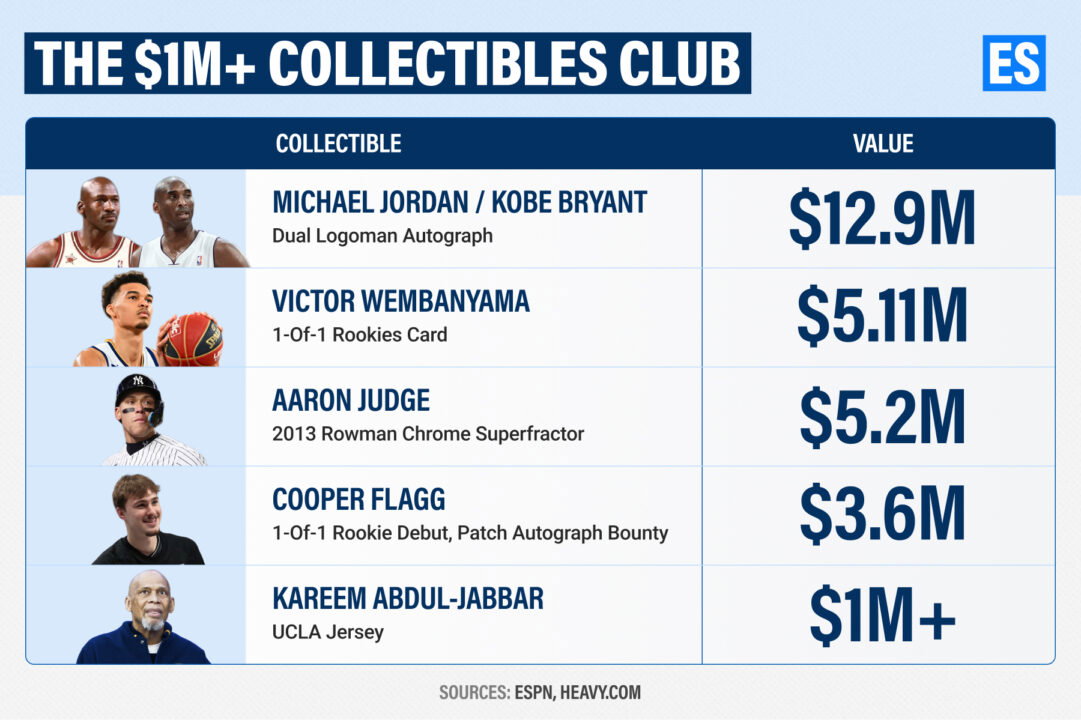
Rookie cards are valuable because they are usually a player’s first major cards. Collectors like them because there is only one rookie season. However, being a rookie card does not automatically make it expensive; a player’s popularity affects its value. For example, three-time MVP Aaron Judge’s Bowman Chrome Draft Pick Autographs SuperFractor 1-of-1 sold for $5.2 million in 2026.
However, with players’ popularity, even history adds to the massive surge.
Game-worn memorabilia when history becomes an asset
A transistor radio turned into a valuable piece of basketball history for David. About 50 years ago, he traded the radio for a UCLA jersey worn by Lew Alcindor, later known as Kareem Abdul-Jabbar, during UCLA’s 1968 NCAA championship win. Today, that same jersey has received bids of more than $1 million, including the buyer’s premium, at Grey Flannel Auctions. It is also the only known photo-matched, game-used UCLA jersey worn by Abdul-Jabbar to become publicly available.
When David made the trade, he did not know the jersey had actually been worn in games. He kept it safely for decades, even as Alcindor changed his name to Kareem Abdul-Jabbar in 1971. Years later, David decided to sell the jersey because he no longer had enough space to properly display it.
“Even growing up, getting married, having kids, the whole shebang, I just basically kept it in good condition,” David said. “I moved two or three times, ended up in Oregon here, and then I just decided I’m tired of carrying this around. I really don’t have a place to put it up where it will be appreciated.”
What began as a simple trade for a radio had turned into a rare piece of basketball history worth more than $1 million. With jerseys, even signed memorabilia holds special value.
Signed memorabilia the value of an athlete’s signature
Signed sports memorabilia can include jerseys, baseballs, basketballs, bats, photographs, helmets, and cards, but an athlete’s popularity holds much bigger value. For example, in 2018, a Babe Ruth-signed baseball with signatures from the 10 other members of the inaugural Baseball Hall of Fame class was sold for a record $623,369, according to SCP Auctions.
The ten other legends with him were Ty Cobb, Walter Johnson, Honus Wagner, Cy Young, Tris Speaker, George Sisler, Connie Mack, Nap Lajoie, Eddie Collins, and Grover Cleveland Alexander.
Besides that, limited supplies push fans to buy even more. The downside? Higher demand also creates a bigger risk of fake signatures entering the market. When an autograph can sell for thousands or even millions of dollars, people have a strong reason to create forgeries. That is why authentication is so important.
The authentication economy
Collectibles need more than rarity to become valuable. Buyers also want proof that the item is real and in the condition the seller claims.
Card grading is one of the most common forms of authentication. Companies such as PSA first check whether a card is genuine and then examine its condition. The card receives a grade from 1 to 10, with 10 being the highest. PSA then seals the card in a protective case and gives it a certification number that buyers can use to check its details.
A card’s grade can have a big impact on its price. A card in excellent condition can be worth much more than the same card in poor condition.
Now buyers want to know if the player actually used it in a game. This is called game-used authentication. Companies such as MeiGray, which have authenticated more than 350,000 items, verify these items using team records, registration numbers, photographs, and videos.
Photo-matching provides another layer of proof. Experts compare the actual jersey or equipment with old game photographs and videos.
A Certificate of Authenticity (COA) or Letter of Authenticity (LOA) gives buyers proof that an expert or authentication company has checked an item. For example, Beckett authenticates autographed cards, jerseys, photographs, programs, and other sports memorabilia.
At last, there’s provenance, which means the item’s history. It tells buyers where the item came from, who owned it, how it was authenticated, and whether it was connected to a specific game or event.
Merch when limited in supply creates collectible value
Sports merchandise can become collectible when it represents a special player, team, event, or moment in history. Limited supply can make it even more desirable.
For example, AC Milan released a special jersey for its 125th anniversary. The club made only 1,899 individually numbered jerseys, with each one carrying its own production number. Coventry City and Admiral used a similar approach for the club’s 50th anniversary. They recreated Coventry’s famous 1975 shirt, but produced only 1,975 individually numbered shirts.
Top athletes can attract sports or other brands to the team. For example, the 2026 Rams x Alfred’s Apartment campaign featured Rams running back Kyren Williams, Brisbane Broncos player Jesse Arthars, and Australian skateboarder Riley Pavey.
A retired jersey number can also make merchandise more special as fans buy it for legacy. Championship merchandise with locker-room shirts, hats, hoodies, and other collectibles also adds up to the list. Then comes the location, as sometimes the collectibles can be limited to one area, like when the Ontario Tower Buzzers released a special jersey for their April 2, 2026, home opener in partnership with Official League at their team stadium.
But then sports collectibles can become valuable because there are only a limited number of them. For example, there can be only one jersey worn by a player in a particular championship game or one 1-of-1 card. Once that item exists, no identical copy can be made.
Kobe Bryant’s rookie-season jersey is a good example. The jersey came from his 1996-97 rookie season and was sold for $7 million in 2025. However, that does not mean every collectible will increase in value because, in the end, it all depends on the player’s popularity.