
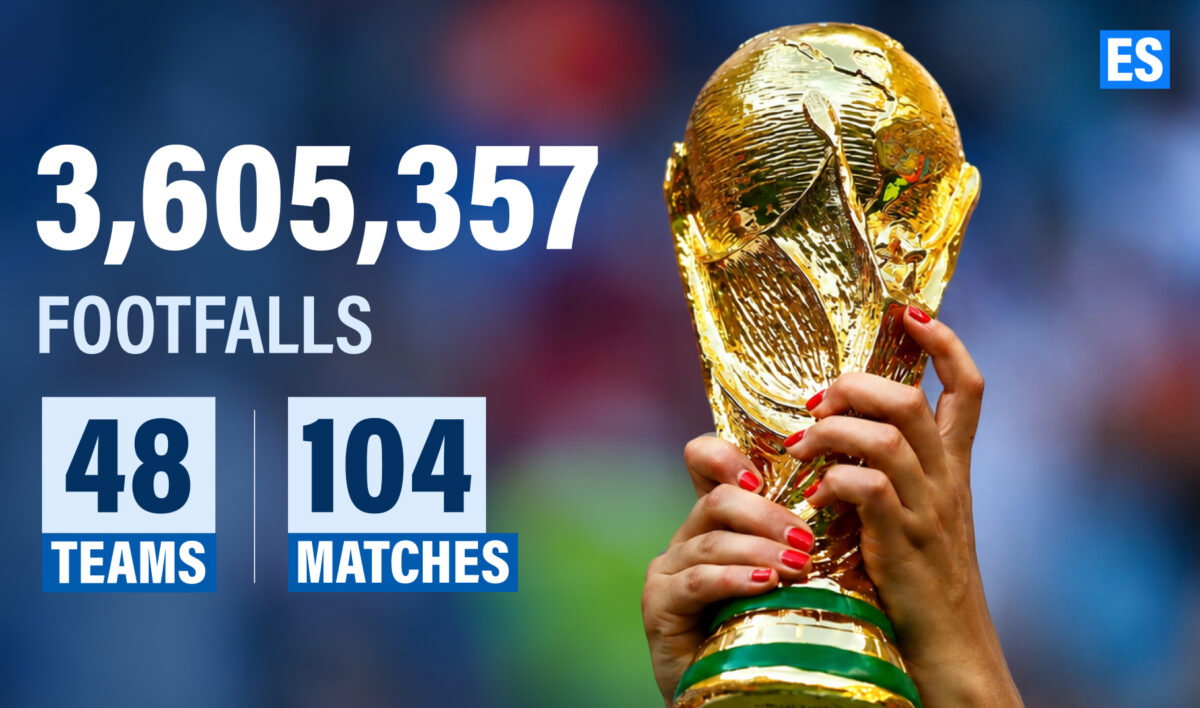
The 2026 FIFA World Cup is breaking records back and forth. The tournament has already brought in more than 3.6 million fans from around the world and is breaking records with every other game. But one of the major reasons behind this massive surge is the new expanded format with 48 teams from 32. This business strategy of hosting more matches is now generating unexpected results.
Watch What’s Trending Now!
Back in 1994, there were just 24 teams, so they played 52 matches. Then in 1998 the number increased to 32 teams, which meant 64 matches, and now in 2026 it’s 48 teams, and they have already played 72 of 104 matches so far. So, more teams, more matches, and more profit.
Before the 2026 FIFA World Cup, the record for highest total attendance was from the 1994 World Cup in the United States, which had 3,587,538 spectators. But this year that record has been broken, and there are still games left to play.
One important moment that helped break the record was the Group E match between Ecuador and Germany at MetLife Stadium in East Rutherford, New Jersey. That single match had 80,663 fans in the stadium, which added a big boost to the total attendance and helped the tournament make history. Another thing that adds more to the excitement is that the World Cup still has 48 games left to be played, so these numbers can go pretty high.
The stadiums are already going more than 99% full on average. So, fans are already showing up for every game. What’s interesting is that even high-ticket prices are not scaring fans. Many thought that sky-high prices would push fans away, but no one is ready to let go of this once-in-a-lifetime experience.
Ticket prices for the World Cup have become extremely high on resale platforms. For example, some final tickets at MetLife Stadium are being listed for around $9,200, and in rare (and unverified) cases, even extremely unrealistic prices as high as nearly $11.5 million.
Prices are also rising for other big matches. For the July 3rd, 2026 game between Portugal and Croatia in Toronto, the cheapest available tickets on resale sites crossed $3,000. Data from Ticketdata shows that the average price for the lowest-cost ticket on secondary platforms is around $3,225, which is still very expensive for most fans.
“Americans like big events,” sports economics expert at the University of San Francisco Dan Rascher said. “They want to be there for the big moments.”
Plus, the tournament is also using new business strategies to gain more and more fans. This time the FIFA World Cup is using “dynamic pricing.” This means ticket prices are not fixed, and they can change depending on how many people want to buy them. So, if the demand is high, prices go up, and if not, they go down. For example, a last-minute ticket for the match between Paraguay and Australia costs about $450.
All this is possible because of fans’ interest and more matches.
How is each match benefiting?
The 2026 World Cup has about 63% more matches than the 2022 World Cup, which means the tournament has and will have many more chances to earn money from each game. Now, the money comes in from ticket sales, and this year the numbers are seeing a massive surge. As per Reddit reports, more than “6 million tickets for the 2026 FIFA World Cup have been sold” so far. Imagine the kind of profit they are seeing.
Then comes the hospitality inventory. Stadiums earn a lot from VIP seats, boxes, and premium lounges. If we talk about this year’s packages, the prices are skyrocketing. In the group stage, VIP tickets are the cheapest, starting around $1,500 to $3,000 for standard hospitality and going up to about $12,000 for private suites. As the tournament reaches the Round of 32 and Round of 16, prices rise from about $2,000 up to $15,000.
In the quarter-finals, the VIP tickets can reach up to $20,000 for suites. During the semi-finals, prices go even higher, reaching around $22,000. The final match is the most expensive of all, with VIP tickets starting around $8,000 and going up to $50,000 or more for luxury suites.
The FIFA commercial cycle from 2023 to 2026 is expected to earn around £10.3 billion in total revenue, and most of this money comes from the 2026 World Cup itself. A very large part of this money comes from TV and streaming rights. These rights are sold in more than 200 countries, and they are expected to earn around £3 billion to £3.3 billion for the 2026 tournament. This is about 22% more than the 2022 World Cup.
In the U.S., Fox and Telemundo hold the official broadcasting rights for showing the matches. At the same time, streaming platforms are getting a share of the pie. Instead of only watching on traditional TV, many fans can now watch matches online. For example, DAZN is streaming the tournament in countries like Japan, Italy, and Spain.
Then come the sponsors. FIFA sells sponsorships for the World Cup in three levels (tiers). The highest level is called “FIFA Partners”; then comes “World Cup Sponsors,” and the third level is “Regional Supporters.” By early 2026, all 16 top global sponsorship spots were already filled, which has never happened before in World Cup history.
Some of the major confirmed sponsors include Qatar Airways, Budweiser, Adidas, Coca-Cola, Hyundai, Visa, Frito-Lay, Diageo, Mengniu Dairy, American Airlines, and Marriott Bonvoy. These brands appear on stadium boards, broadcasts, and official World Cup promotions.
During the World Cup, many businesses earn a lot of extra money because fans spend heavily on food, drinks, and celebrations. In Mexico City, the opening weekend of matches created almost $70 million in economic activity. In Philadelphia, businesses also benefited a lot. The owner of a venue called Midnight & The Wicked reported that sales were 80% to 100% higher than usual.
Merchandise sales also add up to it. So, all in all, FIFA earns massive numbers. All this is because of FIFA’s president, Gianni Infantino, who joined in 2016 with a motive to quadruple FIFA’s income. And after increasing the World Cup to 104 matches from 64, the change is pretty visible.
Each match brings in massive income, and for Infantino, each game is like hosting “104 Super Bowls.”
Why do sponsors love it?
More fans means more watching time and income; that’s exactly why sponsors are loving the increased matches format. But this time they are not running a usual TV ad, which is short and appears during breaks that viewers can easily ignore by switching channels. They are now relying on perimeter LED ads as digital advertisements shown on boards around the football pitch, and it appears during the live match itself, so viewers see it continuously while watching the game and cannot avoid it because it is part of the action on screen.
In the Premier League, which is the most popular league, LED pitchside advertising during a single televised match usually costs around £25,000 to £80,000. In lower leagues like the Championship, prices are lower, with season-long packages starting from about £12,000.
Around $10.5 billion is being spent globally on advertising, which is even more than what is spent during NFL seasons. At the same time, FIFA itself is expected to earn about $8.9 billion in total revenue, mainly from broadcasting rights (TV and streaming deals) and sponsorships.
Apart from that, advertisers see new “ad space” during the World Cup that didn’t exist before, like hydration breaks. Because these breaks happen during a live match when many people are still watching, companies are willing to pay a lot of money to show ads at that moment.
Analysts estimate that ads shown during these hydration breaks could cost about $65 to $100 for every 1,000 viewers reached (CPM). So, this year the FIFA World Cup is not just bringing in more fans to the stadium but also bringing major income.