
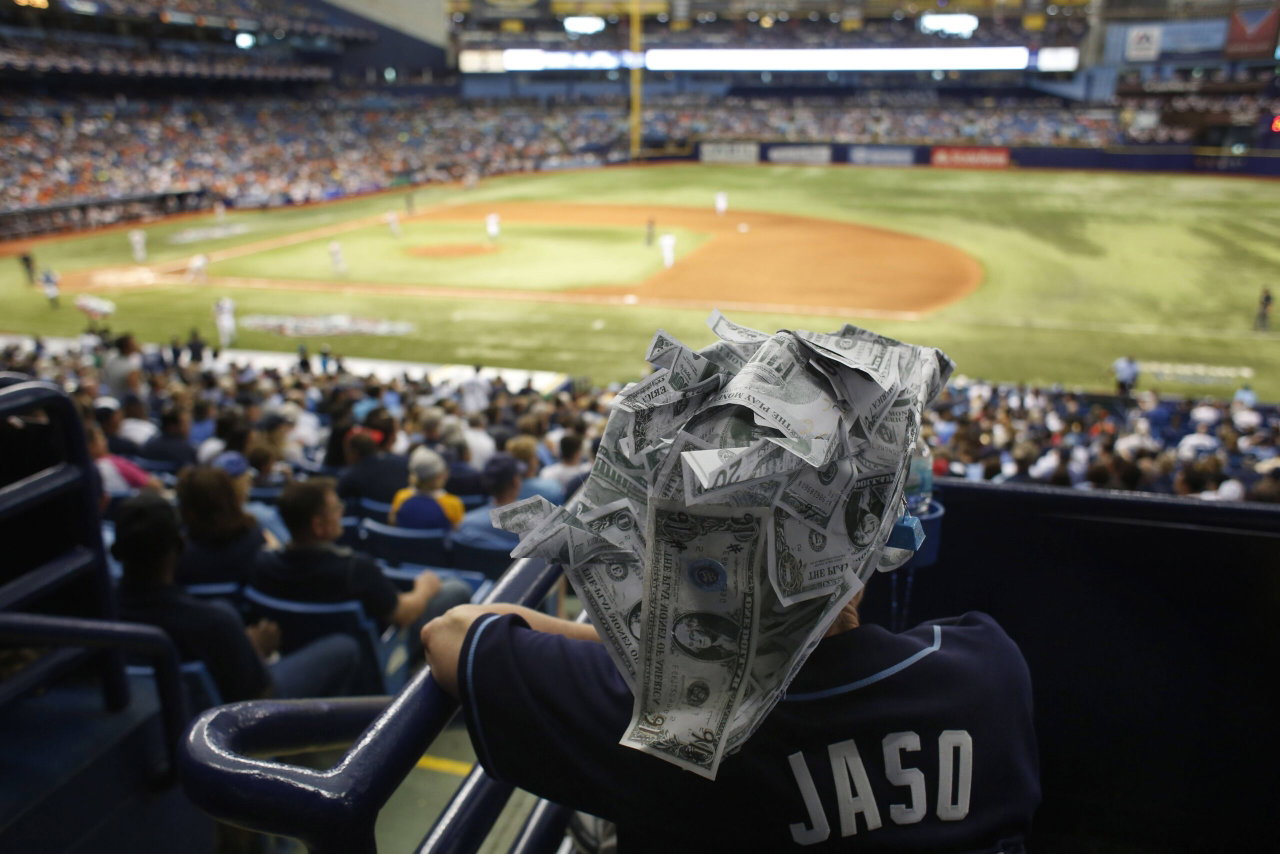
How magical is the MLB postseason? Just ask Ray Kerr.
Watch What’s Trending Now!
The 32-year-old Atlanta Braves pitcher was once working at a 7-Eleven and a movie theater, thinking his baseball career was over. He was then signed for just $2,000 and spent seven seasons in the minor leagues. On Thursday, Oct. 1, Kerr finally got his MLB postseason moment, dominating the Philadelphia Phillies with 3.1 scoreless innings in his first playoff appearance.
At the start of October, a story like this is exactly what amplifies the season of emotions in the MLB. But behind the emotions is a very real engine fueled by the big bucks, which is essential to keep the game running.
The regular season gives an MLB team 162 games to generate revenue. October is a completely different story.
A team can be eliminated after just a few games, or it can play as many as 22 if it hasn’t got a bye past the Wild Card and reaches the World Series. Ticket prices rise, millions of fans tune in across the country, and postseason merchandise hits stores almost immediately. But all that money does not go into one big pool.
Different postseason revenue streams follow different rules. Understanding how that money moves helps explain who actually benefits financially when October baseball arrives.
October brings in revenue in multiple ways
- Ticket sales
Postseason tickets are limited, which makes them much more valuable.
A team may host only two games in a Wild Card Series, while a team that goes deep into October can host many more and earn multifold. That limited supply can push ticket prices much higher than they are during the regular season.
- The 2024 World Series between the Los Angeles Dodgers and New York Yankees had an average secondary-market ticket price of around $2,112 for Games 3-5 in New York.
- Tickets for the entire series averaged around $1,703 on the secondary market heading into Game 1.
- That was the most expensive World Series on record at the time.
- The 2023 World Series averaged around $776 for five games, while the previous record was around $1,691 in 2016.
- Every extra home game also brings more money from premium seating, concessions, and parking.
And there is an important point here: those extra sources of revenue are separate from the players’ postseason pool.
- National media
Postseason television money also works differently from regular-season broadcasts. Playoff games are part of MLB’s national media package rather than the regional sports network deals that are important during the regular season.
The audience numbers show why October is so valuable.
- The 2025 MLB postseason averaged 6.33 million viewers across U.S. television platforms.
- That was up 28% from 2024’s 4.96 million.
- It was also the most-watched MLB postseason since 2017.
- The 2025 World Series averaged 15.7 million viewers on Fox across seven games.
- Game 7 reached 27.3 million viewers on Fox, the most-watched World Series game since 2017.
That larger national audience also makes postseason advertising more valuable.
- Sponsorships and advertising
October gives MLB a much bigger national audience in a short period. That makes postseason advertising space attractive to brands.
MLB has also been changing its national media setup, including new arrangements involving ESPN, NBC, and Netflix. Postseason games and other major October events are an important part of that broader media business.
- Merchandise
Postseason success also creates a new merchandise market. When a team wins a series, championship shirts and other “clinch” merchandise can be produced and shipped very quickly.
The difference between an early exit and a World Series title is huge.
A team eliminated in the Wild Card round has only a short window to sell postseason merchandise. A World Series champion can continue selling championship gear for weeks or even months.
The question with a price tag of $129.1 million
This is where MLB’s postseason money system gets interesting.
The players’ postseason pool is not a percentage of all the money generated during October. Instead, it comes from a specific formula in MLB’s Collective Bargaining Agreement.
The pool is based on gate receipts from a set number of games in each postseason round:
- Wild Card Series: 60% of gate receipts from the first two games after deducting the traveling expenses of the visiting clubs (up to a maximum of $100,000 per Club per game) from the total gate.
- Division Series: 60% of gate receipts from the first three games. (Four if the
- Division Series is expanded to the best of seven games)
- League Championship Series: 60% of gate receipts from the first four games.
- World Series: 60% of gate receipts from the first four games.
The important part is that the formula counts only a set number of games. So whether a series ends quickly or goes the distance, the players’ pool gets its share from the same number of designated games.
The numbers have grown significantly in recent years:
- 2025: $128.2 million
- 2024: $129.1 million, a record at the time
- 2023: $107.8 million
- 2021: $90.47 million
- 2018: $88 million
So while the 2025 pool was slightly smaller than the 2024 record, it was still the second-largest in MLB history.
The search for the other 40%
For the games included in the postseason-pool formula, the basic split is simple:
- 60% → Players’ postseason pool
- 40% → Club side
But there is another important part of the system.
If a series goes beyond the number of games used in the formula, the extra games are different.
The clubs keep 100% of the gate receipts from those additional games after the applicable cut for the Commissioner’s Office. For example, the 2025 World Series between the Los Angeles Dodgers and Toronto Blue Jays went seven games.
Only the first four games were included in the formula used to calculate the players’ pool. The gate receipts from Games 5, 6, and 7 stayed on the club side. That means a longer series can create a much bigger financial opportunity for the teams.
Of course, the clubs also have to pay for extra travel, staffing, security, and game-day operations. So the additional revenue is not pure profit.
How the MLB postseason money flows
| Revenue source | Where the money goes |
| First 2-4 designated games, depending on round | 60% to players / 40% to clubs |
| Games beyond the guaranteed minimum | 100% club-side postseason revenue after Commissioner’s Office cut |
| National media rights | MLB/league commercial structure |
| National advertising and sponsorships | MLB/league commercial structure |
| Postseason merchandise | Separate team and league merchandise economics |
| Local concessions and other game-day revenue | Depends on the team and event |
This is why saying “MLB makes money from the playoffs” does not tell the full story.
There are several money streams operating at the same time.
How is the $128.2 million split?
The distribution of the postseason Players’ pool is not equal among every playoff team.
The money depends on how far each team advances.
The basic percentages are:
- World Series champion: 36% of the pool.
- World Series runner-up: 24%.
- Two LCS losers: 24% combined.
- Four Division Series losers: 13% combined.
- Four Wild Card losers: 3% combined.
The 2025 numbers show how big the difference can be.
- The Los Angeles Dodgers received about $46.15 million from the players’ pool.
- The Toronto Blue Jays received about $30.76 million.
- A full share for a Dodgers player was worth $484,748.
- A full share for a Blue Jays player was worth $354,118.
- Each Mariners full share was worth $182,376.
- Each Brewers full share was worth $168,853.
- Each Guardians full share was worth $11,057 after their Wild Card exit.
Players on each team decide how their pool is distributed.
That means the clubhouse can give full shares, partial shares, and cash awards to players and other members of the organization, including coaches, trainers, and support staff. For a player making the 2025 minimum salary of $760,000, a full Dodgers postseason share of $484,748 was a significant amount of extra money on top of the player’s regular salary.
Not just ticket sales, profit comes from multiple sources
The 40% club share from designated games is important, but it is only one part of the financial benefit of making a deep playoff run.
Teams can also benefit from:
- 100% of gate receipts from games beyond the minimum used for the players’ pool.
- More national exposure, which can help the team’s brand.
- More premium ticket demand for every home playoff game.
- Postseason and championship merchandise sales.
- More exposure for local sponsors during nationally televised games.
- Higher demand for season tickets and group sales the following season.
That last point can be especially important.
A successful playoff run can keep fans interested even after the season ends. More people may want season tickets, group packages, or other team products for the following year.
The Boston Red Sox offer one example. During their 2025 playoff run, ownership reportedly collected around $10.14 million from postseason gate activity, separate from the players’ pool.
October baseball is not just about winning a championship. For MLB’s business, every extra game can mean another major revenue opportunity and a milestone for growth.