
Last week, Stefon Diggs had a strong game against the Philadelphia Eagles. The veteran wide receiver caught four passes for 55 yards and a touchdown, even though the Washington Commanders eventually lost to the Eagles. But his performance was not the only thing that drew attention.
Watch What’s Trending Now!
During the game, Diggs was flagged for unsportsmanlike conduct after celebrating by hugging the goalpost. The penalty affected the Commanders’ plans, and now there is another update. Diggs has been fined $14,926 for the incident.
Interestingly, this is not the first time Diggs has faced a fine for similar conduct. Nine years ago, when he was with the Minnesota Vikings, a similar incident resulted in a 15-yard penalty and a $12,154 fine from the league. Now, let’s get to the bigger question.
Stefon Diggs is not the only player facing these penalties. According to NFL Network insider Tom Pelissero, Dallas Cowboys running back Javonte Williams was fined $11,941 for unsportsmanlike conduct in the game against the New York Giants.
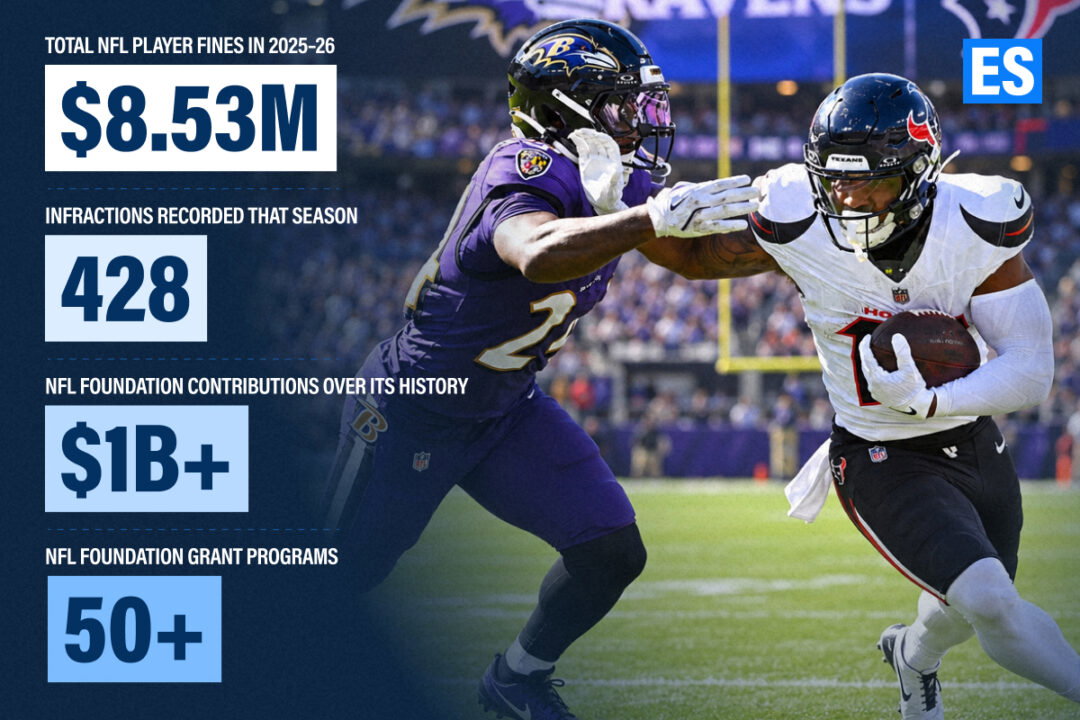
Moreover, per available NFL fine records, league-wide fines totaled $8.53 million across 428 infractions during the 2025-26 season. That is a significant amount of money. Where does all of it go?
The average amount that comes as a fine
As mentioned earlier, fines totaled $8.53 million last season, with the Washington Commanders accounting for the highest team total at $1.49 million. In 2024-25, league-wide fines totaled about $12 million. The Houston Texans were the only team that season to cross the $1 million mark, with roughly $3 million in fines. So, NFL fines can add up to millions of dollars in a single season.
- The league has said fines have averaged about $4 million per season since 2011. Last season was reportedly an outlier, with Spotrac recording approximately $6.8 million in fines.
- Individual penalties can also be substantial. These usually range from thousands of dollars for certain uniform violations to nearly $40,000 for more serious offenses such as fighting or making contact with an official.
- One notable example came in 2018, when former San Francisco 49ers safety Antone Exum was fined $134,423 over the course of the season. That amount represented about 19% of his earnings that year before taxes.
But here is the part that may surprise many fans: the NFL does not simply keep the money from these fines as league revenue.
The dollars go to two destinations
Under the league’s Collective Bargaining Agreement with the NFL Players Association, the money is split between two destinations.
Imago
Image Credits of NFL Players: IMAGO
1. Half goes to the Players Assistance Trust
- The CBA directs 50% of the fines to the Players Assistance Trust, which is run by the NFLPA. The program helps former players adjust to life after football and provides support that can include supplemental health benefits and cognitive evaluations.
- The trust is formally known as the Gene Upshaw Player Assistance Trust. It was created to help former players who face financial, medical, or other challenges after their playing careers end.
- Some of the money from fines also supports the NFL Player Care Foundation, which provides medical, emotional, and financial assistance to retired players.
2. The other half goes to charitable organizations
- The remaining 50% is directed toward charitable organizations jointly determined by the NFL and NFLPA. The NFL Foundation is currently listed by the league as the preferred recipient.
- The foundation focuses on areas such as player health and safety, youth football, and community programs. That means money collected through on-field penalties can eventually support programs far removed from the original incident.
How does the money come back to football?
The process is fairly simple.
A player breaks a rule → the league issues a fine → the money comes out of the player’s paycheck → the funds are directed toward player assistance and charitable programs.
So, the money does not simply disappear into the league’s accounts. Under the current CBA, it is directed toward programs that support former players, young athletes, and communities.
Now, let’s look at how some of that money is being used to support the sport.
How the money helps football grow
The NFL Foundation uses its funding for several programs across the country.
- Youth football camps: In 2026, the foundation awarded grants to more than 350 NFL players, legends, and coaches to host free youth football camps nationwide. The previous year, more than 400 players and legends received grants totaling roughly $1 million.
- First Down Clinics: Through its partnership with USA Football, NFL players hosted more than 300 First Down Clinics in 2025. USA Football also ran these programs at more than 10 major NFL events, reaching more than 60,000 participants.
- Community programs: NFL Foundation tax filings show major grants supporting community and social-impact initiatives, including a $31.8 million Working Group Grant and a $13.6 million Player Coalition Grant in 2024.
- Health and safety: In 2024, the foundation provided $2.3 million to the American Heart Association’s Impact Grant Program and $1.17 million to the University of Connecticut’s Korey Stringer Institute. Both efforts focused on areas such as CPR, AED education, and athlete safety research.
- Super Bowl legacy programs: Ahead of Super Bowl LX in the Bay Area, the foundation worked with local partners to provide $8.2 million in grants and funding for community projects across the region.
Overall, the NFL Foundation says it has surpassed $1 billion in philanthropic donations over more than 50 years.
In simple terms, the system looks like this:
Current players → fines → former players, youth players, and communities → the future of football.
However, there is another part of the fine system that is worth looking at. The NFL is also changing how some penalties work.
The system also aims to change player behavior
The NFL and NFLPA have introduced a new framework for repeat player-safety violations. Under the framework, a player who commits only one eligible player-safety infraction can have 50% of the fine reduced at the end of the season. A player who commits three infractions in that category can receive a one-game suspension.
The league has also said players who commit a single offense in certain eligible categories can have the entire fine returned at the end of the season. However, the league has not yet specified which categories qualify for a full refund.
That adds another layer to the NFL’s fine system. The penalties are not only about taking money from players. In some cases, the league is also using fines, reductions, refunds, and suspensions to encourage players to avoid repeat violations.
For fans, that makes the story behind an NFL fine much bigger than the number attached to it.