
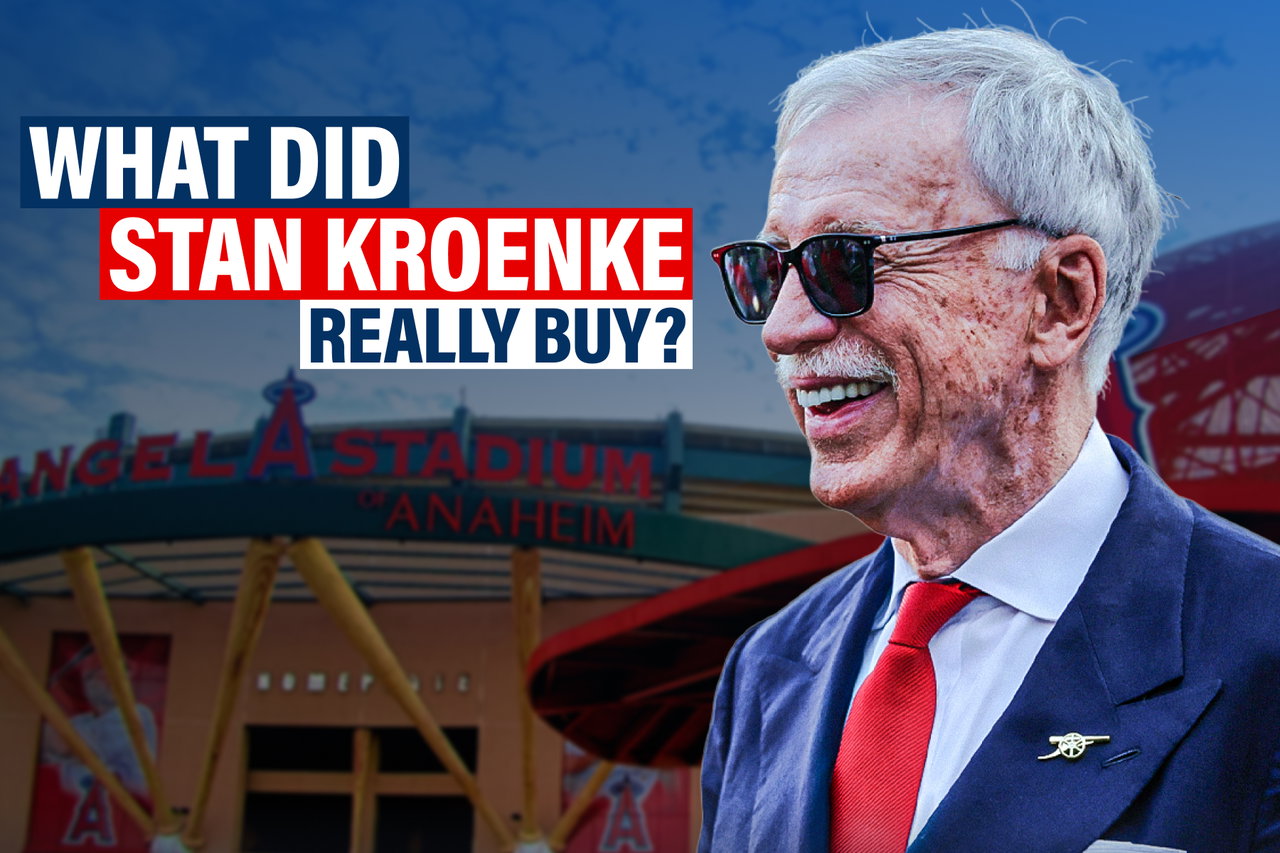
Who said betting on a losing team doesn’t bring money? The Los Angeles Angels’ future seemed darker than ever after 11 straight losing seasons and a playoff drought dating back to 2014. But Stan Kroenke is now putting his bet on the team, reportedly buying it for $4 billion. The Angels may still have plenty of work to do on the field, but for Kroenke, the team is another business opportunity in the Southern California market.
Watch What’s Trending Now!
Mark Cuban’s Mavericks story shows what a new owner can do when a struggling team gets a fresh start. He bought Dallas in 2000 after 11 straight seasons without a playoff appearance.
The team went on to win the 2011 NBA championship, showing how quickly a struggling franchise can change under new ownership. Kroenke now has a similar job with the Angels. But unlike Cuban, Kroenke is also walking into a market where the Angels could add plenty to his existing sports business, giving him another major franchise and another fan base alongside the Rams.
Kroenke is buying more than just a Baseball team
Stan Kroenke already has a sports portfolio that stretches across the NFL, NBA, NHL, MLS and Premier League. Adding the Angels would give him an MLB franchise as well, putting a team from all five major U.S. leagues under his ownership.
That could also create new opportunities on the sponsorship side. Fenway Sports Group (FSG) offers a good example of how multi-team ownership can work commercially. Through Fenway Sports Management, FSG has worked on sponsorship opportunities across properties including the Boston Red Sox and Liverpool, as well as the Pittsburgh Penguins during its ownership.
The advantage is huge. Instead of selling each team to sponsors separately, an ownership group can offer access to multiple teams, leagues, and fan bases. Kroenke could have a similar opportunity, with the Angels adding another audience and another set of commercial inventory to the teams he already owns.
Here’s a look at the major professional sports teams in Kroenke’s portfolio:
| Team | League | Sport | Location |
|---|---|---|---|
| Los Angeles Rams | NFL | Football | Los Angeles, California |
| Denver Nuggets | NBA | Basketball | Denver, Colorado |
| Colorado Avalanche | NHL | Hockey | Denver, Colorado |
| Colorado Rapids | MLS | Soccer | Commerce City, Colorado |
| Colorado Mammoth | NLL | Lacrosse | Denver, Colorado |
| Arsenal | Premier League | Soccer | London, England |
| Los Angeles Angels | MLB | Baseball | Anaheim, California |
But the real opportunity for Kroenke may go beyond sponsorship. The Angels give him another major sports property in Southern California, where he already has a foothold with the Rams.
The Los Angeles multiplier
The Angels could strengthen his position in Southern California in several ways.
- A bigger Southern California footprint: The Rams have already given Kroenke a major presence in Los Angeles County. The Angels would extend that reach into Orange County, which has more than 3 million residents. That gives Kroenke access to another large market without moving beyond Southern California.
- A sports calendar that stretches across the year: The Rams’ season is concentrated in the fall and winter, while the MLB season runs from spring through the fall. With the Angels in the portfolio, Kroenke would have a major sports property generating games, ticket sales, and commercial opportunities through much more of the year.
- Another premium-ticket business: Angel Stadium has 66 suites, premium clubs, and other high-end seating options. For Kroenke, that means another venue where corporate clients and affluent fans can be sold premium experiences.
- More opportunities for corporate partnerships: The Angels also give Kroenke another property to work into sponsorship packages alongside the Rams and the venues and businesses already operating at Hollywood Park. A company interested in reaching Southern California sports fans could potentially be offered access to more than one Kroenke-owned property.
- More content to work with: An MLB team also brings a full season of games, highlights, interviews, and other digital content. The Angels’ local broadcasts add another media property to Kroenke’s portfolio, while the changing mix of streaming and regional sports coverage gives him more ways to reach fans.
Taken together, the Angels deal gives him another major team in the same region where he has already built one of his biggest sports properties. That is where the acquisition starts to look much more interesting.
Where the real estate comes in
SoFi Stadium and the 300-acre Hollywood Park offer a good example of how Kroenke has approached sports venues. What started with a stadium has grown into a much larger development, with the YouTube Theater, shops, offices, homes, parks and a lake all built around it.
The stadium has also become a major event destination. The Rams hosted Super Bowl LVI in 2022 and won the game, while the event was estimated to generate between $234.3 million and $477.5 million in economic impact for Los Angeles County. Four years later, SoFi Stadium hosted eight FIFA World Cup matches, bringing another wave of international visitors to the venue.
Angel Stadium gives Kroenke a chance to explore a similar idea, although the circumstances are different. The biggest question is how long the Angels will remain there.
The team’s current lease runs through December 31, 2032, with two additional three-year extensions that could keep the Angels at the stadium through 2038. That gives the leadership enough time, and after that, they decide whether they want to remain at Angel Stadium and develop the surrounding property or pursue another option.
There is already plenty of land to work with. Angel Stadium sits on roughly 150 acres, and Anaheim Mayor Ashleigh Aitken told the Los Angeles Times in June 2026 that the surrounding land could be “two to three times more valuable than it is as a parking lot.”
That is where the Angels could become more than a baseball investment for Kroenke. The team itself may be worth billions, but the land and the development possibilities around it could give him another way to build value over time.
From $180M to $4B: Why sports teams keep getting more expensive
Arte Moreno bought the Angels for about $184 million in 2003. Kroenke’s reported deal now values the team and its media assets at around $4 billion. That is more than a 20-fold increase in just over two decades.
What makes the jump more striking is that it has happened despite the Angels’ struggles on the field. The team is coming off 11 straight losing seasons and hasn’t made the playoffs since 2014.
That tells an important part of the sports-business story. A franchise’s value is not tied only to its win-loss record. The market it plays in, media rights, sponsorship opportunities, fan base, and the scarcity of major sports franchises can all drive its price higher.
The Angels are hardly an isolated case. Other major franchises have seen their values climb sharply over the years:
- Padres: Ron Fowler’s group bought the Padres for $800 million in 2012. In 2026, the franchise was sold for a reported $3.9 billion.
- Celtics: Wyc Grousbeck’s group paid $360 million for the Celtics in 2002. The franchise was valued at $6.1 billion when it was sold in 2025.
- Timberwolves: Marc Lore and Alex Rodriguez bought the Timberwolves and Lynx at a $1.5 billion valuation in 2021. By 2026, the franchise was valued at around $4.5 billion.
- Seahawks: Paul Allen bought the Seahawks for $194 million in 1997. In 2026, the franchise sold for a record $9.612 billion.
But there is a catch. A team can have enormous business value on paper, but it still needs fans to care. That is where the Angels’ biggest challenge begins, because sustained attention is much easier to build when the team is winning.
The $4B problem: The Angels need to win
The last time the Angels reached the playoffs was in 2014, when they won the AL West before being swept by the Kansas City Royals in the ALDS. They haven’t returned since.
The drought is even more striking considering the talent that has passed through Anaheim. The Angels had Mike Trout and Shohei Ohtani on the same roster, two players capable of defining an era, yet still couldn’t build a team that consistently contended. Ohtani eventually left for the Dodgers on a record $700 million deal and went on to win back-to-back World Series titles, while the Angels continued to struggle.
That makes Kroenke’s investment a bet on more than the franchise’s financial value. He now has to help turn a team that has spent years outside the postseason back into one that fans want to watch. He has some experience with that. The Rams won the Super Bowl in 2022 under his ownership, while Arsenal has grown into one of the biggest clubs in world soccer during Kroenke’s tenure.
The Kroenke playbook
Kroenke’s work with the Rams gives us a pretty good idea of how he views a sports franchise. He didn’t just build SoFi Stadium and call it a day. The stadium became the centerpiece of Hollywood Park, which now has homes, offices, shops, parks, and the YouTube Theater around it.
That approach matters because the Rams benefit from everything happening around the stadium, not just from the games themselves. SoFi hosts major events, brings in premium-ticket customers and gives sponsors another place to reach fans.
The Angels give Kroenke a chance to apply some of that thinking again, although Anaheim is a very different market from Inglewood. The question isn’t whether he will build another Hollywood Park. It’s what he can do with a baseball team, a 60-year-old stadium and roughly 150 acres of land around it.
Kroenke is paying a record price for a team that has spent years struggling to stay relevant. That alone makes the Angels a risky investment. But he isn’t starting from scratch. He already knows what it takes to build a sports business in Southern California, from the Rams to SoFi Stadium and Hollywood Park.
The Angels now give him another team, another market and another stadium to work with. Whether the $4 billion bet pays off, though, may still come down to the one thing no business plan can guarantee: getting the Angels back to winning baseball.