
Who would have thought an advertisement made just for fun would end a solid partnership? Callaway and Good Good joined hands in 2023 to use YouTube videos and social media to connect with younger fans and casual golfers, which ended on August 27 2026. But what’s surprising is that, despite their breakup, the stocks are rising.
Watch What’s Trending Now!
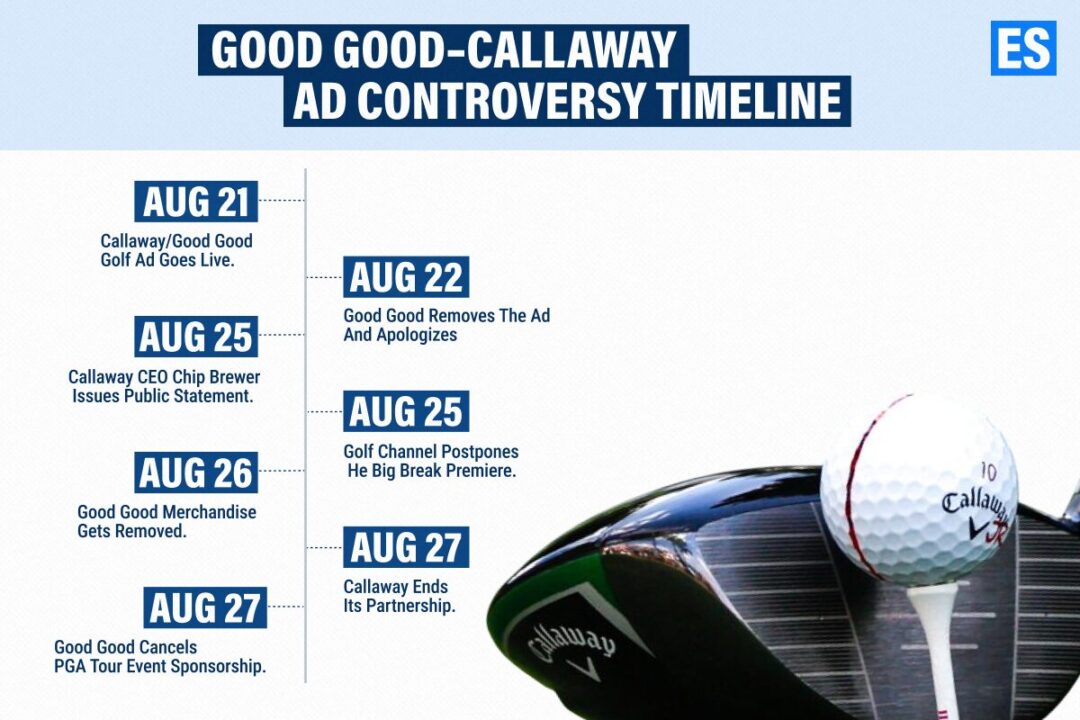
Things went off the rails when Good Good released an advertisement for a Callaway Quantum driver showing their co-founder Garrett Clark running toward Alexis Miestowski after she reached for the driver. Clark pushed her to the ground and said: “Do not touch my new driver.”
The main issue was “a man shoving a woman to the ground made violence against women look like a joke.”
The video was quickly removed, but clips continued spreading on social media. Later, Good Good said the advertisement was meant to be a joke based on the 2026 horror movie Obsession.
However, the joke did not land well. Interestingly, Callaway’s stock went up despite all the negative headlines.
- On August 28, 2026, Callaway shares increased 2.5% to $15.83.
- The rise added about $74 million to Callaway’s market value, taking it to around $3.01 billion.
- Ending the Good Good partnership played a role but the market has many moving parts, so one event does not explain every price change.
At the same time, Callaway’s main golf business was holding its own and showing growth. Its Golf Equipment business made $430.3 million in the second quarter, up 4.5% from a year earlier. Its operating income jumped 31.6% to $100.3 million, showing that the business was making more money.
- Golf clubs: Made $316.5 million, up 1.2%.
- Golf balls: Made $113.8 million, up 14.8%, making them the fastest-growing category.
- Apparel: Made $105.2 million, up 0.9%.
- Gear and other products: Fell 9% to $76.7 million.
So, one bad headline did not sink the ship.
One Bad Advertisement Can Turn a Marketing Asset Into a Liability
But eventually that partnership came to an end, and Callaway clearly did it to clean up the mess.
Imago
Image Courtesy: Imago
Good Good CEO Matt Kendrick admitted that the ad was a mistake, saying: “The execution missed the mark,” and “We got this one wrong.”
The problem also snowballed for Good Good, with the effects spreading beyond its partnership with Callaway:
- PGA Tour: Good Good stepped down as the title sponsor of a November Fall Series event at Omni Barton Creek in Texas.
- Golf Channel: The planned “Big Break x Good Good” revival was postponed after a sponsor asked for its branding to be removed.
- Retail stores: Golf Galaxy, Dick’s Sporting Goods, PGA TOUR Superstore and Target removed Good Good products from their stores and websites.
- The tournament was renamed: The event, originally called the Good Good Championship, was subsequently listed as the Austin Championship after Good Good’s sponsorship ended.
The partnership, which was supposed to reach new heights, ended up in a big hole.
The Partnership Was Built to Reach the Next Generation of Golf Fans
Their main aim was to reach a younger audience. Good Good had more than two million YouTube subscribers, helping Callaway reach a younger online audience. In return, Good Good benefited from working with a major golf brand.
It was a two-way deal.
- Other golf brands did the same: Acushnet partnered with No Laying Up, while TaylorMade worked with Barstool Sports’ Fore Play.
- That makes the breakup important: Callaway was not leaving because its golf equipment was failing.
But the controversy was still pretty big, yet it couldn’t scare off the sponsors.
The $74 Million Question: Why Did Callaway Stock Rise?
Sometimes, a controversy can hurt a company’s stock, but that did not appear to happen with Callaway. As per TS2 Tech on Aug. 28, 2026, Callaway shares were trading at $15.83, up about 2.5%.
So, the ad clearly didn’t affect their shares. Now, one possible explanation for it can be “brand-risk reset.” Callaway took quick steps to remove itself from a partnership that was creating negative attention.
On top of that, Callaway was financially healthy before the Good Good controversy. That gives context for why investors might not have seen ending the partnership as a major financial problem.
Callaway’s Q2 2026 financial results:
| Callaway Q2 2026 | Revenue | YoY Growth |
| Golf Clubs | $316.5M | +1.2% |
| Golf Balls | $113.8M | +14.8% |
| Apparel | $105.2M | +0.9% |
| Gear & Other | $76.7M | -9.0% |
| Golf Equipment | $430.3M | +4.5% |
Plus, with that, the company also didn’t lose much in compensation.
The $1 Million Cost of Saying Goodbye
Callaway said it would give $1 million to groups that help prevent violence against women, support survivors, and spread awareness. The company did not say which organizations would receive the money, but it was their effort to make things right.
But if you look at a broader perspective, $1 million is way less than the amount the company has raised.
- $1 million donation
- Q2 Golf Equipment operating income: $100.3 million, $1M ÷ $100.3M = 0.997%, so ≈ 1%.
- Q2 total revenue: $612.2 million — confirmed by Callaway, $1M ÷ $612.2M = 0.163%, so ≈ 0.16%.
The PGA Tour Bet That Never Got to Play Out
Good Good was supposed to be the main sponsor of the Good Good Championship, which is now renamed the Austin Championship. The idea was to use Good Good’s large online following to attract more young and digital-focused golf fans.
Because Good Good had built its audience mainly through YouTube and social media, it could have promoted the tournament directly to millions of people who regularly watch its content. But the partnership had become more trouble than it was worth.
It also affected Golf Channel’s plans for Big Break x Good Good. The winner was supposed to get a special chance to play in the Austin PGA Tour event, but Good Good had stepped away from sponsoring that tournament, and now the Golf Channel could not give the same prize to the winner.
However, the tournament itself was not canceled. Good Good’s sponsorship disappeared, but the PGA TOUR event stayed on the calendar. The tournament will still take place as planned from Nov. 12-15, 2026, with the PGA TOUR expected to announce a new title sponsor later.
The Creator Economy vs. Corporate Brand Control
Now, this is where the difference comes in. A creator handles his or her page very differently than a corporate brand does. Their space is filled with humor, puns, and comedy. But that doesn’t work in a corporate format. The company’s reputation comes first.
Traditional sports brands operate in these layers.
Legal review: So, here the legal team reviews the content based on how people will consume it. Is it too loud? Too sensitive. They failed to do so in this case. That is why Callaway later admitted that its “content review process was not comprehensive enough.”
Then come other details that the company reviews, which are brand safety, corporate communications, sponsorship approvals, and reputation management.
All of these steps are an integral part of reviewing content before it goes out. The company has to think about its brand’s safety and how it will affect it in the future. Plus, with this, they also have to think about others associated with them and what to do when things go wrong.
But things are not that deep in the creator economy.
Speed: A creator profile posts regularly rather than making it a massive campaign. This connects them with their audience. YouTube said in 2026 that 79% of Gen Z viewers surveyed felt YouTube creators build communities that give them a sense of belonging.
That direct connection was part of what made Good Good attractive to Callaway. Callaway wanted to reach a younger audience that spends more time on YouTube and social media than traditional media.
But social media can be a tricky game. The same humor or edgy content that gets attention can sometimes go too far and create a major backlash. That is what happened with the controversial Good Good advertisement.
It was a serious mistake, but at least the financial damage to Callaway was not immediately obvious.