
The NFL salary cap has crossed $300 million, but does spending more money really bring teams closer to a Super Bowl?
Watch What’s Trending Now!
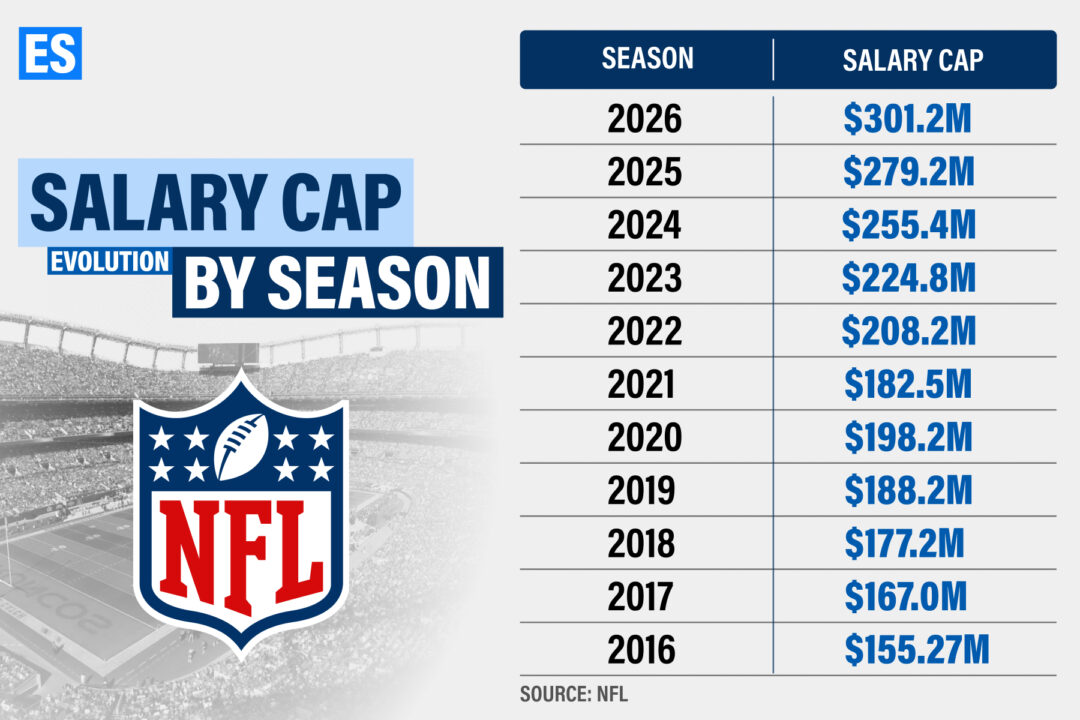
The NFL salary cap reached $301.2 million per team in 2026, up from $279.2 million in 2025. This means every team has more room to pay players and get new ones onto the team. It’s a significant jump from previous years. $208.2 million in 2022 to $255.4 million in 2024.
The main reason behind this growth is that the NFL is making more money. The league earns revenue from television and streaming deals, ticket sales, sponsorships, and other businesses. Its media agreements with Amazon, CBS, ESPN/ABC, Fox, and NBC run through 2033 and are estimated to be worth around $110 billion over 11 years, as per major outlets.
However, the salary cap is not the total amount a team has to run its entire business. It only limits how much a team can count toward player costs under NFL rules. Expenses such as stadium operations and coaching are separate.
So, how much exactly should the team spend to get better results?
The Quarterback Question: How Much Is Too Much?
The Chiefs showed how much they value Patrick Mahomes by signing him to a 10-year, $450 million extension in 2020. And that investment resulted in big results too, as he has won three Super Bowls for the team.
However, keeping a star quarterback comes at a steep price. In February 2026, Kansas City restructured his contract, cutting his salary cap hit for the year from $78.2 million to $34.65 million. This gave the team more breathing room to spend on other players, but there was a catch: more money was pushed into future seasons.
Imago
NFL Image courtesy: Imago
In simple terms, the Chiefs bought themselves some room to maneuver now, but kicked the can down the road financially. It shows why teams are willing to pay big money for a franchise quarterback, whose performance can make or break their championship hopes.
Teams that pay their quarterbacks big salaries have less money left to sign other good players.
For example, the Giants were paying Daniel Jones $40 million a year and didn’t want to spend another $12 million annually on Saquon Barkley. General Manager Joe Schoen felt Jones’s big contract made it harder to justify paying a running back that much, so Barkley left in free agency in 2024.
“You’re paying the guy $40 million,” Schoen said on Hard Knocks. “It’s not to hand the ball off to a $12 million back.”
Paying a quarterback a big salary isn’t necessarily a bad decision. A star quarterback can help a team win championships, but he also needs support around him with good receivers and offensive linemen, and managing that is a real mess.
That’s where rookie quarterbacks come into action. Rookie players sign four-year deals, and later teams can choose to keep them for a fifth season or not.
The Las Vegas Raiders did the same in 2026 with No. 1 overall pick Fernando Mendoza, who signed a four-year, fully guaranteed $57.27 million contract, with a fifth-year option.
So, even if Mendoza performs well, the team does not have to immediately pay him a much bigger salary. This is where a rookie contract gives the team time to breathe.
When a quarterback takes up less space under the salary cap, the team has more money available to sign experienced players, improve its offensive line, strengthen its defense, and keep other key players.
And the Raiders did use this opportunity to fill in their roster. They added Tyler Linderbaum, Nakobe Dean, Quay Walker, and Kwity Paye while his salary-cap cost remains relatively manageable. However, this advantage will not last forever. If Mendoza becomes a star, the Raiders will eventually need to offer him a much bigger contract to keep him.
That could leave them with less money to pay other key players, forcing them to decide who to keep and who to let go. So, the question is whether that short period was enough for any team to fill their roster with solid players.
Then come other factors through which a team loses money. Dead money is one of them. Under this, the team still has to count against its salary cap even after a player is released or traded.
For example, in March 2024, the Denver Broncos released Russell Wilson but still faced around $85 million in dead cap over two years.
Teams can use other ways to lower their salary cap, but it comes with few restrictions.
In March 2026, the Dallas Cowboys restructured the contracts of quarterback Dak Prescott, wide receiver CeeDee Lamb, and offensive lineman Tyler Smith to free up about $66 million in immediate cap space.
This gave Dallas more money to work with.
Restructuring makes sense when a team is close to winning and needs better players now. But pushing too many costs into future seasons can limit spending and weaken the roster later.
But even with restructuring why some teams lose and other wins?
Spending Big vs. Spending Smart: What Winning Teams Get Right
Spending more doesn’t always bring in solid results.
The Minnesota Vikings spent heavily to strengthen their team during the 2025 offseason, committing around $300 million to new contracts. They signed defensive tackles, gave guard Will Fries a five-year, $88 million deal, and paid to keep important players.
According to Over the Cap, the Vikings spent $345.6 million in actual player payments during the 2025 season, the most of any NFL team. However, all that spending did not translate into success. By December 1, Minnesota had a 4–8 record, showing that spending more money does not guarantee better results.
But if you do it smartly, things can take a different turn. The Seattle Seahawks built their Super Bowl-winning team by combining experienced players with young talent.
They signed quarterback Sam Darnold to a three-year, $100.5 million contract and added veterans Cooper Kupp and DeMarcus Lawrence to strengthen their roster. At the same time, they drafted offensive lineman Grey Zabel and safety Nick Emmanwori in 2025.
NFL teams have to decide whether to go all in for a Super Bowl now or play the long game and build for the future.
A rebuilding team, however, is better off keeping its options open, developing young talent, and avoiding contracts that could tie its hands down the road.
But in the end, it depends on the team whether it is chasing immediate results or long-term success.