
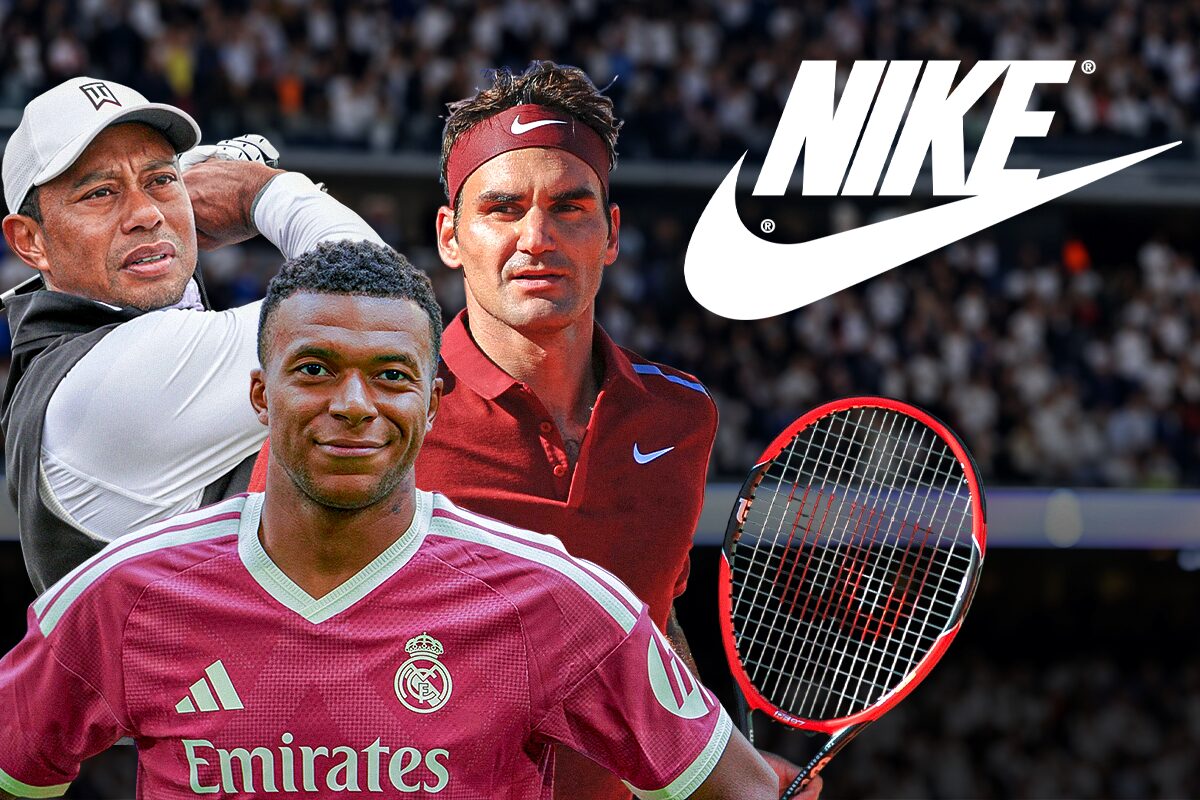
Is this the beginning of the end for Nike? The sportswear giant is now struggling in the very field it helped shape. Nike started its journey in 1964 and grew into one of the biggest names in sportswear, building a powerful brand by teaming up with stars like LeBron James. But after years of dominating the market, Nike is now facing stronger competition and losing some of its biggest athlete names, raising questions about whether it can keep the same star power it once had.
Watch What’s Trending Now!
Nike is losing its star power
Kylian Mbappé’s Nike journey started when he was just nine years old, and over the years, he became one of the biggest faces of Nike Football. Now, he is moving to On, a brand that’s just stepping into football.
And Mbappé is not the only one. Lamine Yamal also moved on from Nike to Adidas in 2024. There’s Tiger Woods too, who ended their 27-year partnership in 2024.
Nike does have legacy players like Michael Jordan, Serena Williams, LeBron James, Cristiano Ronaldo, Rafael Nadal, and Kevin Durant. Then there are the likes of Erling Haaland and Vinícius Jr., who remain new faces. But the sudden shift is clearly alarming.
Besides, it’s not just the stars. Some of the most followed soccer teams on the planet wore Nike kits. On the international side, Nike lost Cristiano Ronaldo’s Portugal side after a twenty-seven-year partnership. From January 2025, they have been wearing Puma.
On the club side, English clubs Arsenal and Manchester United, Italy’s Juventus and AS Roma, all of whom used to wear Nike, now wear Adidas. The biggest names that remain in Nike’s stable are FC Barcelona and Paris Saint-Germain.
Nike’s efforts to save the brand
Nike’s turnaround under CEO Elliott Hill is still a work in progress after he returned in 2024.
Since taking over, he has been trying to fix some of Nike’s biggest problems by rebuilding relationships with wholesalers, cutting back on oversupplied sneaker styles, and putting more focus on athletic innovation.
Wholesale is finally growing again, while running has become a bright spot, with five straight quarters of double-digit growth and roughly $1 billion in added revenue.
But Nike still has plenty on its plate. The company is not just fighting its own problems; it is also facing stronger competition from Adidas, Puma, On, and other rising brands.
Nike’s falling market value is tied to some real challenges in its business. The company brought in $46.4 billion in fiscal 2026, which was 2% lower after adjusting for currency changes. China has been a bigger headache, with fourth-quarter sales there dropping 17%. Nike also expects its revenue to keep falling during the first half of fiscal 2027.
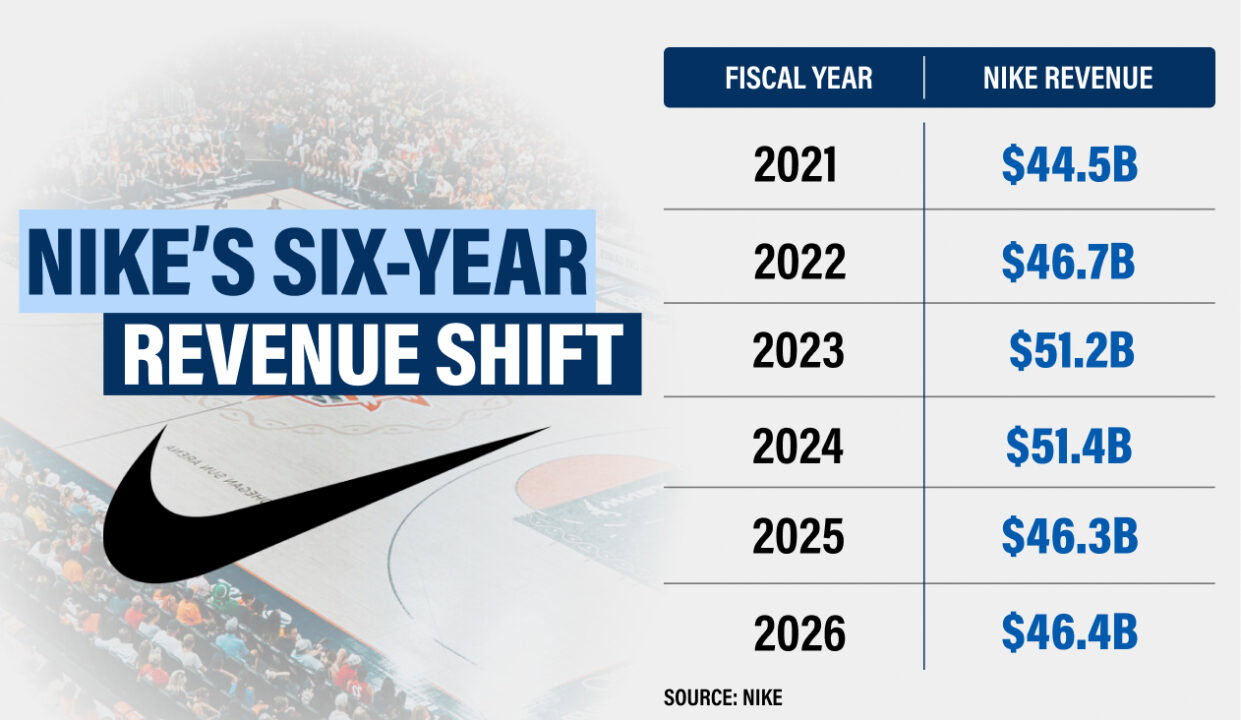
Nike’s online and company-owned store business has taken a hit too. Direct sales dropped 6% to $17.7 billion, while sales through other retailers grew 6% to $27.5 billion. Under CEO Elliott Hill, Nike is trying to turn things around by working more closely with retailers, cutting down extra stock, and putting more focus on performance-focused products. But clearly the issue is a major one.
From Nike to On: The Challenger Is the Story
The shift is challenging Nike’s presence as other market players are taking it away. One of the clear examples is On.
On was once best known for running and tennis, but the brand is now stepping into a much bigger arena. It has brought Kylian Mbappé on board, has Roger Federer as a shareholder, and has Thierry Henry leading its football push as football director. It also plans to launch its first widely available football boots in 2027.
However, Mbappé’s move is especially interesting, as, after spending around two decades with Nike, he has joined On in a deal that reportedly includes cash and equity. He is also expected to become a shareholder.
A giant like Nike already has a massive football setup, while On is still finding its feet in the sport. But that is also what makes On different. Instead of simply becoming another name on a long list of sponsored athletes, players can have a chance to grow alongside the brand and help shape where it goes next.
Nike is losing more than endorsements
Nike is not just losing its players, but also its market presence. PUMA became the Premier League’s Official Ball Supplier from the 2025/26 season. The deal began in summer 2025, ending Nike’s 25-year run with them.
The benefits are something that’s making it worse. Every Premier League match now features a PUMA ball. With the Premier League reaching around 900 million homes across 189 countries, that gives PUMA a huge global platform.
This way, Nike will risk losing its household value and relevance in the market,
Nike’s problems are not just showing up in its business numbers; Wall Street is feeling the hit too. The company was worth around $264 billion in November 2021, but that value has now dropped to about $57 billion, a loss of 78% in value.
The slide has also pushed Nike out of the S&P 100, an index that tracks 100 of the largest U.S. companies. After spending nearly 18 years in the index, Nike is set to leave on September 21, 2026. The company’s market value has already fallen 36% in 2026 alone.
So, now comes the real question: will Nike be able to regain its presence?
The Bigger Question: Can Nike Still Create the Next Icons?
Nike has long been known for turning athletes into huge global stars, but that advantage doesn’t seem as strong as it once was. More players are now looking beyond the usual sportswear giants, especially when other brands can offer bigger contracts, more personal attention, and a chance to stand out.
Taylor Fritz is a good example of someone who moved away from the traditional sportswear route and signed with Hugo Boss in 2024.
“I feel like every brand wants to do a tennis line, even brands that don’t necessarily sponsor tennis players. It’s just kind of become a popular thing,” Fritz said during a news conference after reaching the U.S. Open second round last year.
And he isn’t the only one making a change. Iga Swiatek and Ben Shelton joined On in 2023, while Frances Tiafoe left Nike for Lululemon in January 2025.
Then came Jack Draper. Just before the 2025 U.S. Open, the world No. 5 switched from Nike to Vuori in a deal reportedly worth around $5 million a year.
So, is Nike losing its power?? Well, the shift in players’ interest shows it, but that cannot change the legacy it has built. From players like LeBron James to Caitlin Clark, Nike has made its presence in every generation of players.
Now, it will be interesting to see how well it fits in this ever-changing sports landscape.