
Last week, sports analyst Bob Stew shared an observation about Los Angeles Dodgers right fielder Kyle Tucker on X. With the World Series approaching, his post added to the debate over MLB payrolls and how teams spend their money.
Watch What’s Trending Now!
“Kyle Tucker, who is costing the Dodgers 119 million dollars to roster this year, is batting 8th. Just in case you’re wondering why there won’t be Baseball next season,” Stew wrote on X.
Meanwhile, after the Dodgers advanced to the NLCS, manager Dave Roberts expressed confidence in his team, saying, “We’re smarter. We’re better. And we’re tougher.”
The debate over payroll spending continues. A post from Talkin’ Baseball on X claims that the Dodgers have a payroll of $339 million, compared with a combined $316 million for the three other teams remaining in the Championship Series.
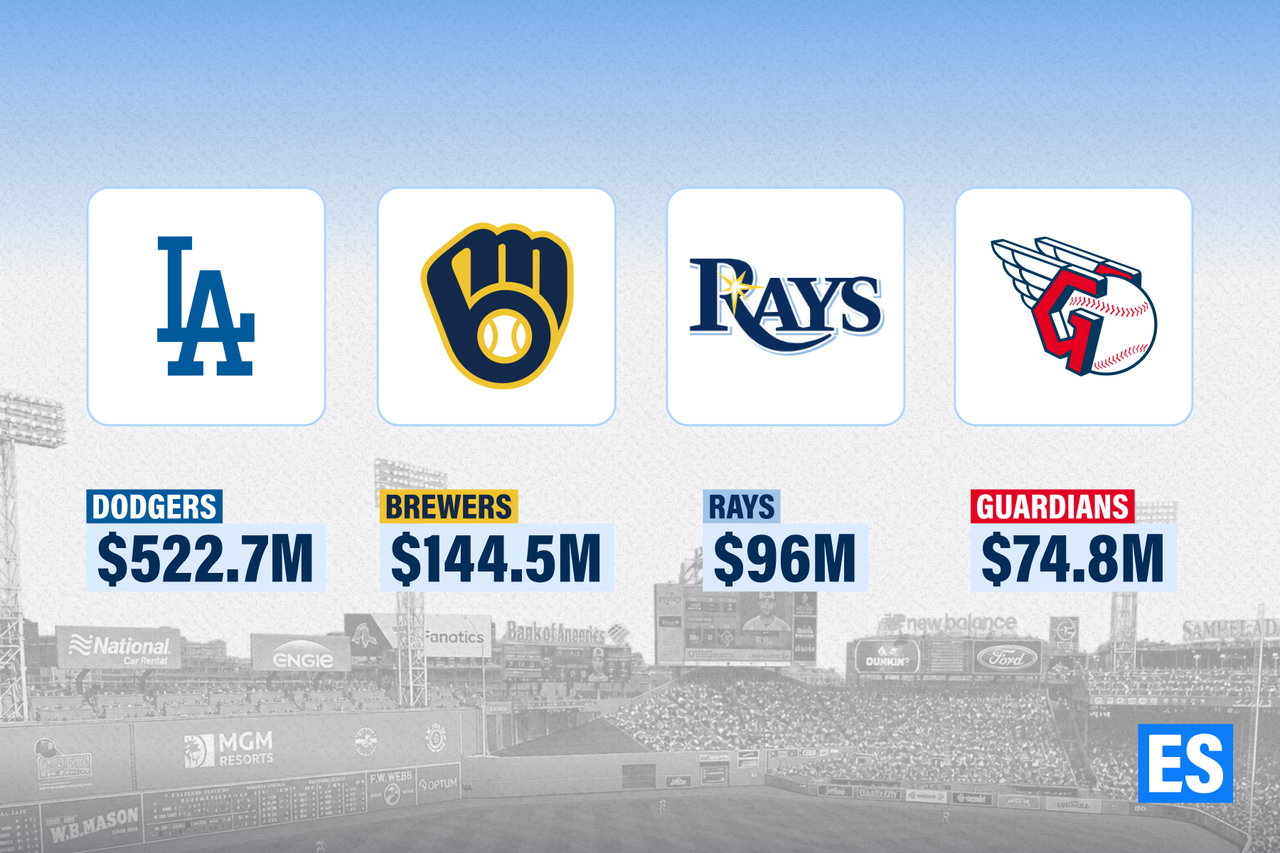
The Brewers have a payroll of $144.5 million, the Rays $96 million, and the Guardians $74.8 million. All four teams have reached the Championship Series, making the spending gap hard to ignore.
A breakdown by The Athletic highlights just how wide that gap is, with the Dodgers’ payroll alone exceeding the combined payrolls of some of their postseason rivals.
Milwaukee finished the regular season with a 103-59 record, the best in MLB, while Tampa Bay went 98-64 and Los Angeles finished 100-62. The Brewers also opened the NLCS with a 2-1 win over the Dodgers.
MLB’s collective bargaining agreement expires in less than 60 days, and a potential salary cap remains a major point of contention. Owners want a cap, while the players’ union has said it will never accept one. This postseason has put the different financial approaches to building a contender under the spotlight.
Can a team contend with a $75 million payroll? What justifies spending more than $500 million? And who ultimately benefits from the gap?
Four teams have taken up four different business models
The gap in spending between these four teams is huge, but the numbers need some context. The Dodgers’ $522.7 million total includes their payroll and an estimated $183 million luxury tax. The figures for the other three teams cover payroll only.
Here’s how the numbers compare:
- Total spending: The Dodgers’ $522.7 million is about seven times the Guardians’ $74.8 million, 5.4 times the Rays’ $96 million, and 3.6 times the Brewers’ $144.5 million.
- Payroll alone: After subtracting the estimated luxury tax, the Dodgers’ payroll comes to about $339.7 million. That is still roughly 4.5 times Cleveland’s payroll.
- Luxury tax: The Dodgers’ estimated $183 million tax bill is higher than the entire payroll of each of the other three teams. Another projection puts their 2026 luxury tax at around $180 million, as reported by Nolo.
Each team has a different approach to building a winning roster:
- Los Angeles Dodgers ($522.7M): They spend heavily on established stars, top free agents, and players acquired before the trade deadline.
- Milwaukee Brewers ($144.5M): They rely on homegrown players, player development, and selective trades.
- Tampa Bay Rays ($96M): They use scouting, analytics, and trades to find players who can perform well without costing too much.
- Cleveland Guardians ($74.8M): They develop talent through their farm system and use carefully structured contracts to keep key players.
The Guardians finished the 2026 regular season 85–77 as the AL’s No. 2 seed, earning a first-round bye before coming back from an 0–2 deficit to beat the White Sox in the Division Series. The Rays also swept the Yankees in their series.
These results show that teams do not need the biggest payroll to compete. The harder part is keeping a winning roster together as young players develop and their salaries rise.
Where are the Dodgers spending their money?
The total payroll only tells part of the story. Looking at each team’s lineup, starting rotation, and bullpen gives a clearer picture of where the money goes.
Here are the listed costs for each roster group:
| Roster group | Dodgers | Brewers | Rays | Guardians |
| Starting lineup | $160.6M | $52.9M | $19.4M | $31.7M |
| Starting rotation | $86.1M | $20.7M | $5.6M | $7.6M |
| Bullpen | $41.2M | $18.4M | $15.3M | $9.4M |
| Combined total | $287.9M | $92.0M | $40.3M | $48.7M |
A few things stand out:
- Starting lineup: The Dodgers’ $160.6 million lineup costs more than the Brewers’ entire $144.5 million payroll. It also costs about 8.3 times as much as Tampa Bay’s lineup.
- Starting rotation: The Dodgers spend $86.1 million on their rotation, more than Cleveland’s entire $74.8 million payroll. Their rotation costs about 15 times as much as the Rays’ $5.6 million rotation.
- Bullpen: The spending gap is smaller here. The Dodgers’ bullpen costs about 4.4 times as much as Cleveland’s and 2.2 times as much as Milwaukee’s.
That spending gives the Dodgers more options. They can bring in top players, add depth, and cover for injuries or poor performances without having to overhaul their plans.
But a bigger budget does not guarantee better results in every area. Despite having the most expensive bullpen among these four teams, the Dodgers ranked ninth in reliever ERA, behind both Milwaukee and Cleveland. Milwaukee’s bullpen also played a key role in its Game 1 win.
The numbers show what money can buy in roster depth. What happens on the field still depends on how those players perform.
The reasons behind focusing on homegrown talent
Developing players from within is one of the biggest advantages for teams that cannot spend as much as the Dodgers.
- Young players cost less: Players can provide major-league production before becoming eligible for arbitration or free agency, when their salaries usually increase. The 2026 minimum salary is $780,000.
- Developing players saves money: Strong farm systems allow teams to build their rosters without constantly paying top market prices for established stars. Milwaukee relies heavily on homegrown players, while Cleveland has also developed much of its roster internally.
- Long-term contracts can help: Cleveland’s José Ramírez is an example of how a team can benefit from keeping an elite player under a long-term deal. His salary is higher than the combined cost of the other players in Cleveland’s listed lineup, yet the entire lineup costs just $31.7 million.
- Cost per win: Based on regular-season wins, the Guardians spent about $880,000 per win. The Rays spent roughly $980,000, the Brewers about $1.4 million, and the Dodgers around $5.2 million. Using the Dodgers’ estimated payroll without the luxury tax, the figure drops to about $3.4 million per win. These numbers offer a rough comparison, not a complete measure of team efficiency.
The challenge is keeping this system working year after year. Not every prospect becomes a star, and successful young players eventually earn bigger contracts. Teams must keep finding and developing affordable talent if they want to remain competitive.
Demystifying the Luxury Tax
Major League Baseball does not have a hard salary cap. Instead, it uses the competitive balance tax, commonly called the luxury tax, to penalize teams that spend above certain payroll limits.
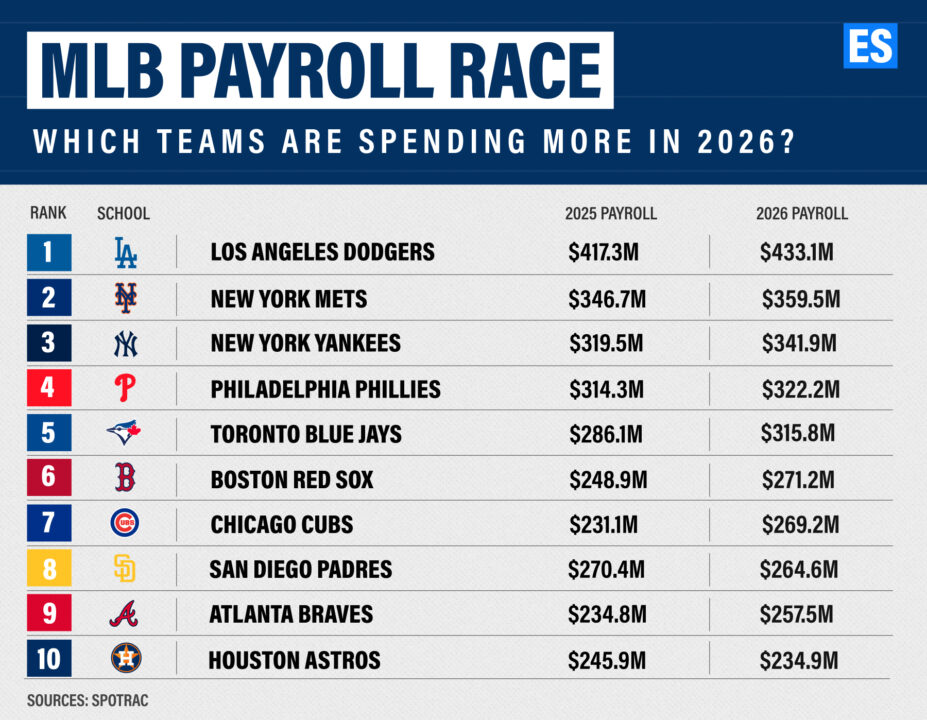
That is why the Dodgers’ $522.7 million total needs to be separated into payroll and tax payments.
- The 2026 threshold: The initial luxury-tax threshold is $244 million.
- Higher penalties for repeat offenders: Teams that pay the tax for three consecutive years face higher rates. Under the rates based on 2025 thresholds, the penalties start at 50% on the first $20 million above the limit, rise to 62% on the next $20 million, reach 95% between $281 million and $301 million, and rise to 110% above that range. The Dodgers fall deep into these higher tax levels.
- Record tax payments: The Dodgers paid a record $169.4 million in luxury tax after winning their second straight title. Their total over two years reached $272.4 million, and they had paid the tax for five consecutive seasons. Across MLB, teams paid a record $402.6 million in luxury tax last year.
- Where the money goes: Luxury-tax payments help fund revenue sharing, which sends money to lower-revenue clubs.
- The spending gap: Commissioner Rob Manfred has put the difference between MLB’s highest and lowest payrolls at $446 million. The Dodgers’ tax bill alone was about $100 million more than the Marlins’ entire payroll.
Has the luxury tax stopped big spenders? So far, it has not stopped the Dodgers. Wealthy teams can treat the penalties as another cost of building a championship roster.
Smaller-market teams face a different problem. They often cannot afford the same player salaries in the first place. The result is that the luxury tax may put more pressure on teams in the middle of the spending range than on the richest clubs.
The salary-cap fight is about money and risk
The spending gap between teams is also driving a major debate between MLB owners and the players’ union.
The current collective bargaining agreement, reached in March 2022 after a 99-day lockout, expires at 11:59 p.m. ET on December 1, 2026.
Here are the main points in the dispute:
- The deadline: The current agreement expires at the start of December 2, 2026, unless a new deal is reached.
- What happened last time: The previous lockout began on December 2, 2021, and ended on March 10, 2022. MLB still managed to play a full 162-game regular season. Based on that timeline, another lockout could continue into early or mid-March 2027 before regular-season games are at risk.
- The owners’ proposal: On May 28, 2026, MLB proposed a $245.3 million salary cap for 2027 and a $171.2 million minimum payroll. These figures include $20.1 million for player benefits and the pre-arbitration bonus pool. The proposal also calls for players and owners to split revenue 50-50 and for media revenue to be handled centrally. Teams currently share 48% of local revenue.
- Which teams would be affected: Eight teams, including the Dodgers, Yankees, and Red Sox, would need to lower their payrolls to meet the proposed cap. Twelve teams, including the Brewers, Rays, and Marlins, would need to increase spending to reach the minimum. The Guardians and Marlins would each need to add nearly $100 million to reach the proposed floor. The accounting methods differ, so the current payroll figures do not match the proposed cap and floor figures exactly.
- The players’ response: The MLB Players Association wants the minimum salary raised from $780,000 to $1.5 million and the first luxury-tax threshold increased from $244 million to $300 million. It has also proposed an “integrity tax” and penalties for teams that fail to use revenue-sharing money to increase payroll. The union has said it is open to a minimum payroll requirement, but it opposes owners tying that requirement to a maximum spending limit.
- The 1994 warning: The 1994 strike canceled 948 games, including that year’s World Series.
The main disagreement is over the difference between a salary cap and a salary floor. A cap limits how much teams can spend, while a floor requires them to spend at least a certain amount.
If the goal is to make the league more competitive, the results in October complicate the owners’ argument. The Brewers, Rays, and Guardians show that teams with smaller payrolls can still win.
The bigger question is whether teams receiving revenue-sharing money are putting enough of it back into their rosters. Players see a salary cap as a limit on their earning potential, while owners argue that it could help address the spending gap.
That debate will be central to negotiations when the current agreement expires.
Does spending more lead to more championship revenue?
A big payroll is an investment, but it does not guarantee a championship or a profit. Reaching the postseason can generate additional revenue in several ways.
- Ticket sales: During the postseason, 60% of gate receipts from the minimum number of games in each series go toward the players’ pool. Teams keep the remaining 40%, along with all gate receipts from additional games.
- Attendance and ticket revenue: The Dodgers generate more ticket revenue per game than any other MLB team. They play in the league’s only stadium with a capacity of more than 50,000 and charge ticket prices close to the Yankees’ highest levels. In the 2025 NLCS, Dodger Stadium drew 51,251 fans for Game 3 and 52,883 for Game 4. Milwaukee drew 41,737 and 41,427 fans for Games 1 and 2, respectively. That means Los Angeles drew roughly 25% more fans per game.
- The players’ pool: The postseason players’ pool totaled $128.2 million in 2025. The Dodgers received $46.15 million of that pool, but the money goes to the players, not the team.
- National television audience: The 2025 World Series averaged about 15.7 million viewers on Fox, while Game 7 drew 27.3 million. A larger audience can increase sponsorship opportunities and help build demand for the following season.
- Merchandise and sponsors: A deep postseason run can boost merchandise sales, attract sponsors, and strengthen long-term fan loyalty.
However, teams must also account for player salaries, luxury taxes, and the cost of acquiring talent. These expenses can eat into the financial benefits of a successful postseason.
A team with a smaller payroll can also gain significant value by reaching October without spending as much. But postseason revenue, franchise value, and operating profit are not the same thing.
Payroll figures alone cannot show which team is the most profitable or gets the best return on its spending. That would require more information about revenue, operating costs, and ownership finances, much of which is not publicly available.
What is better: to spend big or build all the way up?
In a nutshell, there is no playbook for a guaranteed success. The Dodgers and the smaller-spending teams simply follow different paths.
- The Dodgers’ approach: Spend heavily on star players and roster depth to reduce weaknesses and provide options when injuries or poor performances occur. The downside is the cost of long-term contracts and luxury-tax penalties, which can grow over time. Their 100-win season, 2025 NLCS sweep of Milwaukee, and back-to-back titles show that this approach can work.
- The efficiency approach: Develop young players, find undervalued talent, and control costs. This can produce strong results without a massive payroll. However, it depends on good scouting, player development, and a steady supply of affordable players. Keeping successful players also becomes more expensive as they get older and establish themselves in the league.
One postseason cannot determine which strategy is better over the long term. In a short series, bullpen performance, injuries, and a few key plays can make the difference.
The bigger question is which teams can stay competitive year after year while managing their costs. That issue will be central to MLB’s labor negotiations when the current collective bargaining agreement expires in less than two months.