

Two different sports, yet this month, the crises surrounding both have been linked to one common factor: money from Saudi Arabia. In tennis, the story was first reported by The Telegraph’s Simon Briggs, while updates from recent WTA meetings in New York added more context to the situation.
Watch What’s Trending Now!
The latest figures are concerning. The WTA is projecting an operating loss of $23 million for 2026 and expects to have roughly $15 million in cash by the end of the year. If the tour continues losing money at a similar rate, its reserves could be exhausted by the autumn of 2027.
So, how does Saudi Arabian money fit into the picture? And why does the situation invite comparisons with LIV Golf, the breakaway golf tour backed by Saudi Arabia’s Public Investment Fund? What are the similarities between the challenges facing the WTA and the disruption caused by LIV Golf?
The WTA has issues with funding, but the product is still good
The WTA has a money problem. But it does not have a product problem.
The numbers shared during WTA meetings in New York show how serious the situation has become:
- $23 million: the tour’s projected operating loss for 2026.
- $15 million: the cash reserves the WTA expects to have at the end of this year.
- Autumn 2027: when those reserves could run out if the current losses continue.
A major part of the financial pressure comes from the early end of the WTA Finals deal in Riyadh.
But this is not a demand problem. The WTA announced a record $249 million in total prize money for 2025. The tour also has some of the biggest stars in tennis and continues to attract audiences around the world.
That gap between the popularity of the sport and the financial health of the organization is what makes the situation worth watching.
There is also some good news. Charlotte, North Carolina, has secured the WTA Finals from 2027 through 2029 and will become the tour’s new global headquarters. The deal includes a $14.4 million commitment from the state of North Carolina through its sports-betting-funded Major Events, Games, and Attractions (MEGA) Fund.
But that money gives the WTA some breathing room. It does not solve the bigger issue.
The deal from Saudi Arabia could have been the solution
The WTA’s deal to host the Finals in Riyadh made financial sense for one major reason: it gave the tour a reliable source of money. The Saudi-hosted Finals in 2024 and 2025 produced record prize pools. The 2025 edition alone had:
- $15.25 million in total prize money.
- $5.235 million for Elena Rybakina after her undefeated run.
- More than 30,000 people reached through WTA community programs in Saudi Arabia, according to the WTA.
The partnership was also about more than tennis at the top level. The WTA said its work in Saudi Arabia had reached communities through development programs. However, the relationship ended earlier than expected. The 2026 WTA Finals then moved to Indian Wells.
That change comes with a financial cost. The Indian Wells event will be funded largely by the WTA itself, while the prize fund is expected to be around one-third smaller than the Saudi purse from the previous year.
So the trade-off is clear. Moving away from Riyadh may have made sense for the WTA’s long-term plans, but it also removed a major source of financial support.
LIV Golf is the biggest example of a crunch in balance
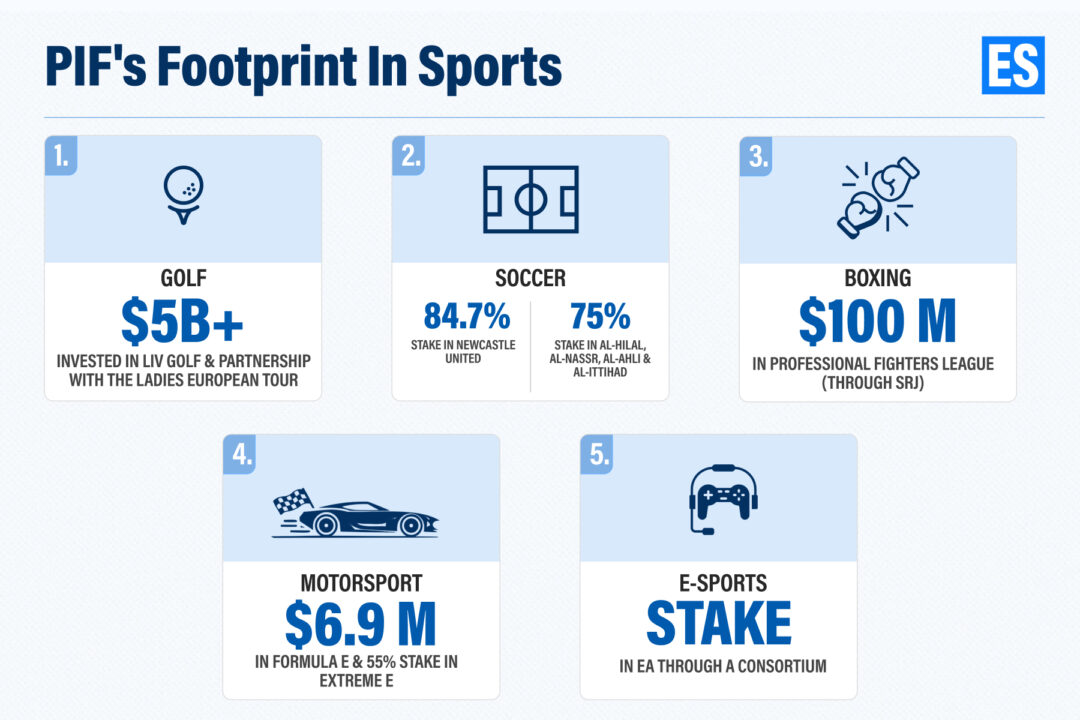
LIV Golf offers another example of the risks that come with depending heavily on one major backer. The league was built with more than $5 billion in investment from Saudi Arabia’s Public Investment Fund (PIF) since its launch in 2022.
That money allowed LIV to offer huge player contracts and prize purses while building a new golf league from the ground up.
But in April 2026, PIF confirmed that it would fund LIV only through the rest of the 2026 season before ending its investment. PIF said the long-term capital needed by LIV no longer fitted its current investment strategy.
LIV then made several changes:
- Investment bankers Gene Davis and Jon Zinman were appointed to an independent board.
- The board was tasked with finding new long-term investors.
- PIF governor Yasir Al-Rumayyan stepped down as LIV’s chairman.
- Reports suggested LIV could need between $250 million and $350 million from new investors to continue operating.
The impact has also reached beyond LIV.
The Asian Tour’s CEO said the loss of LIV-related funding created a $20 million hole in the tour’s event budget for the rest of the year. LIV had invested $300 million in the Asian Tour to help build the International Series.
That money pipeline has now dried up.
The lesson is simple. Outside money can help a sports organization grow very quickly. But once that money disappears, the organization has to show that it can survive without it.
The CVC problem
The WTA has a smaller version of the same problem with CVC Capital Partners.
In 2023, CVC bought a 20% stake in the WTA’s commercial operations for $150 million. The money is being paid over five years. That means the WTA receives roughly $30 million each year.
That investment was supposed to help the tour improve:
- Digital infrastructure.
- Commercial partnerships.
- Broadcast capabilities.
- Overall business operations.
But the payments do not continue forever.
The final $30 million installment is due in 2027. After that, the extra financial support disappears.
The timing is important because 2027 is also when the WTA’s cash reserves could come under serious pressure.
The WTA has used the CVC money to build infrastructure and develop its business. But having better infrastructure does not automatically create a sustainable revenue stream.
That is the real test waiting for the tour.
The real problem is with the recurring revenue
Now, to understand, take away the one-time investments, deals, and grants, and the WTA’s main revenue sources are fairly straightforward:
Media rights → tournament fees → sponsorships → hospitality and ticketing → digital and commercial products
That money has to cover a long list of expenses, including player compensation and prize money, tournament operations, travel, technology, broadcast production, and WTA administration.
The gap between the WTA and ATP is also significant.
- WTA revenue in 2024: $142 million.
- ATP revenue in 2024: $294 million.
- The WTA’s commercial revenue was therefore roughly half of the ATP’s.
- The WTA spends around £25 million of its own money each year to increase prize funds at combined events.
- At tournaments such as Miami and Madrid, the women’s field is valued by the events at roughly 40% of the men’s field.
Merger discussions between the WTA and ATP also broke down, with a proposed 80-20 split of the combined entity’s assets becoming one of the issues in the talks.
That split showed just how different the financial positions of the two tours are.
The problem is that the WTA’s existing revenue streams are not growing quickly enough to close that gap. That makes the current situation more than just a difficult year. It points to a bigger financial challenge.
The lesson learned from the LIV Golf crisis
LIV Golf’s current situation is not simply about whether Saudi money was good or bad for golf. The bigger issue is the risk of relying too heavily on one source of funding.
For any sports organization, the question is simple: what happens when a major source of outside money suddenly stops?
LIV built an entire golf league around the expectation that PIF’s huge financial backing would continue. When that support changed, the league had to search for new investors while under pressure.
The Asian Tour also felt the impact, with its CEO pointing to a $20 million gap in its event budget.
The WTA’s exit from the Saudi Finals deal and the end of the CVC payments in 2027 are smaller examples of the same risk.
Investments, sponsorships, and major funding deals can give a sports organization time to grow. They can also help build infrastructure and create new opportunities.
But they are not the same as having a strong, recurring revenue business.
The star value that should be utilized
This brings the issue back to tennis itself.
But before jumping into anything, let’s check what Greg Rusedski said on the reports of the cash crisis for the WTA Tour.
The tennis legend said, “The WTA will find sponsors; it’s all about personalities and names. If Eala played every match, the WTA could charge big money for TV deals, but it can’t work like that.”
Obviously, Aryna Sabalenka, Coco Gauff, Iga Swiatek, and Alexandra Eala are major stars with strong commercial appeal. Their popularity can create value at every level of the sport.
In that case, the basic chain should look like this:
Athlete popularity → tournament demand → media audience → sponsorship → recurring WTA revenue
But the key question is how much of that value actually reaches the WTA.
Some of it goes directly to players through endorsement deals. Tournament promoters also benefit from ticket sales and sponsorships. Broadcasters pay for media rights, while brands can build campaigns around individual players.
That means the sport can be popular without the central tour organization capturing enough of that value.
And that is where the WTA finds itself today.
The tour has major stars. It has record prize money. It has global events and large audiences. Yet it is still facing a $23 million projected operating loss and could have only $15 million in cash reserves by the end of 2026.
The issue, then, is not whether people want to watch women’s tennis.
It is whether the WTA has built a business model that can turn that interest into steady, long-term revenue.
The $14.4 million Charlotte commitment gives the WTA a new home and some financial breathing room. But with the final $30 million CVC payment coming in 2027, the tour still has to find a way to make its core business financially sustainable.
The WTA has the stars and the audience. Now, it needs to make sure the money generated by that popularity flows back into the tour itself.