
The Seattle Seahawks made a lot of buzz after being sold for $9.612 billion to Vinod Khosla. Now, College Football teams are also seeing that surge in team valuation as private equity firms are looking at college sports as a huge business opportunity through media rights, sponsorships, ticket sales, and hospitality. Now, one question pops up: what if even college football teams could also be bought and sold like NFL franchises? How much will the teams be worth?
Watch What’s Trending Now!
College sports are changing very quickly. For many years, colleges followed the amateur model, where sports were mainly part of education and student life. Now, things are different. Rising costs, NIL deals, athlete revenue sharing, and sponsorship contracts are turning it into a big business. Because of this, private equity firms are starting to see college sports as a major investment opportunity.
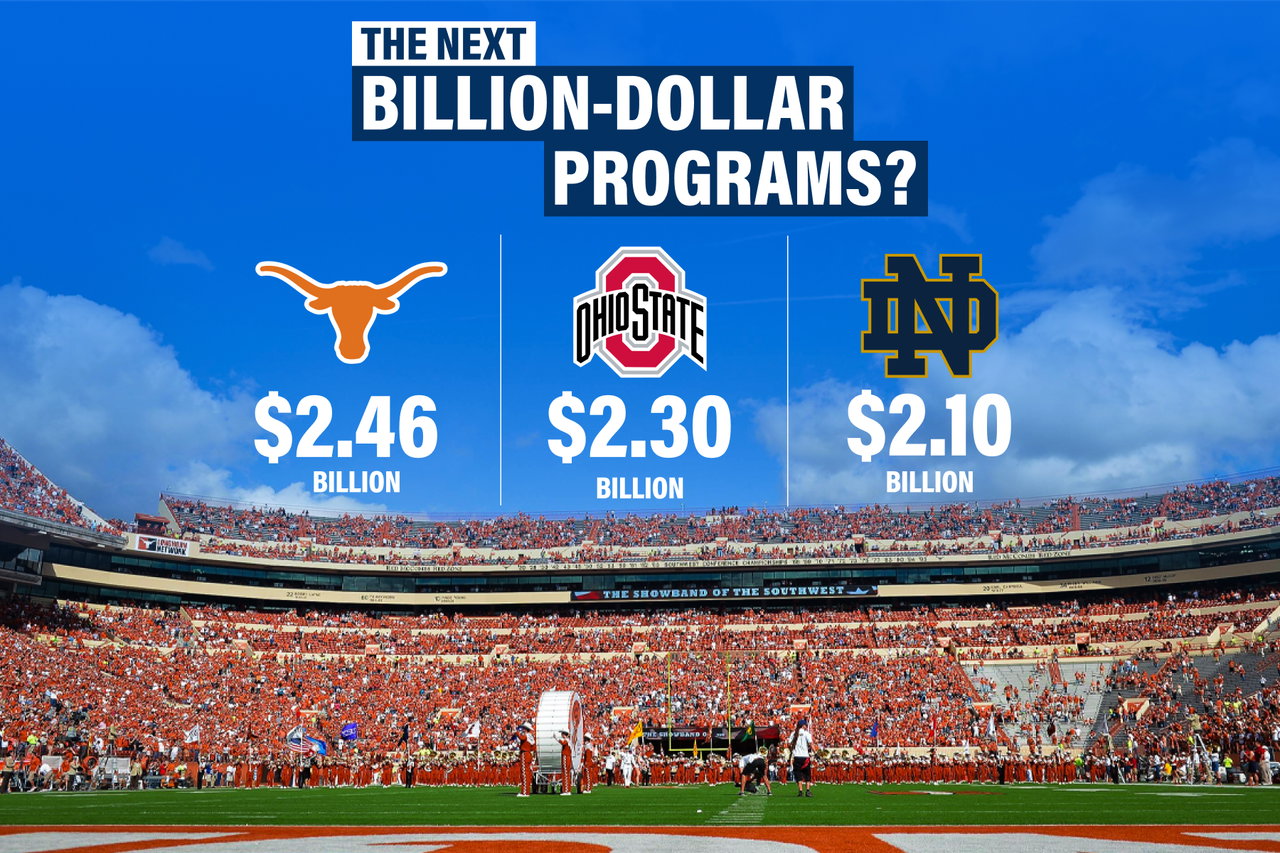
That adds up to teams’ valuation, and if they are ever up for sale, Texas will rule at the top.
Texas Longhorns
Last year, The Athletic ranked every Power Four football program based on how much each team could be worth if it were sold. Texas finished No. 1 with an estimated value of $2.38 billion. The program also had the highest three-year average football revenue in the country at $183 million. Texas was the only school to make more than $200 million in its most recent financial report, and no other program came within $25 million of that mark. Its move to the SEC, huge fan base, strong brand, and recent success on the field helped keep it ahead of everyone else.
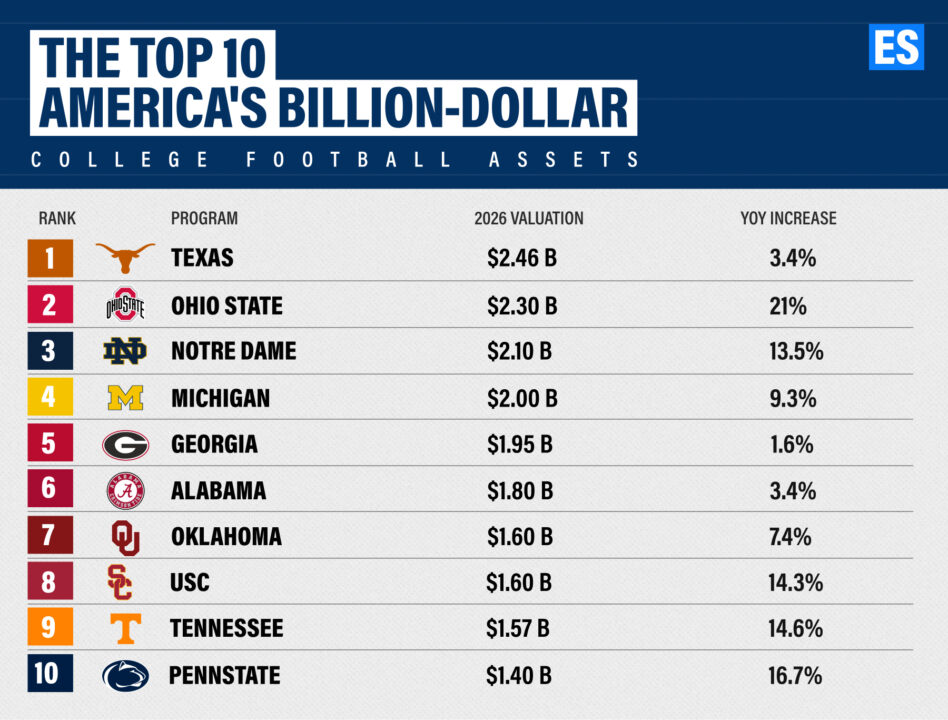
Now, Texas has held on to the No. 1 spot. Its estimated value has grown from $2.38 billion to $2.46 billion, an increase of 3.4%. Its three-year average football revenue has also increased to about $190 million, which is still the highest in the country.
Texas makes a lot of money because fans spend a lot to support the program. In the 2024 financial year, Texas earned $52.8 million from football ticket sales, the highest in the SEC. It also ranked No. 1 in ticket sales across all sports.
Imago
Image Courtesy: IMAGO
The school also gets huge support from donors. During the 2023–24 school year, the Longhorn Foundation raised nearly $200 million in donations and pledges, the highest amount in Texas Athletics history.
Success on the field has also helped. Under Steve Sarkisian, the team reached the College Football Playoff in the 2024 season.
Ohio State
Ohio State saw a massive surge in revenue from last year’s $1.9 billion to $2.3 billion, which is an increase of $400 million.
Their 2024 season championship was the main reason behind it. It increased ticket sales from $58.8 million in FY2024 to $81.7 million in FY2025.
Fans and supporters also gave more money than ever before. Ohio State received a record $68.3 million in donations from fans, foundations, and other supporters, up from $52.5 million the previous year. The school also earned more from television and radio deals, with media rights revenue increasing from $52.8 million to $64.9 million.
Because of that success, Ohio State moved up one spot to become the No. 2 most valuable college football program in The Athletic’s rankings. Along with these two teams, Notre Dame also saw a massive surge.
Notre Dame’s independent advantage
Notre Dame’s value increased from $1.85 billion to $2.1 billion, a jump of $250 million. One of the biggest reasons behind that increase is that Notre Dame has its own TV deal. Unlike other conferences, they don’t have to share any TV money and keep it all, as per their contract with NBC.
In 2023, Notre Dame and NBC extended their partnership through the 2029 season. That freedom is clearly showing in their revenue, as Notre Dame generated $143 million in three-year average football revenue in 2025. But there are some SEC teams who didn’t see that kind of jump in numbers.
The SEC’s slowest movers
Georgia and Alabama are two SEC giants in the league, which added to their rise. Georgia’s estimated value went from $1.92 billion to $1.95 billion, which is a $30 million increase, while Alabama’s increased from $1.74 billion to $1.80 billion, which is a $60 million increase.
However, their growth was much smaller than schools like Ohio State and Notre Dame. One of the biggest reasons behind this decline is the championship drought. Georgia has not won a single championship title since 2022. They have entered the playoffs but couldn’t make it to the end. The same is the case for Alabama. The team went through a major coaching change as Nick Saban retired and Kalen DeBoer took over as head coach.
Under him first they couldn’t reach the playoffs in 2024, and in 2025 they lost their quarterfinals against Indiana. So, fans might be losing interest because of that dip.
Now, it’s not like teams aren’t earning well. Alabama made $147.7 million from football during the 2025 fiscal year, and $53.6 million of that came from donations. The same goes for Georgia; since NIL started in 2021, its Athletic Department has received about $303.7 million in donations over four years from fans.
In the 2024-25 fiscal year, football alone made $42.1 million from ticket sales. Together, football accounted for 88.2% of all the money Georgia earned from tickets and contributions.
But they are still behind teams like Penn State, Tennessee, and others.
Here’s the list of the top 10 college football teams in terms of their valuation.
Conference affiliation is becoming part of the valuation
College football teams’ valuation doesn’t just depend on fans or wins but also on conference affiliation. The Big Ten and SEC make much more money from television than other conferences. The Big Ten has a media deal worth more than $7 billion over seven years with Fox, NBC, and CBS. The SEC has a 10-year, $3 billion deal with ESPN. The ACC has a $4.8 billion television deal that runs through 2036, while the Big 12 has a six-year, $2.28 billion media agreement.
Because of these big TV deals, SEC and Big Ten teams appear on major networks like ESPN, ABC, Fox, CBS, and NBC much more often.
On top of it, ESPN’s College Football Playoff media rights deal, which is worth about $1.3 billion per year through 2032, also adds to it.
The extra exposure also helps schools recruit better players and attract more investors. For example, Nike co-founder Phil Knight supported Oregon, while Barstool Sports founder Dave Portnoy gave Michigan $10.5 million to get Bryce Underwood.
So, hypothetically, if an investor shows interest in any of the college football teams, they will have open access to all of this.
And the numbers don’t lie.
Texas is now valued at about $2.46 billion, which is almost the same price that Steve Cohen paid to buy the New York Mets for [$2.42 billion] in 2020. The gap becomes even bigger when compared with Major League Soccer (MLS). Sportico’s valuations show that the average MLS club is worth about $730 million to $1 billion, and only a few teams are valued above $2 billion.
The difference is even larger with the WNBA. Sportico valued the average WNBA franchise at about $269 million in 2025, and only a few teams were worth $500 million or more. So, it clearly shows how valuable CFB teams actually are.
That means college football teams like Texas, Ohio State, Notre Dame, Georgia, and Alabama are valued way higher.
Plus, they are already moving to private equity. For example, the Big 12 signed a private investment partnership with RedBird Capital Partners and Weatherford Capital. The conference received $12.5 million in new funding, and schools can also access optional $30 million credit lines if they need extra money.
The Big 12 commissioner, Brett Yormark, made the deal because the conference wanted to earn more money to keep up with the SEC and Big Ten conferences. Then there’s Utah who made history in June 2026 by signing a major private-equity deal with New York-based Otro Capital. The agreement could bring up to $500 million into Utah’s athletic department.
As part of the deal, Utah created a new business called Crimson Brand Partners to handle the commercial side of its athletic program. The plus point is that even though Otro Capital is investing a lot of money, Utah still stays in control. The university, through its Growth Capital Partners Foundation, owns the majority of the company.
The Growth Story: Who Is Winning the Valuation Race?
Investors see some major factors before putting in their money. Like team growth, valuation, and what percentage they will own. For now, there’s no rule that investors can buy any college football team. But their valuation clearly shows their actual worth.
Let’s take Ohio State’s example: it saw a massive surge of $400 million from last year, with the biggest percentage increase of 21%. Then there’s Notre Dame with a 13.5% increase, Penn State with a 16.7% increase, Tennessee with a 14.6% and USC with a 14.3% increase. Now, there are major teams lining up to be the fastest-growing ones.
But Ohio State stands out the most because of its major rise. Now, if college football programs keep growing in this manner, will investors try to play a bigger role in how they run in the future?