
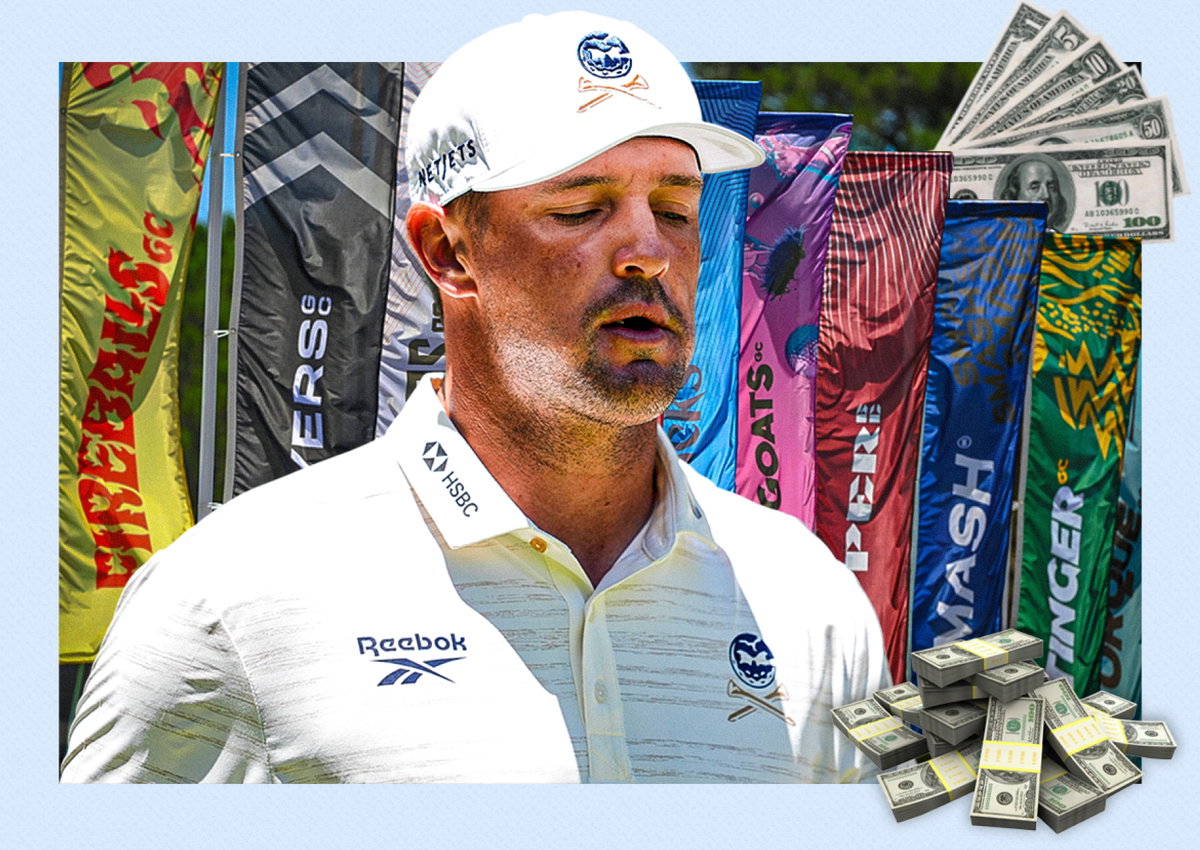
The party is finally over for LIV Golf, and the bill has also arrived. After investing billions into the league since 2022, Saudi Arabia has now suddenly pulled back its financial backing. This marks an end to their partnership, which had put LIV Golf in contention with other leagues like the NFL and NBA. Massive player contracts and heavy team investments fueled its rise, but with funding now gone before the 2027 season, LIV is now left to find a way to survive on its own.
Watch What’s Trending Now!
Saudi Arabia’s Public Investment Fund (PIF) will stop funding LIV Golf after the 2026 season. The trouble started when PIF outlined its investment plans for the next five years, and there was no mention of LIV Golf. As of now, the league no longer fits the fund’s evolving investment plans. In the statement, PIF mentioned “investment priorities and current macro dynamics” and that LIV has “forever changed the game of golf for the better.”
PIF has invested more than $5 billion into LIV Golf since the league launched in 2022. They have offered golfers contracts like those of NBA and NFL team players. For example, players like Spanish golfer Jon Rahm got an estimated signing bonus of $300 million, and Phil Mickelson got $200 million to leave the PGA Tour. Now, without proper returns on investment and the Middle East war, PIF is not funding them anymore.
This withdrawal has forced LIV to search for different investors so that their league doesn’t suffer. The main problem is that events in Mexico, South Africa, and Australia in 2027 have already been announced, and without proper financial backing, they will not be able to fund those events.
LIV Golf faces financial uncertainty after PIF’s exit
A life without PIF will be a tough one for LIV Golf, but they are trying their best to gather funds that will support their league. One of the major problems is gaining investors and finding a new business model that will give them success and profit. The financial pressure is already showing on the league, as they have postponed their New Orleans tournament, which was scheduled for June. This caused a major gap between LIV Golf Andalucia in Spain and LIV Golf UK.
Their CEO, Scott O’Neil, has already started the search for new investors, and they might get a $250 million investment as well, Axios reported. As per the report, this money can help the league become profitable in two years.
They are also planning to discuss another investment plan worth $150 million. But that lifeline can’t help them either, and they might have to let go of the ownership of their 13 teams and sell TV and streaming rights for more money.
To attract more investors, LIV Golf is also making major changes to its business by reducing 14 tournaments to 10 each season. This can reduce their operating cost. Investment bank Ducera Partners is helping them to find new investors.
Now, even if the investors’ problem is solved, their success rate is so far out that no investor would wait that long. With PIF, that was fine, but now new investors will demand immediate success. Their own CEO, Scott O’Neil, mentioned it, saying it will “take another five to 10 years” for the league to “become profitable” and propose their business plan to investors.
All in all, the troubles are just increasing, and solutions are becoming hard to find.
What it means for its future
After PIF pulled back its funding, the league might look very different from before. Their future events are already at risk, like LIV Golf UK in July, which is already more uncertain than the three tournaments in the US. Those US events are scheduled at Trump National Golf Club Bedminster, Indianapolis, and a team championship game in Michigan, which even features $40 million in prize money. But among them, only Bedminster is likely to take place because it is taking place on US President Donald Trump’s property.
To reduce cost, the league might keep fewer events that have earned it the most profits. For example, Adelaide, South Africa, London, and some US events mentioned above. And that makes sense too; Adelaide has drawn more than 102,000 fans in 2025 and generated around AUD $81.46 million. The same goes for South Africa, which has already sold 90,000 tickets. The UK event, at JCB Golf and Country Club, attracted 43,000 fans last year, earning $63 million (€45 million).
Other venues like Singapore and Korea might face trouble, but that’s not a given, as Korea has a special case. LIV has an all-Korean team, Iron Heads GC, which holds a solid position in the Korean market and is their only source to connect to Korean fans.
Coming to Singapore, they are yet to add major numbers like South Africa and the UK, so they might face a reduction as per their plan to go from 14 to 10.
To save more money, the league can partner with existing National Open tournaments rather than running solo. They can work with tournaments like the Indian Open, Singapore Open, Hong Kong Open, and others. This way, they will keep their presence but will also save on spending entirely.
The league could also reduce the prize money. Since 2022, LIV Golf has enjoyed a very high prize pool. In 2021, the Players Championship offered $15 million, and the winner got $2.7 million, but next year that amount jumped to $20 million, and the winner, Cameron Smith, got $3.6 million. Then, in 2023, it went straight up to $25 million, and the winner took home $4.5 million.
But if they want to save the league, they can’t spend so much. A former winner himself, Smith made it clear.
“This has been an awesome four or five years for us golfers, for everyone around the world. It’s changed a lot of things, but I think realistically, it’s time for everything to come back to the way it was,” Smith said.
Now, players’ contracts will also be a concerning part, as the league will not have a massive amount to offer them, and they will ultimately struggle to offer them millions. But to keep some of them hooked, the league came up with a solution of giving senior players minority stakes in their teams so that when their value increases, players can also get benefits from it.
Most importantly, LIV Golf is a league that might be viewed as a “distressed asset.” With all the reduction in tournaments and prize money, it’s pretty clear the team is and will be struggling financially. But it won’t be the same forever, as investors sometimes show interest in such businesses and buy them at a lower value so that in the future, if they blow up, they can earn billions.
One of the perfect examples of that is the XFL, which filed for bankruptcy in 2020 and was later bought by Dwayne “The Rock” Johnson, Dany Garcia, and RedBird Capital for $15 million.
Lastly, if anything doesn’t go as planned, LIV Golf can come under one umbrella, PGA Tour Enterprises, where their league and the PGA Tour can function together. This way, both can run on their own wishes but together, not against each other.
Can player-ownership really save LIV Golf?
LIV Golf is suffering big time from finding investors to think of a new business model, to recruit tournaments, and to give players stakes in the team. But how far will this take them? That remains the major question. The league will need solid investors backing, but looking at the condition and their CEO’s verdict, that seems like a 10-year wait.
That risk is something that no one wants to take. And even if they reduce tournaments, they still need money to fund the ones they are planning to keep. One decision that might create a bigger debate is whether a league can stay afloat with players becoming owners of teams. Even if the idea works, it might not reach the level the league’s expecting it to go to.
The unconventional model could work, but teams have to attract investors, and right now, they don’t have a decades-long fanbase like the NFL or NBA. It all depends on the success of the league and how much revenue it can generate, because if the teams’ values go down, players will be left with nothing. So, this model could work, but it might reduce the size of the league forever.