
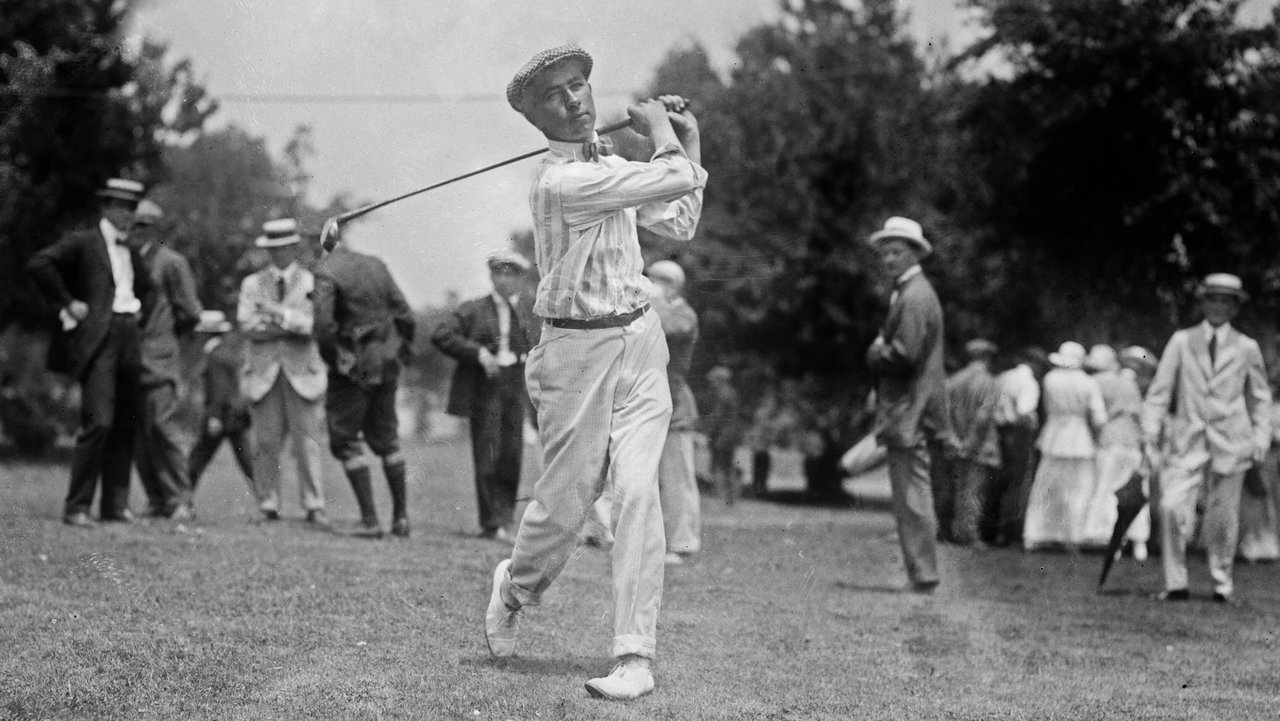
The best golfer in America, Walter Hagen, was forced to eat pheasant, caviar, and smoked salmon inside a limousine while amateur golfers walked freely into the clubhouse. It was June 30, 1920, and the Open Championship had returned after a six-year break. But despite his talent, one of golf’s biggest stars was not welcome inside.
Watch What’s Trending Now!
Two years later, on the eve of the 1922 Open, Walter Hagen explained what that day had really been about. “The golf professional is respected far more in the USA than here. He is encouraged to rise in the social as well as the financial scale. This gives him greater confidence in himself and his work.”
He had a good reason to feel that way. Just six weeks after the Open Championship at Deal, Inverness Club in Toledo, Ohio, allowed every player in the 1920 U.S. Open to use its clubhouse. Before that, only amateur golfers could use the clubhouse facilities at major tournaments. Professionals were treated more like club employees. They had to enter through the back door and were not allowed to change clothes or shower inside. To show their gratitude, the players donated a grandfather clock, which still stands in the clubhouse today. This change signaled a shift in attitudes toward professional golfers, and Walter Hagen became one of the faces of that change.
To understand why Hagen made this move, it helps to look at what made the 1920 Open so important. World War I had forced the tournament to stop from 1915 to 1919. When it returned, Royal Cinque Ports in Deal hosted the championship. There was also a big question hanging over the event: were British golfers better than their American rivals? Walter Hagen, then 28, wanted to prove that American players could compete with the best. No American-born golfer had ever won The Open.
Hagen was also known for his confidence. During the 1919 U.S. Open, he challenged his rival Mike Brady to leave the clubhouse and watch him putt for the title. Hagen missed the putt but went on to beat Brady in a playoff. Before the 1920 Open, a Daily Mail interview made his confident comments sound arrogant. Hagen was unhappy with the report and complained to media owner Lord Northcliffe, who had the reporter reprimanded.
The Rolls-Royce That May Have Been a Daimler
When Hagen arrived at Deal, he and fellow golfer Jim Barnes walked toward the clubhouse before a practice round. But they were turned away and told to use professional Harry Hunter’s shop to change their clothes.
Hagen decided to make a point. He hired a chauffeur and a car, parked it outside the clubhouse and used it as his changing room and dining room. However, accounts differ on the type of car he used. The PGA Tour’s player profile identifies it as a Rolls-Royce, while The Open and Golf Monthly say it was a Daimler. Wikipedia lists it as a Pierce-Arrow. The Open’s own player profile confirms that Hagen changed his shoes in the car park.
While Walter Hagen Dined, a Scot Staged a Miracle
The tournament belonged to George Duncan. He opened with two 80s and trailed Abe Mitchell by 13 shots at halfway. Then he bought a new driver at the exhibition tent, shot 71 and 72, and won on 303 by two over Sandy Herd. Mitchell, six clear after 36 holes, collapsed to an 84. It remains the largest deficit overturned in Open history, and Duncan is the last man to win a major with a round in the 80s, per The Open.
Hagen played 84-82-78-85 and tied for 53rd out of 82, 26 shots back, level with fellow debutant Tommy Armour. The wind had beaten him. He left with a promise: “I’ll be back.”
He kept it. A year later at St Andrews he tied for sixth on 302, 27 shots better than at Deal. By the next summer he was ready.
Not everyone wrote Hagen off. Harry Vardon had watched him at Deal and offered a prediction. “He does the right thing at the right time. I predict he’ll win our championship not once but several times.”
Vardon knew greatness. He is the Open’s record six-time champion, and at 52 he still finished in the top 10 in 1922, the year Hagen proved him right.
In 1922 at Royal St George’s, Hagen led qualifying, opened 76-73 for the halfway lead and then slipped with a third-round 79. He employed a runner to report his rivals’ scores and closed with a 72 despite bogeying the last for 300. Duncan, an hour behind, needed a 68 to tie. A birdie at the 16th made it possible, but he failed to get up and down at the last and lost by one. Hagen, by all accounts, was visibly shaking as he commiserated. The winner’s check was £75.
Golf Monthly reports that Bernard Darwin, writing in The Times, saw the future. “Unless our younger professionals do some hard thinking and learn to hit the ball truly on the green, America will win it again and again.”
He was right. Hagen won four Opens (1922, 1924, 1928 and 1929), and Bobby Jones had won three by 1930. Hagen’s 11 majors trail only Jack Nicklaus and Tiger Woods, per The Open.
Hagen’s lifestyle was his argument. “I never wanted to be a millionaire, I just wanted to live like one.”
He may have done both. The PGA Tour’s bio says he is widely considered the first athlete to become a millionaire, and EBSCO says he played more than 2,500 exhibitions from 1914 to 1929. He sometimes arrived at the first tee in a dinner coat, as if he’d been out all night. The showmanship could be read as a business model that showed professionals could earn like gentlemen.
Hagen’s friendship with the Prince of Wales did the rest. Gene Sarazen recalled in a 1977 New York Times interview a day at Royal St George’s when the Prince invited him and Hagen for a drink, and someone whispered that professionals weren’t admitted. The Prince’s reply: “You stop this nonsense, or I’ll take the Royal out of Royal St. George’s!”
According to the R&A’s Champion Golfer magazine, the Prince, then the club’s captain, presented Hagen with the Claret Jug after his 1928 win there. EBSCO says clubhouse doors then opened to professionals in England and abroad.
Sarazen put the legacy plainly: all professionals “should say a silent thanks to Walter Hagen.”
Hagen also captained the first six U.S. Ryder Cup teams, carrying the same message into team golf. Today, professionals walk through the front door at Open venues. Arguably, that started with a car parked outside one clubhouse in Kent.