
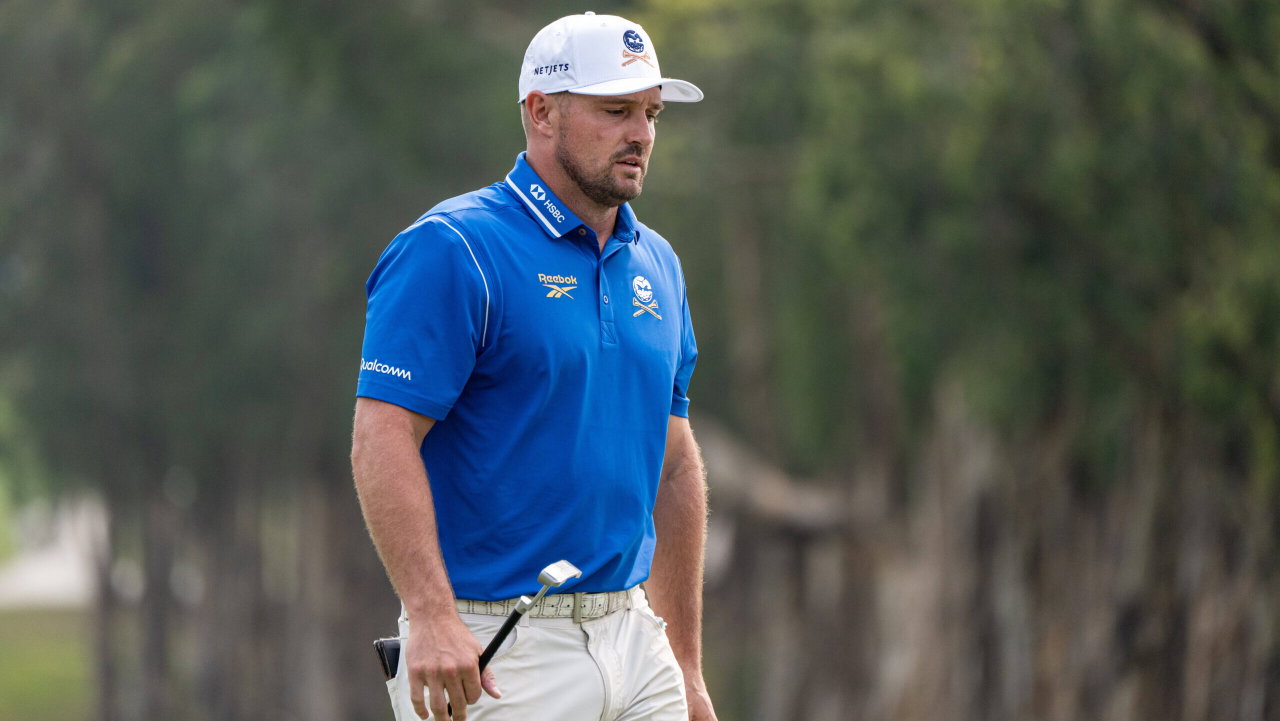
Bryson DeChambeau came to Augusta National after winning his last two LIV Golf events in Singapore and South Africa. His top-10 finishes at the Masters in 2024 and 2025 had changed how people talked about him. However, the 2026 Masters presented a different narrative: he shot 76 and 74, finished six over par, and missed the cut by two shots. Two former PGA Tour winners believe they know the reason.
Watch What’s Trending Now!
Johnson Wagner and Brendon de Jonge, who co-host The Wagyu Filet Show on SiriusXM PGA TOUR Radio, discussed why DeChambeau struggled. They argued that his data-driven approach does not fit what Augusta National requires. On April 15, the official SiriusXM PGA TOUR Radio X account summed it up: “You have to be an artist, not a scientist at Augusta National.”
“When you look at Bryson and those single-linked irons, and you look specifically at Augusta National and the lies that you get around this golf course, whether it’s 9 and the ball’s below your feet or it’s 8 and you’re coming up the hill on the par 5 and it’s a severe uphill lie, for me, the most telling is hitting into 13 and 2 off the severe upslope where the ball’s way above your feet.”
Wagner’s argument is about structure. Holes 2, 9, and 13 at Augusta force players into uneven lies that require shot-shaping in the moment. Single-length irons are designed to remove that adjustment. That is the conflict.

“You have to be an artist, not a scientist at Augusta National” Bryson DeChambeau’s 2026 Masters didn’t go as planned… 👀 Johnson & Brendon might have an answer as to why. @WagyuFiletShow Listen: sxm.app.link/WagyuFilet
“And the way he talks about the 10 o’clock swing and the length of backswing and all this stuff, like, yeah, you can get away with it for a while at around Augusta National. You have to be an artist, not a scientist, around Augusta National.”
That is the main point: a fixed, mechanical approach can work at Augusta for a while. It does not win over four days.
“And until he figures that out, like, the poor bunker play on Thursday on 11 and the poor bunker play on Friday on 18 made him miss the cut and have no chance to win the Masters Tournament.”
On Thursday, DeChambeau was at even par after 10 holes. On the 11th, he needed three shots to get out of the bunker and made a triple bogey. On Friday, a birdie at 15 put him inside the cut line at three over. The 18th bunker finished his week: the first shot stayed in, the second rolled off, the chip went long, two putts, and another triple bogey. He left before speaking to the media.
“I think I have a 60-degree one that has a shorter shaft that gives you more options of how to play. Personally, I just think it’s too glaring, and it’s probably why he’s played poorly in the Open Championship except for Port Rush when the wind didn’t blow on the weekend.”
Wagner is not calling for a rebuild but is suggesting one club. The comparison to the Open Championship matters. Links golf, like Augusta, punishes players who cannot improvise around the greens.
DeChambeau has missed the cut in three of his last five Masters tournaments. He also has a T6 and a T5 in that stretch. The volatility is the key factor. Wagner and de Jonge are not talking about one disastrous week. It is the same problem, in the same holes and situations.
Bryson DeChambeau’s Artist vs. Scientist Debate Reignited After the 2026 Masters
Wagner and de Jonge are not the only ones raising this issue. Just days before the tournament, Augusta National chairman Fred Ridley stated in his annual press conference that elite golf has become one-dimensional, with players focused on distance and routinely hitting wedges into par-fours.
Fred Ridley addressed the state of professional golf before the 2026 Masters, focusing on more than just individual players. He emphasized that the game’s strength lies in imagination, creativity, and variety—qualities Augusta tests each year.
DeChambeau represents exactly what Ridley described. His approach removes variables, while Augusta introduces them. Ridley pointed out that the best players are defined by more than distance—they must shape shots, manage risk, and perform under pressure. On holes 11 and 18, Augusta tested DeChambeau on all of these, not just distance.
Wagner and de Jonge raised the same point from the broadcast booth, though their focus was narrower than Ridley’s. Johnson Wagner, making his Masters broadcasting debut in 2026 with CBS, covered featured groups with Billy Kratzert and Shane Bacon. The question remains whether DeChambeau will adjust before his next appearance, as the scoreboard has now highlighted this issue three times.