
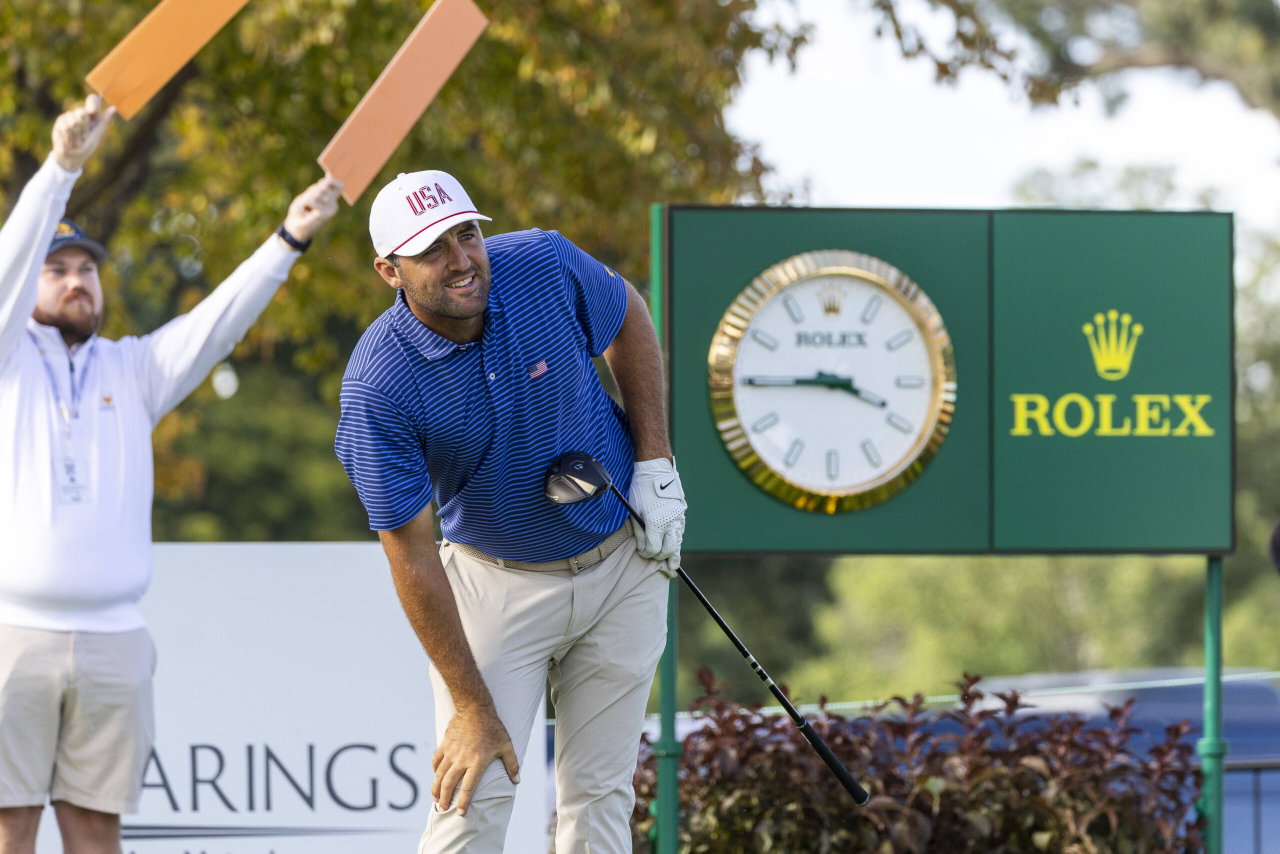
Back in 1996, Mark O’Meara led a group of players demanding a bigger cut from the Presidents Cup that was already making real money. At the time, players were getting $10,000 each, double what they got in the event’s first year. Now, three decades later at Medinah Country Club, every player picked up $250,000. The number has certainly changed dramatically. Now, whether it counts as “getting paid” the way a normal tournament pays out is a different question and one worth breaking down properly.
Watch What’s Trending Now!
So, are players being paid this year?
Yes, directly and in full. All 24 players at the 2026 Presidents Cup received $250,000 each. Both captains and all eight vice-captains also get the same amount. That turns out to be $4.25 million per team and $8.5 million across both sides for the week. This is the third Presidents Cup running where that exact figure has been paid, following 2022 and 2024. Simply put, the number has not changed. Combined, the tour has now handed out $25.5 million in stipends since the system began.
Is this tied to performance?
Before we elaborate on the system, let’s first understand: is it tied to performance? Well, no, it isn’t. This is where the Presidents Cup differs from almost every other event on the golf calendar. A normal PGA Tour stop hands out money based on the leaderboard, with the winner earning far more than the player who finishes last. The Presidents Cup pays a flat rate. Win each match, lose every match, or finish somewhere in between, the number stays at $250,000. Plus, there is no team bonus for winning, and nothing is deducted for losing. It behaves like an appearance fee rather than prize money.
Why bring in a stipend at all?
Interestingly, the story starts and lines up with a bigger shift seen in professional golf. The Presidents Cup switched from an old charity model to direct stipends in 2022, the same year LIV Golf began signing PGA Tour players away with guaranteed money. Multiple Team USA members have said part of the reasoning was practical. The tour previously covered travel costs for each player’s support team, including coaches, trainers, and family. That responsibility shifted to players themselves once the stipend was introduced, with, of course, extra money meant to cover it.
The old system that we refer to started in 1994, the Presidents Cup debut year, in which players received a token $5,000 each. By 1996, that rose to $10,000, when O’Meara publicly pushed back, arguing it was unfair that others were profiting off players who received what he had called a token fee. For years after that, the response was the charity share model rather than a raise, meaning each player, captain, and vice-captain had roughly $50,000 of event profits set aside in his name, and it went straight to a charity of his choice. That system ran until 2022, when the tour replaced it with the current personal stipend model.
Does the charity element disappear?
Well, not entirely. It just became optional. Since 1994, the Presidents Cup has generated more than $56 million for charity, and the current format still guarantees at least one million in charitable impact for whichever city hosts the event. Players can send some or all of their $250,000 to a cause of their choice. The difference is they’re simply no longer obligated to do it, and they don’t have to reveal how they use it.
How does the Ryder Cup compare?
For most of its history, the Ryder Cup paid nothing beyond a modest charity allocation. But that also changed in 2025, when U.S. players were paid for the first time in 97 years. That was $500,000 each, split into a $300,000 charity donation and a $200,000 personal stipend. Team Europe still takes nothing by choice. For context, Scottie Scheffler earned just $37,500 from the U.S. Olympic Committee for his Paris gold medal, less than a sixth of what a Presidents Cup player now makes for a week’s work. The Presidents Cup model in 2022 became the blueprint for the Ryder Cup’s 2025 payment structure. The PGA of America simply followed it three years later at a much higher number.