
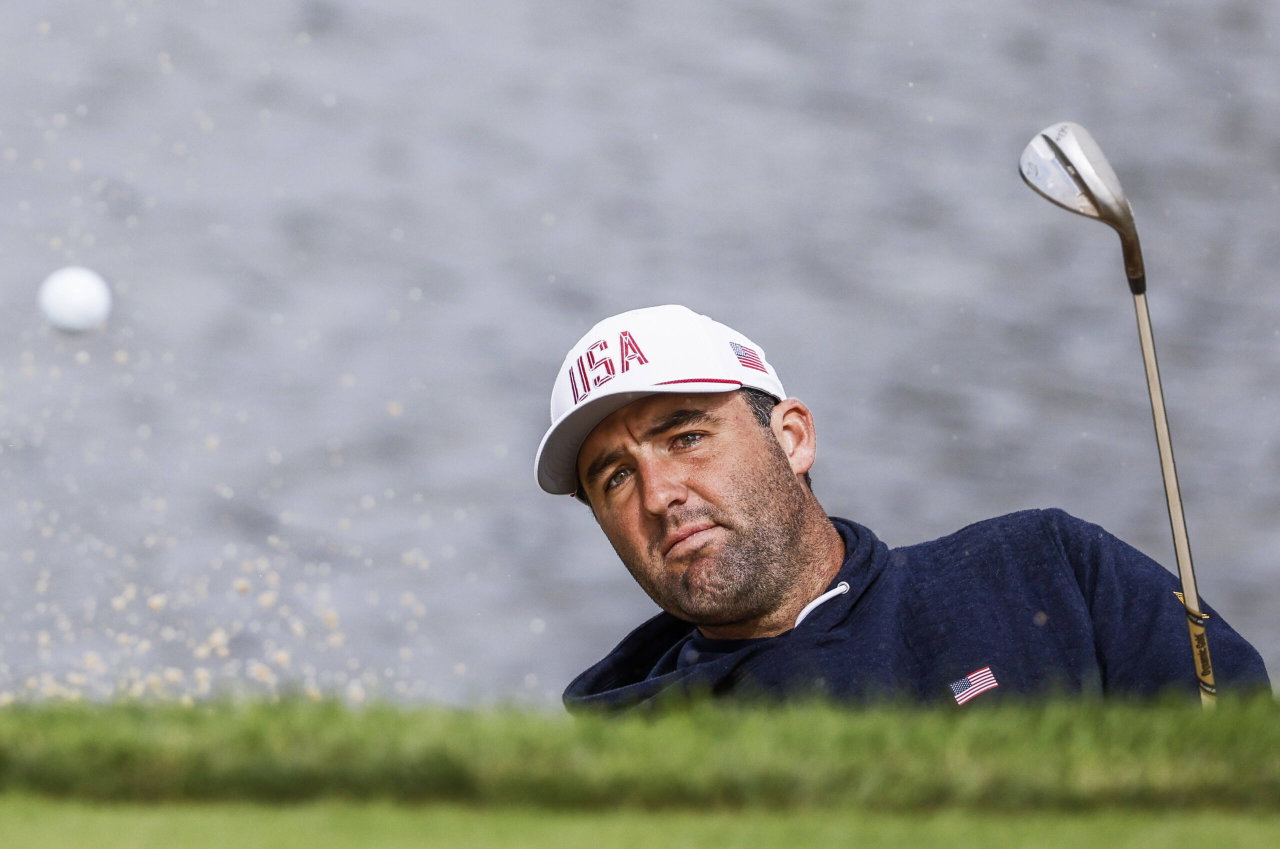
We have all seen Scottie Scheffler be competitive on the golf course. His coach, his caddie, and his fellow players could all vouch for how competitive he can be. But that behavior extended well beyond the golf course long before he became one of the PGA Tour’s most successful players. A newly shared junior-golf anecdote offers a glimpse into that side of the World No. 1, with a personal ping-pong paddle, a lopsided scoreline, and an opponent who quickly realized he had underestimated the challenge.
Watch What’s Trending Now!
The Shotgun Start, the golf podcast associated with Fried Egg Golf, shared the story. It shared a memory submitted by a former junior-golf competitor identified as Tyler.
“I had met Scottie once or twice before and could tell he was competitive. At one of the tournaments, we started chatting about ping-pong. He mentioned he was pretty good, and I said I was too. I had won my high school ping-pong tournament. A random achievement. We decided to go play at one of the host homes. To my surprise, Scottie pulled out his personal ping-pong paddle from its case. He had traveled across the country with his paddle,” Brendan Porath read from the message shared by Tyler.
Tyler had entered the match believing he could put up a fight. Instead, he found himself thoroughly outplayed by someone he already knew to be a highly competitive junior golfer. He added that Scottie Scheffler isn’t just competitive; he is good at ping-pong, too.
“I quickly realized I was no match for Scotty. We agreed on a game to 21, but he went up 7-0. Automatically winning the game. A skunk. I figured he was competitive as a top junior golfer, but getting killed in ping-pong opened my eyes to how competitive and talented he was. He wanted to beat you badly at anything.”
Scheffler’s connection to ping-pong extends beyond playing the game against friends.
Before the 2024 Open Championship, he discussed hitting ping-pong balls around the house with a golf club as a child. He would experiment with shaping shots and making the ball curve from room to room.
The recollection offers a glimpse into his early interest in experimenting with ball flight and shot-making.
Scottie Scheffler has not independently confirmed Tyler’s submission, as the podcast reported. Nevertheless, the memory offers a revealing personal account of his competitive temperament before his professional success made that quality familiar to golf fans.
Tyler’s account becomes more interesting when placed alongside a comment from Ted Scott, Scheffler’s caddie.
A SiriusXM PGA Tour Radio episode shared Scott’s assessment of how Scheffler approaches table tennis.
“If Scottie Scheffler was playing a 9-year-old girl in ping pong, he’d want to beat her 21-0,” Scott said. “And then he would apologize afterwards, but while it was going on, he would have no mercy.”
The remark was a humorous hypothetical, but it shows how competitive the World No. 1 is. But ping-pong is far from the only activity in which Scottie Scheffler’s competitive instincts have reportedly surfaced.
In a feature published by the PGA Tour, Scott recalled playing water volleyball with Scottie Scheffler and witnessing the intensity with which the golfer approached the game. The contest became so heated that Scheffler nearly got into a fistfight with a friend.
Scott described the experience as a different level of competition than he was used to seeing in volleyball.
He also offered a broader assessment of Scheffler’s personality.
“He’s not about the trophies, the fame; he really just honestly loves to compete at anything. He just happens to be incredible at golf. The perfect storm,” Scott said.
His broader athletic background has also attracted attention. A 2024 Washington Post profile explored Scheffler’s basketball ability and general athleticism, while a 2025 PGA Tour feature on his competitive spirit mentioned ping-pong with friends and pickup basketball at a local gym.
Together, these accounts suggest that his interest in sport has long extended beyond the game that eventually made him famous.
He has carried on this competitiveness to the PGA Tour, too.
Scottie Scheffler’s 2026 success reflects the same commitment
Scheffler’s PGA Tour achievements offer a different perspective on the mentality described in these anecdotes.
He finished the 2026 season with his second FedExCup title after winning the Tour Championship at East Lake on August 30. A final-round 66 secured a three-stroke victory over Viktor Hovland.
He began the final round three strokes behind, making the comeback another example of his ability to perform under competitive pressure. Although he did not win a major in 2026, his season-ending triumph reinforced his position among the game’s leading players.
Scheffler has been consistent in describing the work ethic behind those results.
“I don’t take days off during tournaments. I try to give it my all each and every day,” he said after the Tour Championship.
He also explained why maintaining that standard matters to him.
“I don’t want to look back at the end of my career and feel like I could have done more in order to play well,” he added.
Another side to Scheffler’s relationship with competition keeps the story from becoming a simplistic celebration of winning at all costs.
Ahead of the 2025 Open Championship at Royal Portrush, Scheffler spoke candidly about the limitations of professional success.
“This is not a fulfilling life. It’s fulfilling from the sense of accomplishment, but it’s not fulfilling from a sense of the deepest places of your heart,” he said.
He also reflected on how briefly victory’s satisfaction can last. The American professional explained that the excitement of winning a tournament may endure for only a few minutes.
That distinction makes Tyler’s story more compelling. The junior-golf anecdote suggests that Scheffler does not need a trophy, a ranking point, or a substantial reward to enjoy a contest. The competition itself appears to be part of the appeal.
Scott’s description of a man who loves competing, rather than chasing fame or trophies, reinforces that interpretation without claiming to explain Scheffler’s private motivations.