
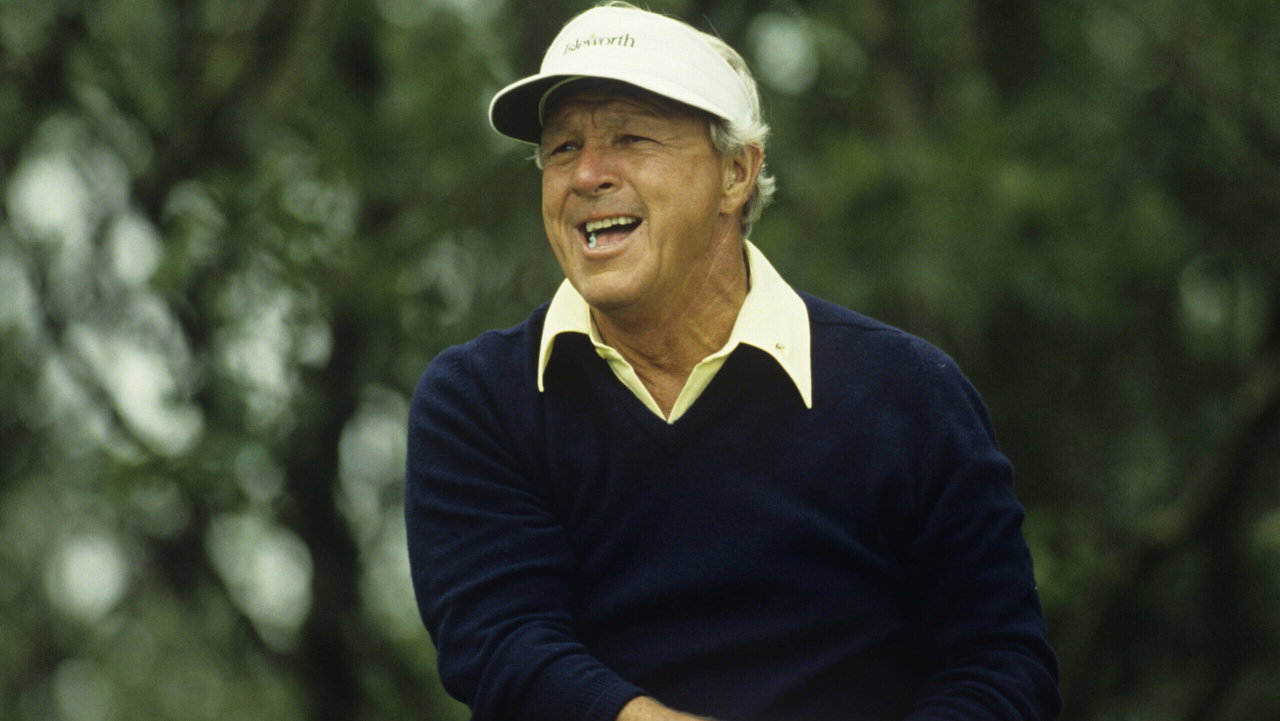
Arnold Palmer never forgot the way Ben Hogan addressed him, or the question Hogan once asked about his place at the Masters. Yet, when Palmer recalled those moments in an interview with Graham Bensinger, he made clear that the tension never turned into lasting bitterness.
Watch What’s Trending Now!
In an interview with Graham Bensinger, Palmer remembered how Hogan went through their entire acquaintance without, as far as Palmer could recall, addressing him as Arnold or Palmer. The slight bothered him, particularly because Hogan was one of golf’s most accomplished players.
“Well, that’s funny because it it did bother me. Uh, and I wasn’t ever quite sure why he didn’t, but uh, till the day he passed, I never remember him calling my name out and pronouncing my name, Arnold or Palmer. It was, ‘Hey, you or something like that all the time.’ And and I objected to it, but there was nothing I could do about it,” Arnold Palmer told Bensinger in a 2016 interview when asked about whether it bothered him.
For Palmer, the experience carried added weight because of the stature of the men he encountered at Augusta. In the same interview, he spoke about the thrill of meeting golfing legends such as Bobby Jones, Hogan, Sam Snead and Byron Nelson. Having grown up as the son of a golf professional, Palmer had read about and admired these players long before he shared the course with them.
Hogan’s treatment therefore stood in contrast to the excitement Arnold Palmer felt about entering their company. The golfer he admired for his ability was also the one whose recognition he never quite received in the way he wanted.
Then came an even more pointed moment at Augusta National, when Palmer overheard Hogan questioning how he had earned an invitation to the Masters.
But The King eventually answered that doubt with a victory at Augusta in 1958. The win brought him personal satisfaction.
“Well, uh geez, I didn’t know you knew that, but that uh he was with my friend uh Jackie Burke, and he said his exact remarks were, “How in the hell did he get in the Masters?” and and of course when I won the masters uh I I personally had a little personal satisfaction uh from that but as it turned out uh Hogan and I became friends. We weren’t I never held a bitterness or anything against him. Uh uh I thought he was a great talent, a great player. He proved he was a great player. Uh and and I accepted that and accepted him. He he did his thing. I did mine,” Arnold Palmer added.
According to Golf Channel’s retrospective of The King’s career, the episode followed a difficult practice match at Augusta National. Palmer had competed at the Wilmington Azalea Open in North Carolina on the preceding Monday. He lost a playoff and then drove through the night to reach Augusta in the early hours.
Dow Finsterwald subsequently invited Palmer to play a practice-round match against Hogan and Burke. Exhausted from the overnight journey, Arnold Palmer struggled during the round, although Finsterwald helped their partnership win the match.
This shows that Hogan’s assessment followed a poor practice performance by a tired golfer. It was not merely a comprehensive judgment of Palmer’s career. Palmer already had an established professional record, including eight PGA Tour victories before the 1958 Masters, but he had yet to win a major championship.
Arnold Palmer won the 1958 Masters and began his major championship career
Palmer’s first major victory came just days after the incident. He turned a difficult practice-round memory into a striking piece of golf history.
At the 1958 Masters, Palmer finished at 284, four under par, to win by one stroke over Doug Ford and Fred Hawkins. The victory marked his first major championship and the beginning of a remarkable run that would help transform his standing in professional golf.
The final round also featured a rules controversy at the 12th hole. Palmer believed he was entitled to relief after his ball became embedded. However, playing partner Ken Venturi disagreed with his interpretation. Thus, Arnold Palmer played two balls before the committee ultimately ruled that he was entitled to relief.
Despite a three-putt on the 18th, Palmer finished with the lead. He waited as Ford and Hawkins attempted to catch him. Neither managed to make the birdie needed to force a playoff.
Augusta’s history also provided an interesting backdrop to the victory. The 1958 Masters was the first played after the installation of the stone bridges spanning Rae’s Creek. One of them was honoring Ben Hogan near the 12th green and another honoring Byron Nelson near the 13th tee.
Palmer went on to win the tournament again in 1960, 1962, and 1964, becoming its first four-time champion. He ultimately collected seven major titles and 62 PGA Tour victories.
His success made the earlier question about his invitation increasingly striking in retrospect. A golfer whose presence at Augusta had been questioned became one of the tournament’s most celebrated champions.
Later in the conversation, Palmer explained why he continued writing letters to tournament winners. He said he appreciated receiving letters from people who had already experienced success and understood what winning meant.
“I think that it’s always nice to receive a letter from someone that has been there, done that, and is appreciative,” Arnold Palmer said.
Palmer also eventually had success against Hogan on the biggest stages of golf.
At the 1960 U.S. Open at Cherry Hills Country Club, Palmer produced one of the most celebrated final rounds in major championship history. He began the day seven strokes behind the lead and fired a 65 to win his first U.S. Open title.
Hogan was also in contention, alongside the 20-year-old amateur Jack Nicklaus, who was beginning his own remarkable career. Arnold Palmer’s charge ultimately left Hogan and Nicklaus behind as he claimed the championship.