
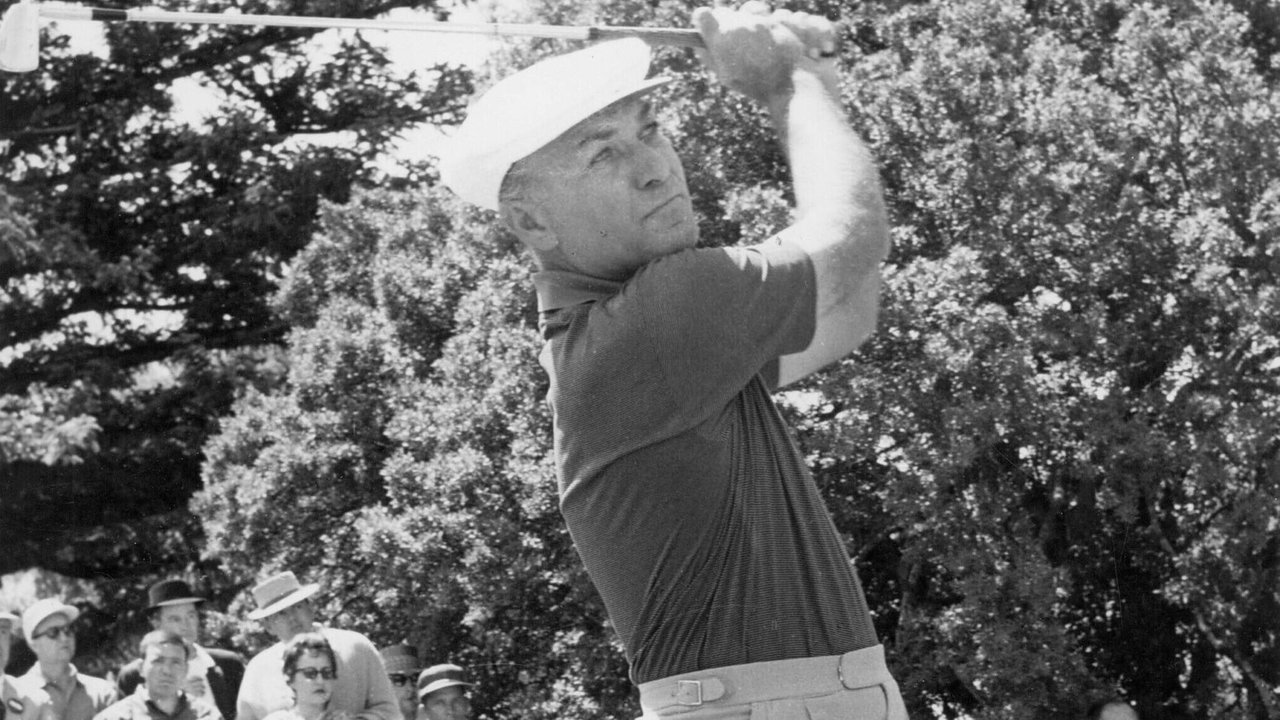
Most kids who watch Ben Hogan hit a shot just stare. Butch Harmon waited until Hogan left, found the exact divot, dropped a pile of balls in it, and spent the evening trying to steal the move. Years before he coached Tiger Woods, Harmon was a teenager grinding in the dirt over one shot from the rough that he couldn’t explain.
Watch What’s Trending Now!
Harmon told the story on Golf Digest’s The Real Deal with Bob Philion, in an episode:
“I’ll tell you a great Ben Hogan story. I was I used to cry for my dad when I was a teenager. Mr. Hogan was in town at Wingfoot and we were playing on the west course and on the eighth hole in the west course which they lengthened about 70 yards now compared to what it used to be with old wooden drivers and softballs,” Butch Harmon said.
“Mr. Hogan hit a ball on the right rough and he was about 210 yards from the flag and I saw him take his forewood and I mean he opened his club face up like this before he gripped it and he beat down on this ball and this ball jumped up out of the this rough which was probably two to three inches tall with a big high left to right landed short of the green ran up to about 12 feet from the hole and I’m thinking to myself that’s the damnedest shot I’ve ever seen. How the heck did he do that? Well, when we got done playing, what I would do when dad would play with these great players.”
Whenever his dad played with the best golfers, Harmon watched closely and looked for a shot he wanted to learn. His dad would teach him until dark, but Harmon wanted to practise more. After the round, he took his clubs and returned to the 8th hole. He found the divot Hogan had left behind, placed a pile of balls beside it, and tried to understand how Hogan had hit the shot. He realised that Hogan opened the clubface wide before gripping the club because turning it after taking the grip would close the face. Harmon then gripped the club, lifted it, and swung down hard at the ball. He hit 15 or 20 balls and promised himself he would master the shot.
Hogan’s trick was what coaches still teach today for thick grass. The rough grabs the club’s neck and slams the face shut at impact, so the face has to start open to end up square. Golf instruction pieces say to open the face first and then re-grip, because opening it after you grip just lets it twist back. Harmon worked that out at a teenager’s pace, with no coach to explain it. The shot’s high left-to-right flight also fits Hogan’s game. Golf Digest has explained that Hogan built his famous fade as a fix for a wild hook. He turned his hands more on top of the grip and opened the face on the takeaway. He could do that because he had huge torque in the downswing to snap the face shut again. In 2-3 inches of rough, he used the same open-face feel and let the grass do part of the closing.
Harmon didn’t just happen to be standing there. His father, Claude Harmon, was Winged Foot’s head pro for more than three decades and won the 1948 Masters by five shots. The course is Winged Foot’s West Course in Mamaroneck, New York. Hogan was one of Claude’s closest friends, and Butch explained what that meant for a kid growing up there:
“So, I saw stuff when I was a kid that no one ever got, not just me, my my three younger brothers, the same thing. We had an education.”
The proof is in the guest list. Butch caddied for his dad in friendly games when Sam Snead, Jimmy Demaret, Craig Wood and Hogan stopped by Winged Foot. Hogan and Claude played tournament practice rounds together, and Claude reportedly beat Hogan often in their winter games in Florida. That helped convince him he could win at Augusta in 1948. Claude was a legitimate player himself. He shot 61 on both Winged Foot courses and finished third at the 1959 U.S. Open at his home club. He and Ben Hogan were close enough that Hogan once turned down Claude’s steak dinner and cooked his own, and the friendship survived. Butch played golf with Hogan for the first time at 16, and Hogan later put him on the Hogan Staff team. Butch’s “education” meant a front-row seat to the greatest ball-striker of his era.
The most interesting part, though, is when Harmon says it sank in:
“I think I was probably 35 or 40 years old till I really realized how much I’d really seen in my life and how much that helped me be better at what I did because I saw how the best players did it, and none of them were the same.”
That line explains his coaching career. Harmon went on to coach Tiger Woods, Greg Norman and Rickie Fowler, and the idea that no two great players look alike runs through his work. He doesn’t hand a star a copy of someone else’s swing. Hogan is the best warning against that, because even his own “secret” wrecked many amateurs who copied it. Golf Digest has noted that golfers who copy Hogan’s open-face moves often can’t release the club as hard as he did, so the face stays open. Harmon learned early what Ben Hogan could do and why it only worked for Hogan.
His last point explains where that variety came from:
“And the old guys, there was no instruction in those days. They they beat it out in the dirt. They all came out of caddy yards. So they all had their own different swings. There isn’t one swing. But my point is that I had an education that I don’t think many people have ever had.”
Ben Hogan fits this story well. He started as a caddie in Fort Worth before becoming a champion. He spent years testing and changing his grip and swing until he found a way that worked under pressure. There was no guide to explain his technique. That is why it makes sense that a young Harmon hit 15 or 20 balls from Hogan’s divot at Winged Foot. He couldn’t look up how to hit the shot. He had to find the divot and try it himself. Decades later, Harmon says that studying the best players and learning why they did things a certain way became the foundation of his career.