
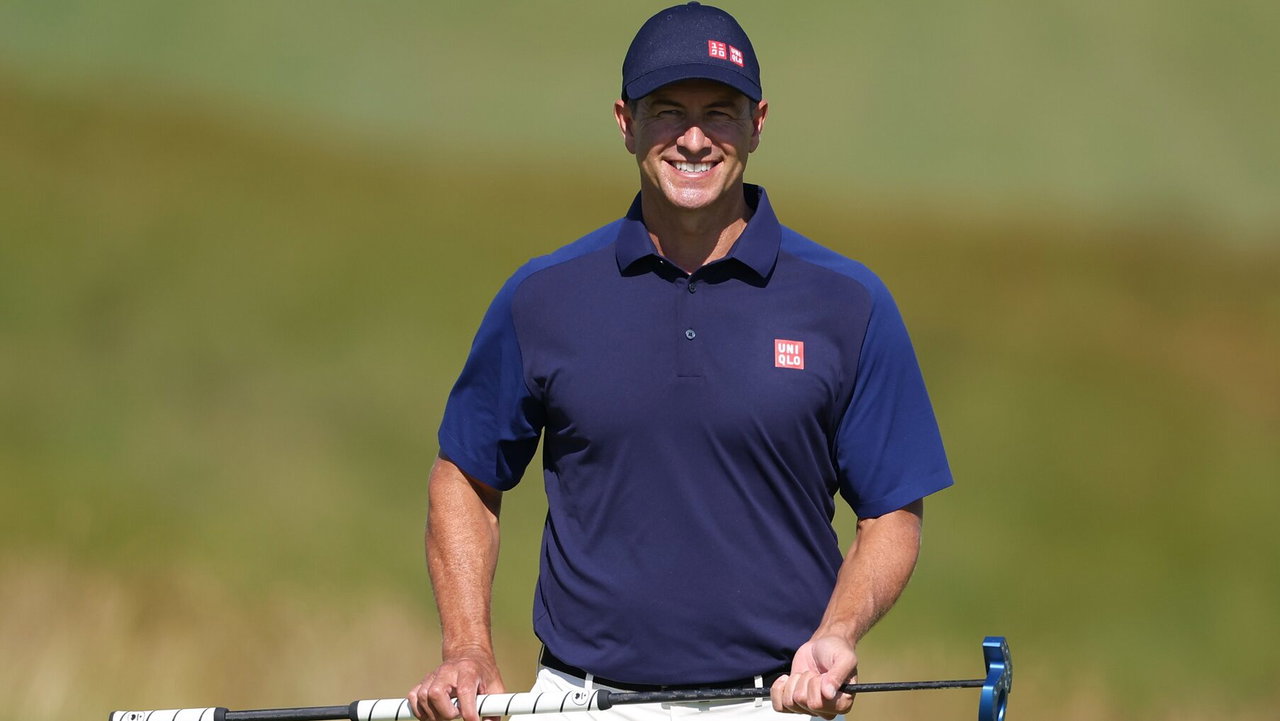
Professional golf’s distance debate is entering another interesting phase. Both Adam Scott and Patrick Reed say that while the driver used to be difficult to play, it has now become the most forgiving. They are also questioning whether changing the golf ball alone will do enough to address the problem.
Watch What’s Trending Now!
Their concerns point to a different approach to controlling distance.
“The biggest problem I have with the driver is it’s gone from the most difficult club to hit in the bag to the most forgiving,” Adam Scott told Ben Parsons of Today’s Golfer at the Abu Dhabi Aldar Championship. “That’s fundamentally wrong in the evolution of the game. If we could correct that, I think that would be a good thing.”
Scott’s concerns date back to July 2023, when he discussed the distance debate on The Smylie Show. At the time, the conversation centered heavily on a proposed golf ball rollback. But the Australian believed the driver deserved attention before regulators focused exclusively on the ball.
He argued that modern drivers have reduced the consequences of poor contact. This allows players to pursue greater swing speeds without sacrificing as much accuracy. A mishit that might once have found the rough or created a difficult recovery can now produce a relatively manageable result.
“The penalty for missing a driver just isn’t high enough any more, in my opinion, at the top level,” he had said in 2023.
Scott suggested that reducing driver-head sizes could restore some of the challenge. He argued that players should remain free to swing at 130 mph, but they should need exceptional contact to turn that speed into a successful tee shot.
“I believe a smaller head and a bit more loft for amateurs would be a really good thing for them. I think they would drive it better,” Adam Scott added at the Abu Dhabi Aldar Championship 2026. “We can’t just exponentially keep hitting it further and building bigger golf courses. They lose a lot of character, and it’s not that much fun to play anyway. We want all the courses to be relevant for everyone.”
The 2013 Masters champion has also previously questioned whether placing the entire burden on the golf ball was the right solution. He admitted he appreciated the traditional appeal of bringing the ball back but was uncomfortable applying a blanket restriction. He also expressed reservations about bifurcation, which would mean professionals and recreational golfers playing under different equipment standards.
The 46-year-old believes that distance has developed through several interconnected factors.
Patrick Reed has taken the driver discussion further.
“Obviously guys are hitting it farther and farther, but driver heads these days are so large and guys are just swinging harder and harder,” Reed explained. “You can barely mishit a regular size driver, and it still goes relatively straight. I feel like if you want to swing it 125, 130, or however fast you can swing it, you need to make hitting the ball out of the center of the face a premium.”
He further proposed a solution that involves equipment changes.
“The easiest way to me, instead of trying to roll back the golf ball, would be to make the head smaller on drivers and three-woods. For some of the best golfers in the world, there shouldn’t be a reason why they can’t hit the ball with the center of the face.”
Like Adam Scott, this is not the first time Patrick Reed has given his two cents on the distance debate.
In an interview with Joseph LaMagna for Fried Egg Golf on April 7, 2025, the 2018 Masters champion said professional golfers should face greater consequences for missing the center of the clubface.
Reed suggested returning to smaller driver heads, similar to those used during the early days of metal woods. He also advocated for lower-compression, higher-spinning golf balls that would produce greater movement on mishits.
Reed’s argument comes from personal experience with older equipment. He revealed that he still practices with persimmon drivers to improve his contact and ensure he strikes the ball squarely.
His comparison between older and modern equipment was particularly interesting. Patrick Reed said he could hit a persimmon driver about 275 yards with his regular golf ball, compared with about 305 yards with his modern driver.
However, he acknowledged that the difference wasn’t solely due to equipment. The smaller persimmon head also made him reduce his swing speed because he knew that a poor strike would produce a much less favorable result. With a modern driver, he feels more comfortable swinging aggressively because slight mishits are less damaging.
He also wants professionals to recover some of the shot-making options associated with older golf balls. His suggestion is to make mishits spin more and move in different directions, forcing players to demonstrate greater creativity and control.
Unlike Adam Scott, Reed has no reservations about separating professional and amateur equipment standards.
“We’re the top 1% in golf – the guys out here on tour,” he said, arguing that elite players should be able to handle more demanding equipment. He added that recreational golfers should be free to continue using the modern equipment currently available.
The original golf ball rollback announcement came in December 2023. The governing bodies proposed changing golf ball testing conditions to reduce driving distances for the longest hitters by about 13 to 15 yards.
The original timetable envisaged revised testing requirements from 2028, while recreational golfers would have until January 2030 to transition to the new standards.
However, the latest developments have changed that timeline.
In a joint statement issued by the USGA, R&A, PGA Tour, and DP World Tour in 2026, the organizations confirmed that there would be no change to the Overall Distance Standard testing approach before January 2030.
The decision followed feedback from the golf industry and discussions with professional tours. Three important points emerged from those discussions:
- The organizations acknowledged that driving distances continue to increase at the elite level.
- The tours raised concerns about whether the revised golf ball testing approach would deliver the intended results.
- All parties agreed to examine alternative measures that could have a more meaningful effect on future distance increases while limiting disruption to the wider golf equipment market.
The governing bodies also stated that their objective was to prevent elite golf from becoming too one-dimensional while maintaining the importance of shot-making.
Adam Scott’s latest golf ball test has strengthened his argument
Scott’s position has also gained renewed attention after he tested a golf ball that would likely meet the proposed revised standards.
In May 2026, Golf Channel reported that Scott experienced a driving-distance reduction of approximately two yards when testing a ball that would conform under the proposed testing conditions.
The result appeared to reinforce his concerns about relying exclusively on a golf ball rollback to address distance gains.
“I just feel like they [the R&A and USGA] are not going to achieve what they want to achieve the way they are going about trying to roll back the ball,” Adam Scott said.
He also suggested that several other factors could be addressed to achieve the intended results.
The debate has also attracted criticism from players who do not necessarily share Scott and Reed’s views on smaller driver heads.
Justin Thomas, Jordan Spieth, and others have all raised concerns about the proposed golf ball changes, although their arguments focus on different aspects of the issue.
Thomas questioned whether the golf ball caused the problem in the first place. He also raised concerns about modern golf course architecture, suggesting that changes such as removing hundreds of trees can affect strategy more than driving distance alone.
Spieth, meanwhile, questioned whether the proposed ball changes would affect players consistently.
“They should be finding a way for it to be the same for everybody. Some players will be affected by 2 yards and others by 20,” Spieth said.
His concern followed testing with prototype golf balls, during which he noticed substantial differences in carry distance and dispersion despite similar ball speeds.
Similarly, many golfers have suggested other equipment changes. Nick Faldo, for instance, suggested smaller tee lengths. José María Olazábal and Butch Harmon suggested reducing the number of clubs in a golf bag as an alternative to cope with the distance issue and also bring back some creativity to the sport.
For Adam Scott and Reed, the underlying objective is to reward professionals for controlling their equipment, not simply for generating more speed.
With driver performance now included in formal regulatory discussions, the next equipment changes could significantly influence how professional golf is played in the years ahead.