
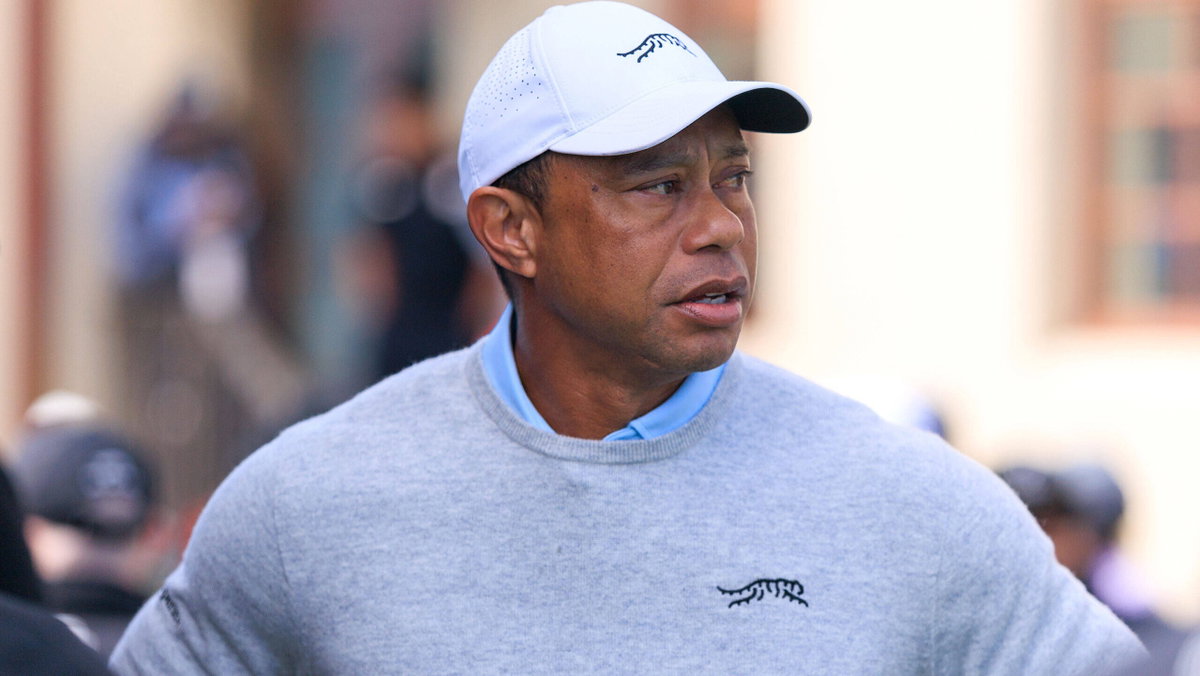
For generations, golf’s unwritten code demanded composure even in moments of frustration. But as the sport tightens its conduct standards following a recent breach at the U.S. Open, debate has resurfaced over whether modern players are being held to stricter expectations than their predecessors. Amid the renewed scrutiny, Golf Channel analyst Brandel Chamblee pointed to Tiger Woods, arguing that the 15-time major champion helped normalize on-course outbursts and was rarely held accountable for the profanity and frustration that are now under greater focus.
Watch What’s Trending Now!
“Tiger Woods is the greatest player ever. We all love him. Everybody got rich off of him. But he was one of the most profane golfers to ever play the game,” he said on the Golf Channel show.
“Nobody ever criticized him. He skated through. They did (criticize him) to some extent. They did. But it wasn’t prolific. And it wasn’t pervasive. And he wasn’t held to account, not the way Wyndham Clark was last year when he broke that locker. Not the way, you know, people… And everybody that’s playing now grew up watching him. These are Tiger’s progeny, if you will. And it rains F-bombs on the PGA Tour. Clubs get thrown all the time. T-markers get destroyed. And you’re right. The players got all the power in the world. Nobody reins them in.”
For years, television microphones picked up Woods reacting to poor shots with audible expletives, moments that often generated headlines and viewer complaints but rarely resulted in public discipline. One of the clearest recent examples came during the opening round of the 2022 Masters.
After pulling his approach shot into the trees on the ninth hole, Woods was caught on a live microphone saying, “Ah, f— off.” The clip quickly spread across social media, yet neither tournament officials nor the PGA Tour announced any disciplinary action. Woods did not publicly address the incident.
It was far from the first time his language had drawn attention. According to records reviewed by Golf.com, viewers filed complaints with the Federal Communications Commission after Woods was heard using profanity during the 2011 Masters on CBS, the 2012 Masters on ESPN, and the 2013 Open Championship at Muirfield, where he was caught saying, “God d—.”
In each case, the complaints were directed at the broadcasters rather than Woods himself, and no penalties or sanctions were publicly reported.
In fact, by the mid-2000s, Woods’ on-course language had become a familiar part of the television experience.
USA Today via Reuters
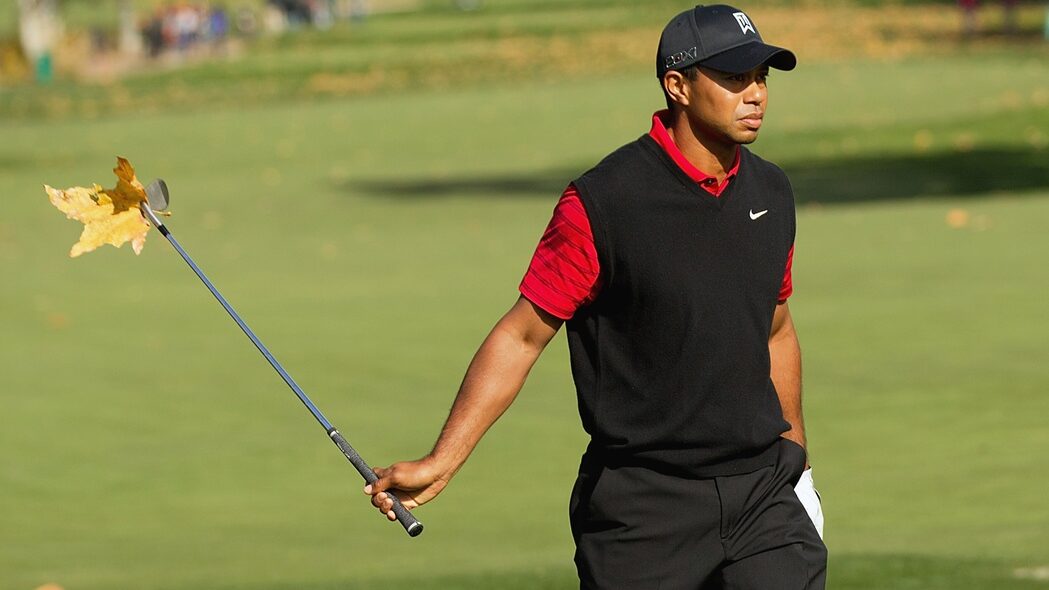
Dec 4, 2011; Thousand Oaks, CA, USA; Tiger Woods walks in the fairway of the fifth hole with a leaf stuck on the head of his iron during the final round of the Chevron World Challenge at Sherwood Country Club. Mandatory Credit: Allan Henry-USA TODAY Sports
Golf writer Jay Flemma wrote that “every network has been burned by having the on-course microphone open when he blocks one right into the cabbage and starts with the F-bombs.”
Flemma also pointed to an incident at the WGC-Cadillac Championship at Doral, where Woods allegedly unleashed an expletive-filled outburst at photographers after becoming distracted during play. No official action followed.
Profanity was only one part of the image Chamblee referenced. Throughout his career, Woods was regularly seen showing frustration after poor shots — slamming clubs into the turf, gesturing angrily after missed putts, and directing expletives at himself or his golf ball. The moments were frequent enough that broadcasters increasingly relied on audio delays to prevent explicit language from reaching viewers uncensored.
Despite the visibility of those incidents, there is no public record of Woods receiving a stroke penalty, suspension, or announced fine specifically for profanity during competition.
The PGA Tour has long maintained a “Conduct Unbecoming a Professional” policy, which allows for disciplinary action in cases involving profanity, club abuse, or disrespect toward officials and spectators. However, the Tour does not publicly disclose most player discipline. According to reports cited by Fox Sports, the system historically included minor fines of up to $10,000, intermediate fines ranging from $10,000 to $20,000, and major penalties exceeding $20,000.
That lack of transparency is central to Chamblee’s argument, particularly as golf’s governing bodies move toward stricter and more clearly defined standards.
Earlier this year, the USGA introduced an updated code of conduct under Rule 1.2b, which states: “If a player’s behavior is so far removed from what is expected in the spirit of the game of golf, in accordance with Rule 1.2b, the Chief Referee, in consultation with the Championship Directorate, may apply a penalty of two strokes or disqualification, taking account of frequency, impact, intent, and severity of misconduct.”
The rule change follows several recent incidents involving current players. Wyndham Clark faced consequences after damaging a locker following the 2025 U.S. Open, while Joaquin Niemann received a two-stroke penalty at the 2026 U.S. Open for throwing a club.
For Chamblee, those cases illustrate a wider shift in how player behavior is judged.
“And these guys are videotaped everywhere now that they go. Okay? And TV is everywhere. With that burden comes unimaginable wealth. It goes with the scrutiny. And composure is a skill. It’s a skill. And it’s lazy to throw clubs, and it’s lazy to drop F-bombs when you know the whole world is watching,” Chamblee explained.
His contention is not that Woods was alone in showing frustration on the course, but that the game’s biggest star spent decades displaying those emotions in full view of fans and television audiences without facing the kind of scrutiny or consequences that players encounter today.