
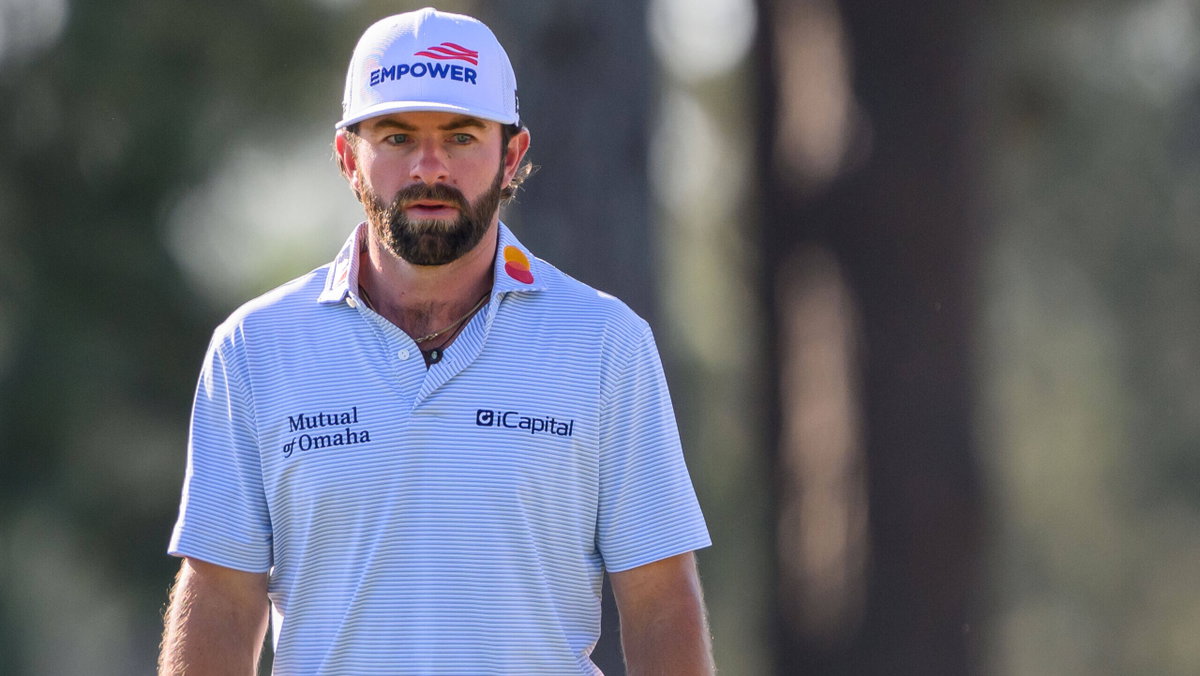
The only person who gave Cameron Young any trouble on Sunday was well, Cameron Young itself. Because in the final round of the 2026 Cadillac Championship final round at Trump National Doral, he was in complete control of things. A six-shot lead, clean ball striking all week, and the finish line was in sight. Nothing suggested drama, until on the second fairway, something happened that nobody else around him even noticed.
Watch What’s Trending Now!
As he took his backswing, Young felt that his ball had moved. Nobody else saw it. Not his playing partner. Not the rules official. In fact, the broadcast cameras later replayed it in slow motion and zoomed in on the ball. But nothing was discernible. In fact, the PGA Tour pro wasn’t sure whether his actions caused the ball to move a bit forward. Nevertheless, Young consulted the rules officials for possible implications.
After reviewing the situation, officials determined that his actions, possibly a slight touch of the clubhead, had caused the ball to move. Under Rule 9.4b, a player receives a one-stroke penalty if their actions cause the ball to move. Many would’ve looked away, but Young chose to self-report and he is not sorry about it.
“Your heart sinks when you see it move,” Young said. “But it moved. That’s part of what’s golf about. There’s no one who’s going to give me a penalty there but myself.” The incident itself occurred on a massive, $20 million stage. The atmosphere was different, given that even President Donald Trump arrived at the location to watch from a suite at the 18th green.

Cameron Young called a one-stroke penalty on himself on No. 2 Sunday @Cadillac_Champ after causing his ball to move at address. He still saved par and maintains a five-shot lead. 📺 PGA TOUR LIVE on ESPN+
Young’s stance to accept the repercussion, even with a $3.6 million winner’s check on the line, was lauded by everyone, even the President. In fact, he stood for the ovation as Young walked up the 18th hole. “It’s very unique. He’s nothing if not a very, very interesting man,” Young said. “He’s very powerful, and it’s an honor to get to play in front of him.”
Even veteran analyst Paul McGinley said, “He told his caddie and called over a referee to say he was pretty sure it moved, and even though there was not 100% evidence that it did, he accepted the penalty…to then step up and still go on to save par.”
Young stood over a 14-foot putt to save par and successfully holed it. What could’ve been a possible birdie was a par-save. But it didn’t really matter in the larger scheme of things. Cameron Young made six birdies to claim the Cadillac Championship by six shots over Scottie Scheffler. That margin of victory was the largest at the venue since 1976. He became the first player to be a wire-to-wire winner at Doral since 1977.
Young had opened the week with a bogey-free 8-under 64 on the Blue Monster, the best round of the day. By the end of three rounds, he led the field in scrambling and ranked third in strokes gained: tee to green. He entered the final round at 15-under par, six shots clear of a group that included World No. 1 Scottie Scheffler, and maintained that till the 72nd hole. It was his third victory in 14 starts. With that said, Sunday’s incident is not an isolated moment.
During the second round at the 2023 PGA Championship at Oak Hill, Young moved his ball marker on the 16th green to get out of the line of his playing partners. And then forgot to move it back before putting it there. Officials handed him a two-stroke penalty for playing from the wrong place, which turned his par into a double bogey, and he ended up missing the cut.
Self-reporting penalties are nothing new in golf. Golfers do it, as the game is all about honesty and sportsmanship.
- During the Valspar Championship, Mat Wallace penalized himself one stroke after his ball moved while addressing it in the rough. He stated it was about integrity and “doing the right thing” for the field, caddy, and team.
- Russell Henley called a one-stroke penalty on himself on the 8th hole on a Friday after his ball moved a dimple to the right when taking his club back.
- At the TOUR Championship 2024, Sahith Theegala called a two-stroke penalty on himself during the third round after his backswing moved sand in a greenside bunker.
One time, honesty cost this PGA Tour pro his win
Brian Davis was caught in a very familiar situation in 2010 on his first playoff hole on the Verizon Heritage. He was one shot away from winning his first PGA Tour win in his 169th start. However, his approach led to a hazard. As he played his next shot, the club grazed against a loose reed on the backswing.
He immediately called a rules official. Nobody had seen him, not the official standing 30 feet away. And after that, he was handed a two-stroke penalty, which gave the tournament to Jim Furyk instead. His reasoning was pretty simple.
“When I did it, I didn’t even think about it, Davis said. And when you are on the PGA Tour, you’re on the main stage. We are self-governed out here.”
Fifteen years later, Cameron Young stood in the second fairway and self-reported a mistake, perhaps because he was self-governed on the PGA Tour as well.