
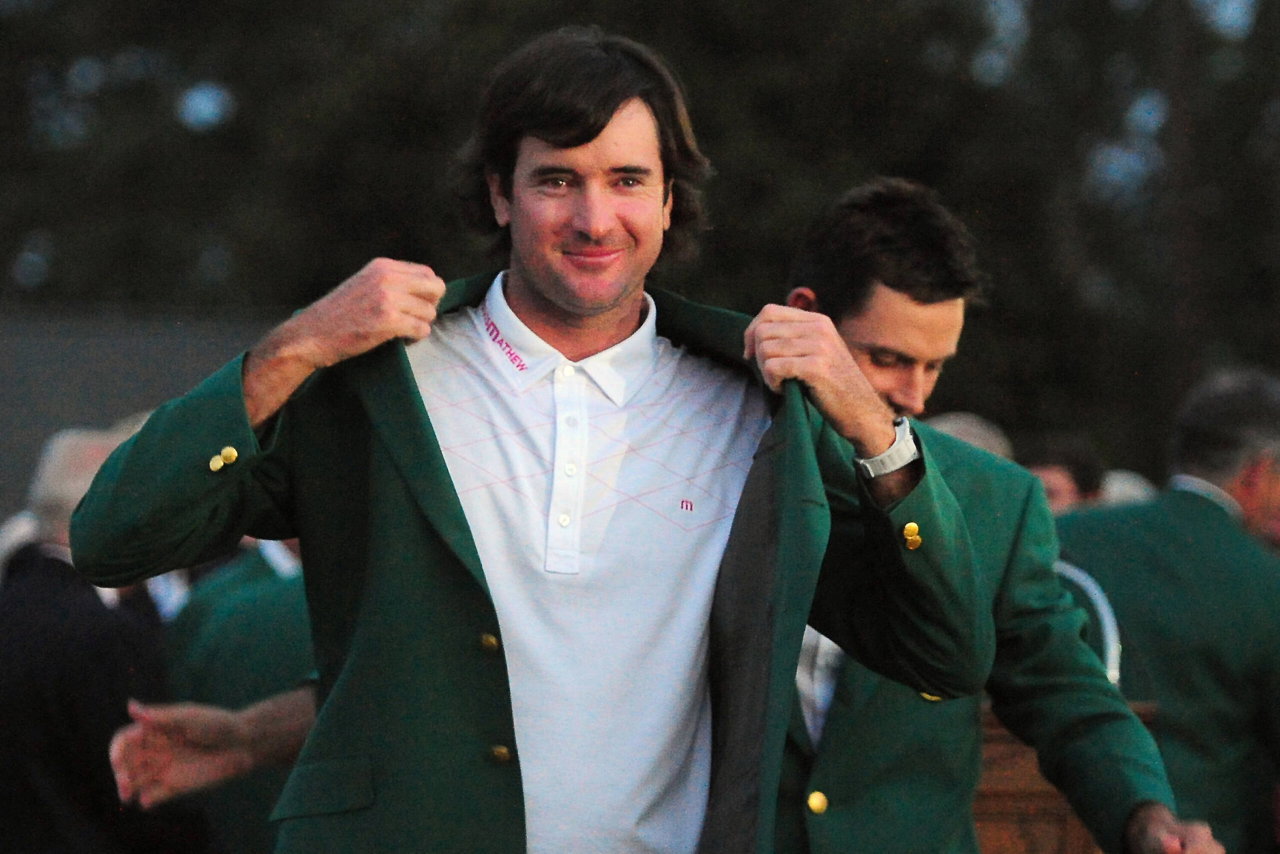
Bubba Watson has never had much interest in hitting the ball straight. Give him a gap in the trees and a reason to curve one, and he will take it.
Watch What’s Trending Now!
Now, as Gerry Lester Watson Jr. turns 48 today, the best present is to go back to April 8, 2012, when a left-hander from Florida stood in the trees on the 10th hole with a Masters green jacket on the line and played the shot of his life.
But to understand how he pulled it off, you have to understand Bubba first.
Meet Bubba
He was born in Bagdad, Florida, and was such a chubby, pink newborn that his father took about ten seconds to nickname him Bubba!
Moreover, Watson grew up whacking plastic balls around the backyard, learning to twist and bend them any way he liked. He has famously never had a lesson.
Quirkily enough, he had a reason for it: “I only take advice from someone who is better than me.”
In fact, his high school teammates Boo Weekley and Heath Slocum gave his style a name: “Bubba golf.” It means hitting the pink driver as hard as he can, finding the ball, and then bending it over, under, or around whatever is in the way.
He has his own nickname for it, too. He calls himself “Freak Show” because he hits shots other players don’t.
“Because my nickname is ‘Freak Show,’ because I can hit shots that people don’t hit,” Watson said. “You can have the most educated man in the world, and he can put a hypothesis on it, but it doesn’t make sense.”
His pink driver is another good window into his personality. He has said he likes the look of it, and it fits a guy who calls himself a goofball. He’s also a softie. Bubba cries openly after big wins, and he’s admitted he’s a little scared of people. His caddie, Ted Scott, once summed it up for 60 Minutes: “He’s scared of everything.”
The man who is scared of everything, it turns out, is not scared of a tree!
Before the Shot: Bubba at Augusta
Bubba wasn’t exactly a Masters favorite in 2012. His record at Augusta was modest. He debuted in 2008 and tied for 20th, still his best finish. In 2009, he placed 42nd. He sat out 2010, then tied for 38th in 2011.
By his own admission, it took him a few years to work out how to play the place.
His first PGA Tour win had come only two years earlier, in 2010. That same year, he lost a playoff at the PGA Championship, so he already knew what it felt like to come up just short. When the 2012 Masters arrived, he was a talented, quirky long-hitter with a good story. The big catch was that he wasn’t yet a major champion.
But that soon was about to change at Augusta National, 2012.
The Hole: Camellia
The 10th at Augusta National is called Camellia, after the bushes behind it.
It’s a par-4 of 495 yards, and the tee box sits at the top of a hill. From there, the fairway drops nearly 100 feet into a valley hemmed in by tall pines. It certainly looks friendly. It isn’t.
At Masters time, the 10th has long ranked among the hardest holes on the course, with an all-time scoring average of about 4.30. A huge bunker, roughly 60 yards long, guards the approach, while the green slopes from right to left. Danny Lee once made a 9 here in 2009.
Interestingly, the 10th was originally the first hole at Augusta. The club flipped its nines in 1935, which made it the 10th. The ideal drive here is a draw to the left side of the fairway. The safe miss is anywhere that isn’t right.
The Miraculous Shot
Bubba started the final round three shots behind Peter Hanson. Then he made four birdies in a row, from the 13th through the 16th, and signed for a 68 to reach 10 under par, tied with Louis Oosthuizen.
Oosthuizen had already given the crowd something to remember, holing his second shot on the par-5 2nd for only the fourth double eagle in Masters history. By his own account, though, it did not make the day easier. He knew it was too early for that shot to decide anything and felt he spent the first nine defending a lead.
After trading pars on the 18th in the playoff, the two players headed back to the 10th tee. Both drove right, but Bubba went further into the trees. Oosthuizen glanced off a pine and left himself a long way from the green. Bubba had roughly 155 yards to the hole, but nothing resembling a straight line to get there.
Scott had seen this movie before. He says the lie was actually good, with the ball slightly above Bubba’s feet. There was no panic and no talk of chipping out. Their catchphrase says it all: “If Bubba has a swing, Bubba has a shot.”
Bubba took a 52-degree gap wedge, aimed well left of the green, and hooked it roughly 40 yards. The ball skimmed between two rows of spectators and under the branches before rising and turning toward the green.
It landed on the front, spun up the slope, and settled somewhere between ten and fifteen feet from the hole, depending on whose telling you trust.
The View From Everywhere
Oosthuizen had the best seat in the house. Walking up the fairway, he watched the ball curve and laughed. Only a left-hander, he said, could have played that shot. A right-hander would have had to cut it.
“I was level with him when I walked up the fairway and saw the shot and saw it was curving quite a bit,” Oosthuizen laughed as he marvelled at his opponent’s shot.
Bubba was equally charmed. “I just wanted to run over there and give him a high five,” he said of his playing partner’s reaction.
The scene around the green was just as colorful. His friends, Crane and Fowler watched from the caddie barn, and Fowler changed back into his Sunday orange. Crane said he ducked when he saw the ball coming toward him behind the green. Fowler remembers saying “hook” over and over as it flew.
As for Oosthuizen, his approach came up short of the green with a 5-iron, and he couldn’t get up and down for par. And Chairman Billy Payne announced the winner, and Bubba cried on the green.
Afterward, he described what had happened as if still not believing it himself: “I’ve never had a dream go this far, so I can’t really say it’s a dream come true. … I don’t even know what happened on the back nine. … Nervous on every shot, every putt. Went into a playoff. I got in these trees and hit a crazy shot that I saw in my head, and somehow I’m here talking to you with a green jacket on.”
Why It Was Brilliant?
How did he do it? The simple answer is speed and technique. The more interesting answer is how Watson’s mind works, and that is where a few threads come together.
First, the mechanics. Sean Foley, the swing coach, put numbers on them. He estimated the clubface was about 2 degrees closed at impact, with the path moving 10 to 12 degrees from inside to out. He credited Watson’s speed above all, since more speed means more curve.
NPR’s conversation with Golf World editor-in-chief Jaime Diaz covered the same ground. The backswing sits inside the line through the ball, while the downswing moves out to the other side. At the bottom of the swing, Watson also rotates his hands in a way he is not consciously thinking about. All of that happens at what Diaz called exceptional clubhead speed, which lets Watson curve a ball more than almost anyone else.
Second, where he learned it. Watson never took formal lessons. He did work with coaches at the University of Georgia, but he is largely self-taught. As a boy, he spent hours hitting plastic balls around the yard and making them bend and fly the way he wanted.
Third, and the part that fascinated NPR’s audience, is the way he thinks. As NPR reported, Diaz has written that Watson himself believes he almost certainly has attention-deficit disorder, ADD.
Diaz argued that this wiring helps explain the creativity, since Watson sees connections other people miss and solves problems in an unusual, more complex way. In a 2009 profile, Diaz cited psychiatrist Dr. Edward Hallowell, a leading ADD expert, who suspects the condition can enhance creativity. He reasons that people who live with constant mental disorder crave structure, and when they find an activity that gives it to them, they attack it with a passion.
Not the Caddie’s Favorite
Ironically, Watson’s own caddie did not rate it as his best shot of the week. Scott called it third. Second was a 9-iron on Friday, carved out of a 10-foot gap in the trees at the seventh. His top pick was a Friday shot from a fluffy bed of pine straw at the 11th, where Watson needed a low hook to start left of the pond.
Scott begged him to chip out. “You know I’m known for hooking it, right?” Bubba replied, which was also his way of saying, “Back off.”
To this day, Scott calls it the greatest shot he’s ever seen. Bubba, he says, agrees.
One shot out of the pines, played in a way only Bubba could imagine, made him a Masters champion. Happy birthday, Bubba.