
According to a ShotLink study, the average PGA Tour driving distance has climbed from about 262 yards in 1997 to nearly 300 yards in 2023. The golfers are getting stronger, and to abide by how far they can drive the ball, venues are stretching in length, too. To tackle the obvious issue, the USGA and R&A planned to introduce the Model Local rule that should help with golf ball rollback.
Watch What’s Trending Now!
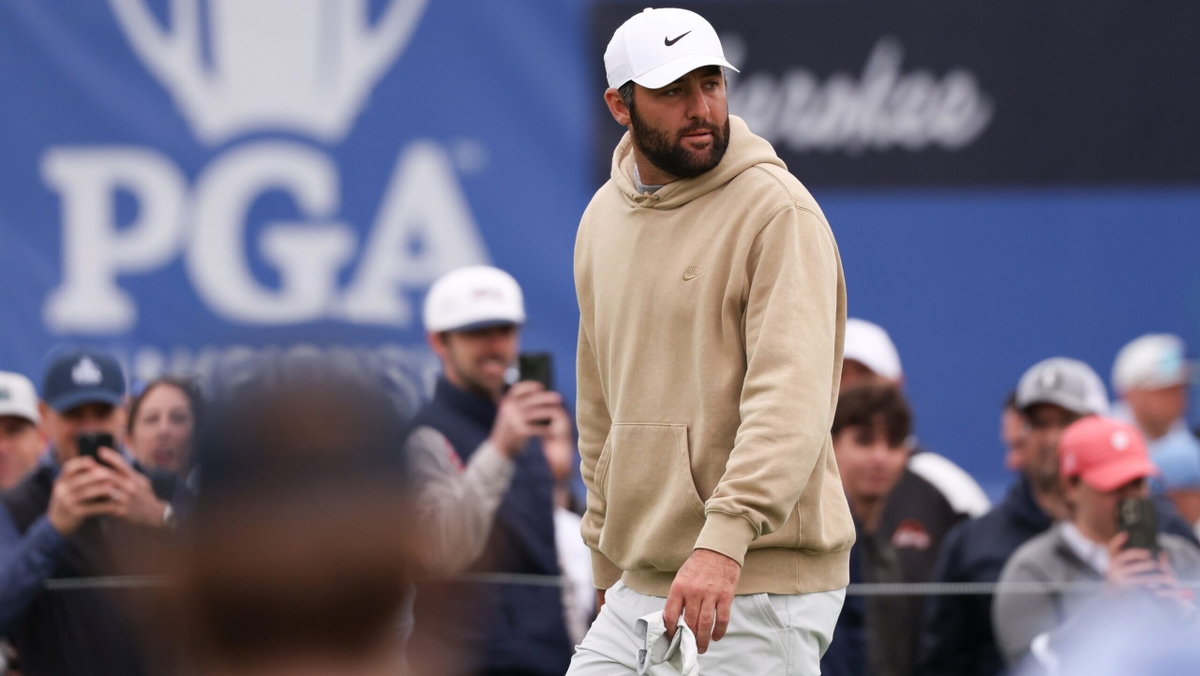
With the U.S. Open at Shinnecock Hills coming back and governing bodies closer to making a call on the final implementation, Scottie Scheffler has a better solution.
“I think when you look at the golf ball rollback, when you start moving it back only eight yards, not only does it disproportionately affect certain players, where you have some guys who it won’t affect at all, and some guys where it will affect 15 to 20 yards,” Scheffler said in a presser yesterday at the Murifield Village. “I think it creates some issues within our game when you start changing the rules.
“On top of that, I think it’s a greater issue in terms of golf course design where power is becoming too rewarded. You look at certain golf courses that we have that are great tests, like a Colonial or a Harbour Town, and they’re not overly long golf courses, but it challenges you in different ways.
“I feel like they’re doing it to make the game of golf a little bit more difficult at the elite level, which I understand, but golf is the easiest game in the world to make hard. Like, if you just make the area small to have a guy to hit the ball into, he’s going to try and learn how to control it. When the corridors are big and greens are big and there’s not many trees in your way, guys are going to learn how to hit the ball far.”
In October 2025, LPGA legend Annika Sorrenstam also raised the same solution. And it’s understandable.
If the ball being hit long is the issue, the course can be manipulated in various ways to increase the difficulty levels. Instead, the new rule will change the outcome and impact only a handful of players.
It all started in March 2023, when the USGA and R&A proposed a Model Local Rule. By December, they had approved a universal rollback, with elite competitions set to begin using it in 2028 and recreational golfers in 2030. However, by January 2026, feedback had led the governing bodies to consider one rollout date for everyone: January 1, 2030. No final decision has been made yet.
The USGA and R&A have their reasons for pushing these changes.
They want to increase the test driver’s clubhead speed from 120 mph to 125 mph, while keeping the Overall Distance Standard at 317 yards. The governing bodies have not changed their stance, and R&A CEO Mark Darbon has said that the distance trend cannot be ignored and that a final decision is expected soon.

Imago
Mandatory Credit: Raymond Carlin III-Imagn Images
Many modern courses feature wide fairways, fewer trees, and less punishment for missed drives. The game has changed because of this.
Scheffler, meanwhile, learned to play golf on a narrow course in Dallas, where firm fairways and dense trees forced him to shape shots both ways. Some courses, such as Colonial and Harbour Town, still demand that skill today, but most newer courses do not.
The speed training arms race inside Tour locker rooms, he argues, is a direct consequence of how courses are now designed, not a problem the golf ball created.
Justin Thomas, who sits on the Player Advisory Council, has made his position clear. He told Golfweek in May that the rollback is a solution to a problem that does not exist. His main concern is the risk of a split, where the Masters, U.S. Open, and The Open Championship use one ball, while the PGA Championship and regular Tour events use another.
“I feel a majority of guys out here are under the same opinion I am, that there isn’t a problem with the golf ball. I don’t know why we’d let a group of amateur golfers decide how we play the game.”
The divide between institutions is already clear.
Maverick McNealy, a Tour policy board director, has called the governing bodies’ approach half-baked. He argues they are protecting their own tournaments and leaving Tour players to deal with the consequences. Brian Harman summed it up directly.
“If there was a solution out there where you could snap your fingers, and every single person lost 20 yards, well, everyone would be in favor of it. But that’s not the solution that’s been provided,” he said.
The data support these concerns, and that is very visible in Cameron Young’s play. Young played this year’s PGA Championship with a Titleist Pro V1x Double Dot, which already meets the proposed rollback standards, yet he still holds the longest recorded drive in ShotLink history. There is no answer to this controversy.
Scottie Scheffler and the golf ball rollback: A debate three years in the making
The rollback process began in March 2023, when the USGA and R&A introduced a Model Local Rule aimed at elite competitions. The PGA Tour and PGA of America responded with formal opposition after the governing bodies finalized approval in December 2023. The initial plan set 2028 as the target for elite professionals and 2030 for recreational golfers.
“We remain concerned that the golf ball rollback overly impacts golfers and does not fully reflect the input of those closest to the game. There have been requests to align on what data is used and how it is used to conclude prior to any equipment changes being made. Many important stakeholders do not see distance as a problem the way the governing bodies do,” a statement released by the PGA Tour read.
By January of this year, the structure was under review, and there were concerns about the practicality of enforcing two standards at once. As such, a single rollout date in 2030 was considered. The effectiveness of the rollback, however, also began to be questioned.
Scheffler does not oppose the rollback itself. He supports the principle, but his argument is specific: the distance issue may have more to do with changes in course architecture over the last 20 years than with the ball itself. Adjusting the ball for an eight-yard reduction without addressing course design may leave the problem unresolved.