
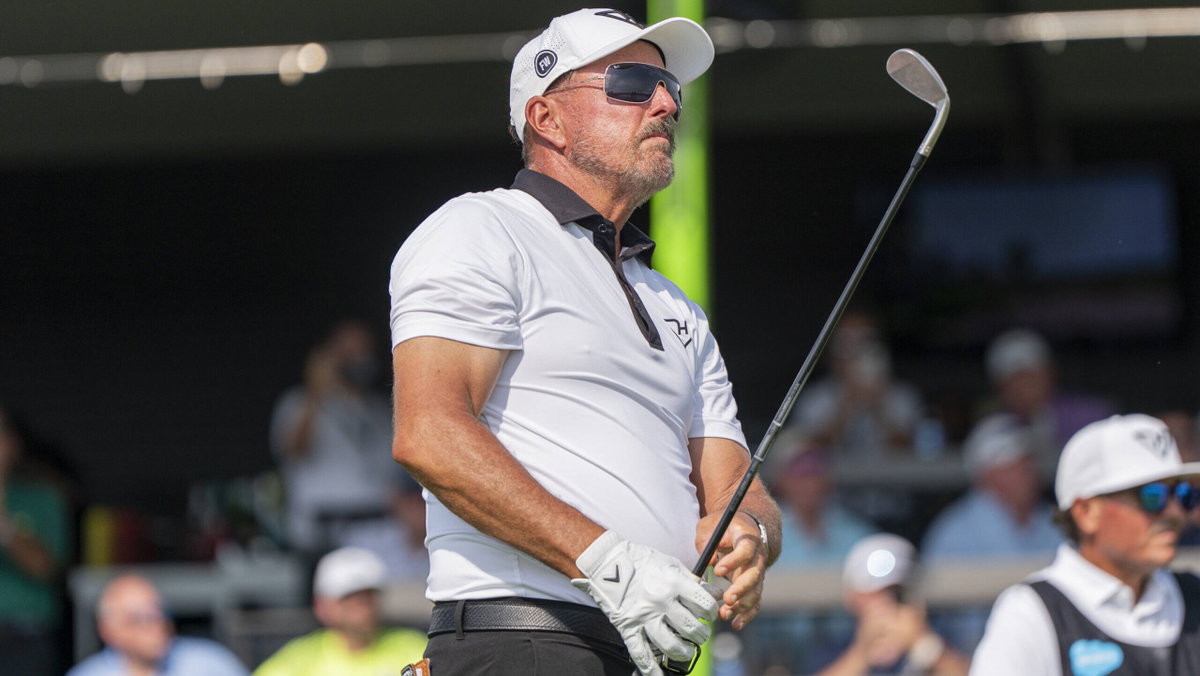
Five years after winning a major at 50, Phil Mickelson now faces a golf world with no place for him.
Watch What’s Trending Now!
Mickelson is no longer sure whether his 56-year-old body can still compete. According to a grim verdict delivered on the Fore Play podcast, the real issue is the sheer scale of the fallout he triggered during the bitter LIV Golf–PGA Tour civil war.
“Combined with the bridges that were burned with the LIV versus the PGA Tour, all of it, I just am like, man, I really don’t see a redemption path,” host Sam “Riggs” Bozoian said. The verdict reflected the hosts’ assessment that Mickelson’s reputation damage and LIV’s collapse have created structural obstacles to any return.
The exchange between Riggs and co-host Trent Ryan framed Mickelson not simply as an aging athlete facing a competitive decline, but as a fractured icon whose place in golf’s mainstream has become almost impossible to visualize.
The End of the “Lefty” Era
The podcast’s central thesis arrived quickly when Trent asked whether Phil was officially done. Riggs answered without hesitation.
“Yeah, we’ll never see another resurgence from Phil Mickelson ever again.”
By “resurgence,” Riggs didn’t necessarily mean a return to the winner’s circle. He meant Mickelson returning to the overarching cultural role he occupied for decades: golf’s magnetic, thumbs-up-flashing showman. Riggs presented this not as an inside scoop, but as a heavy realization based on the sheer volume of controversy trailing the Hall of Famer.
The Baggage of “The Phil Stuff”
Riggs explained his caution in discussing the granular details of Mickelson’s downfall, noting the hosts hadn’t dived deeply into “the Phil stuff” because “there’s enough of it that’s bad enough” to complicate any potential return.
“Just from what I hear, from what I have read thus far, I don’t know how Phil makes like any kind of comeback, really,” Riggs admitted, earning immediate agreement from Trent.
Although the hosts didn’t specify the details, the golf world knows the context well. Over the last four years, Mickelson’s public image has been battered by explosive revelations, from his infamous “scary motherf—ers” quote regarding his Saudi backers (revealed in Alan Shipnuck’s unauthorized biography) to Billy Walters’ explosive book detailing Mickelson’s staggering gambling debts. These are not standard competitive slumps; they are reputational craters.
A Burned Bridge with No Opposite Shore
The timing of this podcast verdict is crucial. Mickelson’s alienation from the golf establishment carries terminal weight because LIV Golf itself is fading. On November 5, a lawyer for the league told a bankruptcy court that LIV had abandoned plans for a reboot and would instead pursue a “value-maximizing wind-down” after losing its financial backing.
Meanwhile, the PGA Tour has shown zero urgency to rescue former defectors, outright confirming it has no plans to revive the Returning Members Program. Mickelson isn’t just any defector; he was the chief recruiter of the rebellion who publicly accused the PGA Tour of “obnoxious greed.”
Because of this, Riggs accurately identified that Mickelson’s association with LIV created an institutional obstacle that no apology tour can easily fix. Mickelson needs a place to play, but more importantly, he needs a constituency willing to welcome him back. Right now, neither appears to exist.
Fading Into the Shadows
Faced with a golf landscape that no longer has a clear place for him, Riggs raised the starkest possibility: Mickelson might walk away entirely.
“I don’t know if Phil’s enough of a spotlight guy that he’s going to like, really try to make that happen at some point. I have no idea,” Riggs speculated. He envisioned Mickelson disappearing into private life, where the public only hears “whispers that he’s out at this club occasionally playing golf… and that’s it.”
For a player who fed off the energy of the galleries more than anyone in his generation, retreating into silence would be a stunning final chapter. Yet it reflects the grim reality that Mickelson might prefer a quiet exile over the brutal public scrutiny required to attempt a comeback.
A Tale of Two Auras: The Tiger Woods Contrast
To truly understand the tragedy of Phil’s current standing, Riggs naturally pivoted to Tiger Woods. For two decades, Tiger and Phil were golf’s twin pillars—Tiger providing the mythical, cutthroat dominance, and Phil offering the charismatic, aggressive, accessible foil.
Thinking about Mickelson’s fractured legacy made Riggs “more excited about Tiger potentially getting back on the scene.” However, he quickly rejected calling Tiger’s eventual return a “comeback” in a competitive sense.
“I don’t need him to come back and dominate in any way, shape, or form,” Riggs noted. “Just having him around, he’s earned it. Those guys still look up to him so much… he still carries the most aura ever of anybody in golf, and we need him around.”
That contrast is the ultimate gut punch of the podcast’s verdict. Tiger Woods retains his aura; all he has to do is show up on a driving range or ride in a cart as a Ryder Cup vice-captain to be universally celebrated. Mickelson, who once stood shoulder-to-shoulder with Tiger in fans’ hearts, traded his aura for a breakaway league dying in bankruptcy court.
The Final Read
His swing speed or short game will not dictate Phil Mickelson’s future. As the Fore Play hosts concluded, it will be decided by whether a path to redemption even exists for a man who burned the map on his way out.
If Mickelson chooses a quiet life away from the spotlight, the sport loses one of its most entertaining and historically consequential figures. But if he tries to return, he will find that making birdies is the easy part. Repairing a reputation that may be irreparably broken is a hazard not even Phil Mickelson can easily escape.