
Imago
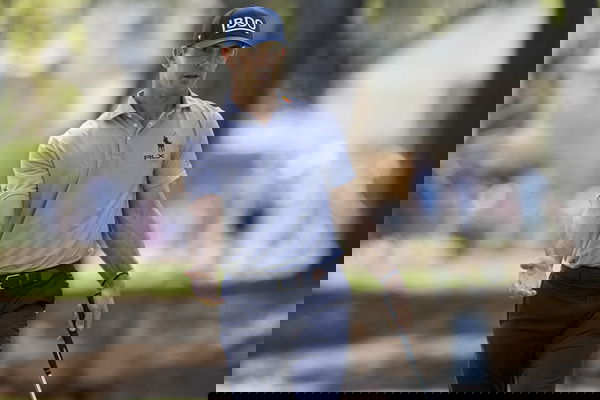
PACIFIC PALISADES, CA – FEBRUARY 16: Tiger Woods looks on during the second round of the Genesis Invitational on February 16, 2024, at Riviera Country Club in Pacific Palisades, CA. Photo by Brian Rothmuller/Icon Sportswire GOLF: FEB 16 PGA, Golf Herren The Genesis Invitational EDITORIAL USE ONLY Icon24021610042
Imago
PACIFIC PALISADES, CA – FEBRUARY 16: Tiger Woods looks on during the second round of the Genesis Invitational on February 16, 2024, at Riviera Country Club in Pacific Palisades, CA. Photo by Brian Rothmuller/Icon Sportswire GOLF: FEB 16 PGA, Golf Herren The Genesis Invitational EDITORIAL USE ONLY Icon24021610042
The theory had been building for weeks. Six TGL players, all nursing injuries, all within the same stretch of the season. Rory McIlroy had already heard enough. Turns out, so had Billy Horschel, and he didn’t even let the question finish!
“Are players getting injured…?” asked the reporter, and the 8X PGA Tour winner had an immediate response.
Watch What’s Trending Now!
“No, they’re not getting injured because of TGL. We’re used to hitting golf balls all the time, and the majority of the time, we’re probably hitting fewer golf balls on a match day than we would on a normal day. To think that players are getting injured because of TGL is, in Rory’s words from last week, preposterous.
Last week, when the Northern Irishman withdrew from Bay Hill due to lower back spasms, the questions surrounded whether playing more than usual with TGL was creating an issue. The #2 declined and cited another reason.
“It’s a little more travel for the guys, a little more. To put it [injuries] solely on that is preposterous. No,” McIlroy said.
The travel side of the argument, however, does have some basis. TGL is scheduled on weeknights to avoid PGA Tour events, but players’ schedules aren’t exempt. The league runs throughout the Florida Swing, so players often switch between tournaments and TGL matches within 24 hours. Tom Kim, for instance, went from PGA National to the SoFi Center for a TGL match the day after his Cognizant Classic final round.
But the swing mechanics argument is harder to justify. However, the data present a different picture. Rory McIlroy averaged 185.3 MPH ball speed in TGL this year, compared to 186.89 MPH on the PGA Tour. His clubhead speed was actually higher in TGL, too: 128.4 MPH versus 124.06 MPH on Tour. If harder swings were the problem, the PGA Tour would be the bigger culprit, not the simulator.
Imago
PGA, Golf Herren RBC Heritage – Second Round Apr 18, 2025 Hilton Head, South Carolina, USA Billy Horschel motions to his ball on seven green during the second round of the RBC Heritage golf tournament. Hilton Head South Carolina USA, EDITORIAL USE ONLY PUBLICATIONxINxGERxSUIxAUTxONLY Copyright: xJimxDedmonx 20250418_jla_db2_071
The injury list, though, is long enough to understand why the theory gained traction. Sahith Theegala missed several events in 2025 with an oblique issue that spread to his neck and back. Justin Thomas was sidelined for nearly six months after back surgery following the Ryder Cup. Xander Schauffele missed two months with a rib cartilage tear. Horschel himself had hip surgery in May 2025. And when Collin Morikawa withdrew from the PLAYERS it created a fuss that TGL might be responsible for all those injuries.
Moreover, Ryan French of Monday Q Info pointed to all of this, suggesting extra travel and harder simulator swings were a factor. Notably, Billy Horschel pushed back on that, too, saying that his injury wasn’t because of TGL. Then he further asked what the excuse would be if a player simply practiced or played a money game on a Monday without any TGL involvement.
The real culprit, according to most experts, is a packed schedule and the physical demands of the modern high-speed swing, not a Tuesday night in a simulator. In the same presser, along with Billy Horschel, Patrick Cantlay was also there, and he just reflected on another aspect, which says TGL is helping them.
Tiger Woods’s TGL is becoming useful for golfers
While the injury debate continues, some players are pointing to the opposite effect. Rather than draining them, TGL is giving players something hard to replicate elsewhere: competitive pressure without the full weight of a Tour event on the line.
Cantlay, who lives 15 minutes from the SoFi Center, keeps it simple. He doesn’t see TGL as remotely comparable to Tour golf, which actually makes it easier to treat it as a low-stakes sharpening tool rather than an added burden on his schedule.
Billy Horschel, on the other hand, takes a more profound approach. He argues that hitting shots with fans watching, cameras rolling, and nerves genuinely activated is more valuable than a Monday money game with buddies. That kind of pressure rep is difficult to manufacture outside of actual competition.
And that’s the part the injury narrative misses entirely. TGL isn’t just an entertainment product. For players between Tour events, it’s a controlled environment to stay sharp, stay competitive, and walk into the next tournament having already felt the pressure once that week.
Related Newsletters