
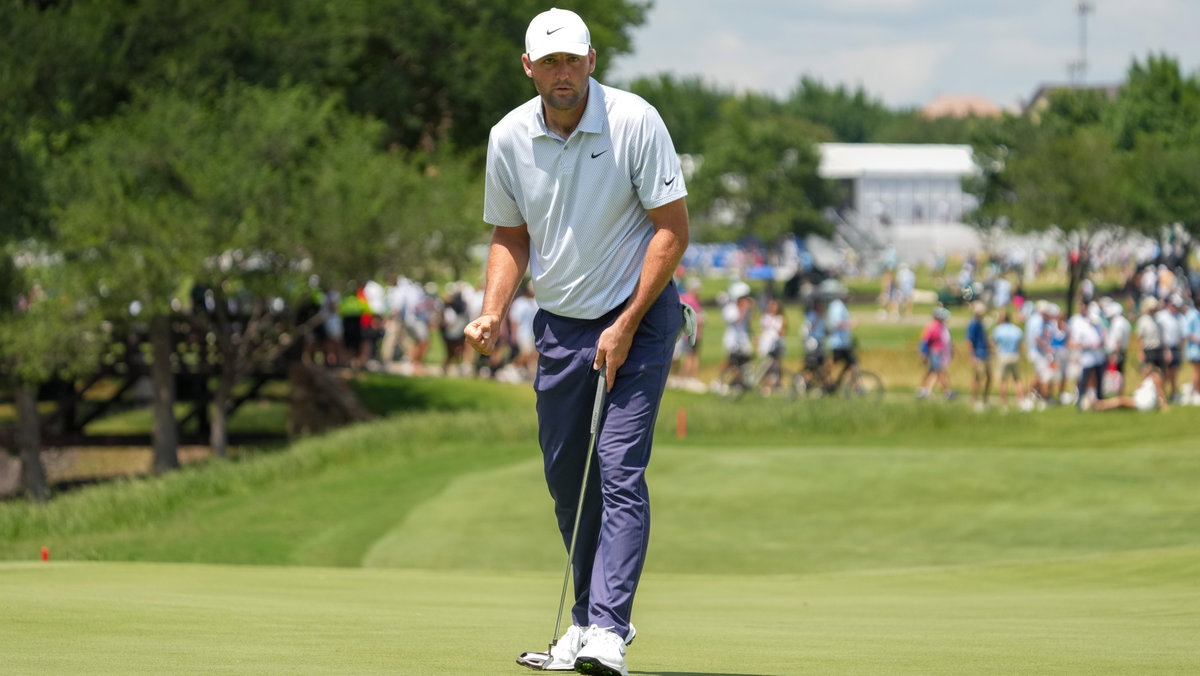
Golfers have to sustain focus, make decisions, and absorb pressure for hours at a time. And they do this for four straight days when they play in any professional tournament. For Scottie Scheffler, that pressure is amplified because being World No. 1 means constant attention and expectations. He recently alluded to Tiger Woods to explain the scheduling dilemma modern-day pros face.
Watch What’s Trending Now!
“I think when you look at this sport, it’s unique in a sense of like the amount of time we spend in front of people throughout a week,” the 20-time PGA Tour winner said at the Travelers Championship 2026. “From the moment I step out onto the driving range—if we’re playing at a four-hour pace—that’s over five hours. Five and a half hours if you include this part of my day [the media interaction], where we’re in front of people. And doing that four days in a row in a mental sport can take a toll on you.
“I think that’s why you see a guy like Tiger can only play so many events because mentally the challenge of just being in front of people for that long [is too much]. And what it takes to compete week in and week out takes a lot out of you mentally. So, for me, playing more than three weeks in a row is extraordinarily difficult. I can’t handle much more than that.”
Many pros have highlighted the issue of the packed PGA Tour schedule. For instance, Rory McIlroy didn’t just call it out; he also decided to reduce his schedule and focus more on majors. Similarly, Jack Nicklaus also stated that he didn’t like the way the PGA Tour was headed with the scheduling.
“See, the problem is not so much from the standpoint of players,” Nicklaus said ahead of the Memorial Tournament. “It’s hard for the players to really be focused to play that much and be on top of their game.”
Scottie Scheffler explains why playing too many events in a row can mentally drain players and referred to Tiger Woods always playing a limited schedule: “I think when you look at this sport it's unique in a sense of like the amount of time we spend in front of people throughout Show more

Since Covid, golf has become increasingly more mainstream. Scottie Scheffler was asked ahead of the Travelers Championship how he feels about the impact it’s had on the game: “Yeah, I think it's great for golf to become more mainstream. I think you see, especially since COVID,
It’s not the first time Scottie Scheffler has highlighted the mental struggles of golf, though. Speaking ahead of the Travelers Championship 2024, he said that the physical aspect of golf is something a professional can train for. However, training for the mental aspect is much more challenging.
“I think I’m mentally fatigued,” he said at the time. “I think with golf, the physical aspect of it is something you can really train for. The mental part is, I would say, more difficult to train for.”
This is an approach Scottie Scheffler is already following. He rarely plays in any event right before the majors. Instead, he takes some time off to practice without any distractions or challenges. Tiger Woods has done the same over the years.
He used to build his year around big events and then use windows to rest and prepare. His average starts per season used to be around 20, even at his peak. The new PGA Tour schedule, announced by CEO Brian Rolapp at the Travelers Championship 2026, can help ease things out.
Maverick McNealy highlighted how splitting the tour into the Championship Series and the Challenger Series offers more flexibility to professionals. Since everyone will know which events they are eligible for, they can better plan their calendars.
Scottie Scheffler even pointed out how the new system allows for a more relaxed offseason, which gives him more time to spend with his family.
This added flexibility aligns with the World No. 1’s broader point that success in professional golf is not just about playing more tournaments. On the contrary, it is about knowing when to step away and recharge.