
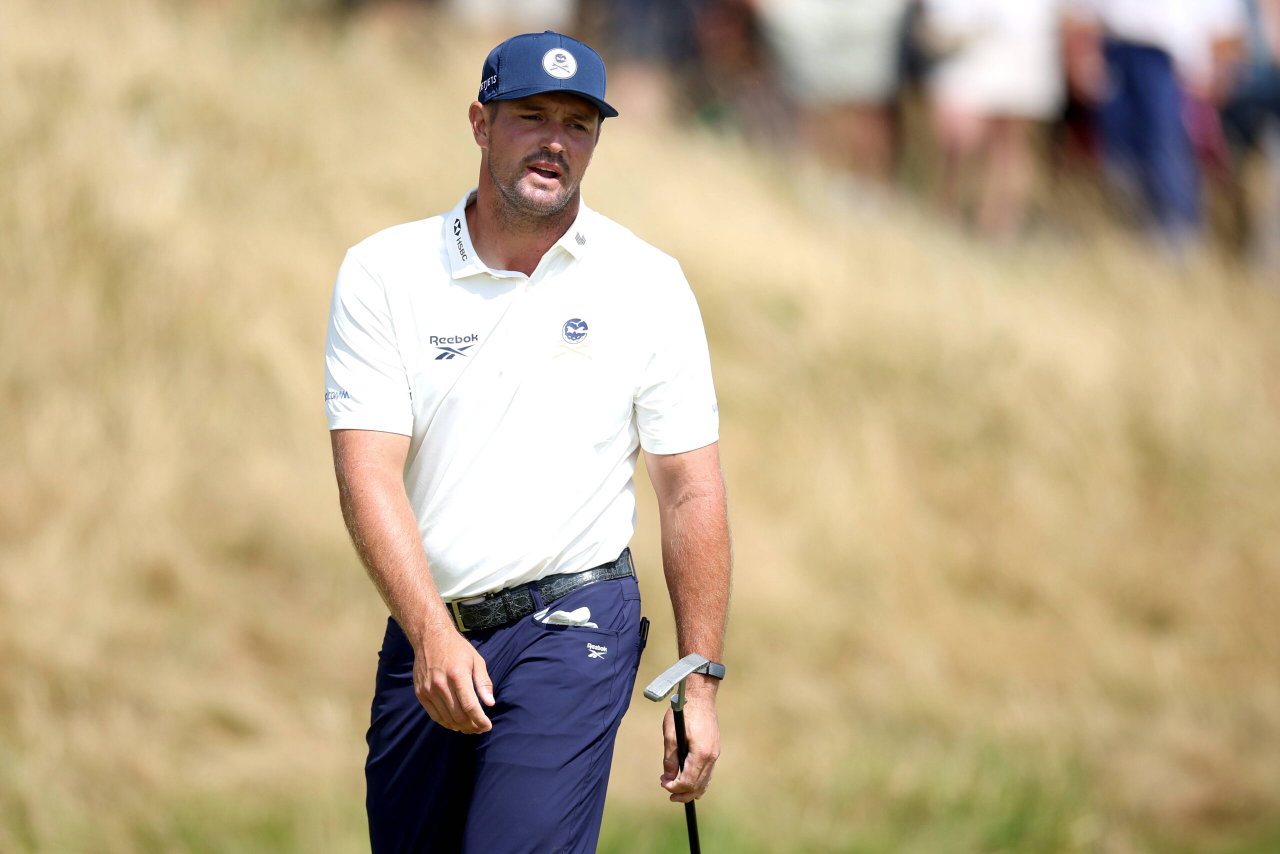
One of the biggest storylines surrounding Bryson DeChambeau was that he could complete a Grand Slam of missing the cut at all majors. He missed the cut at the Masters, the PGA Championship, and then the US Open 2026. He has endured plenty of ups and downs, but his darkest chapter came years earlier than most fans realize. During his rookie PGA Tour season in 2016–2017, he endured a brutal stretch of missed cuts so severe that he nearly walked away from the game.
Watch What’s Trending Now!
“I missed 14 cuts in a row. There were times where I felt like the littlest human being in the world. I didn’t want to play golf ever again. It was… You start losing belief. Your mind starts to cycle in really bad directions,” DeChambeau told Good Good Golf.
The stretch occurred during his first full season after turning pro in 2016. He missed multiple cuts early, including at the CareerBuilder Challenge and Honda Classic, and withdrew from the Genesis Open. He briefly rebounded with three straight made cuts, including a runner-up finish at the Puerto Rico Open, but then endured eight consecutive missed cuts.
Finally, he broke through with his first PGA Tour victory at the John Deere Classic in 2017. Even after that win, he had two more missed cuts before the season ended, including at The Open 2017.
The pressure was immense for Bryson. As a rookie with a US Amateur and NCAA title to his name, expectations were sky-high. Missing cuts amplified the humiliation and drained his confidence. On top of that, Bryson was hemorrhaging money, losing roughly $60,000–$70,000 while still paying caddies, coaches, physios, and travel expenses.
However, he had a support system in the form of his family, friends, and close circle who encouraged him. Bryson DeChambeau even admitted that his sponsors didn’t leave him despite all those missed cuts.
This echoes sentiments he shared in 2022 on Full Spend, where he explained that anyone outside the top 165 on the PGA Tour often loses money. Missed cuts mean zero prize money, but expenses remain constant. That’s why he has long advocated for minimum pay for Tour card holders.
But he did acknowledge that things have changed now, and LIV Golf is to be thanked for that.
Bryson DeChambeau credits LIV Golf for the changing financials on the PGA Tour
Regardless of how much professionals or golf analysts argue about LIV Golf vs. the PGA Tour, there’s no denying that purses on the latter have skyrocketed since LIV Golf’s inception.
“I will specify. It is a little bit different now. Okay. Which, luckily for LIV, we were part of that change where we were able to make the top one… Well, all PGA Tour players at least make $500,000 for the year. Right. Which is awesome. And I had been advocating that from the beginning,” Bryson DeChambeau added.
Signature Events, higher purses, and even equity opportunities have reshaped the Tour.
Greg Norman, Phil Mickelson, Bubba Watson, and many others have said the same thing. Even Rory McIlroy indirectly admitted it, though he called it a “false economy.”
While Bryson DeChambeau believes LIV Golf helped improve the financial landscape for PGA Tour players, his own struggles early in his career explain why he has pushed for those changes for years.