Imago
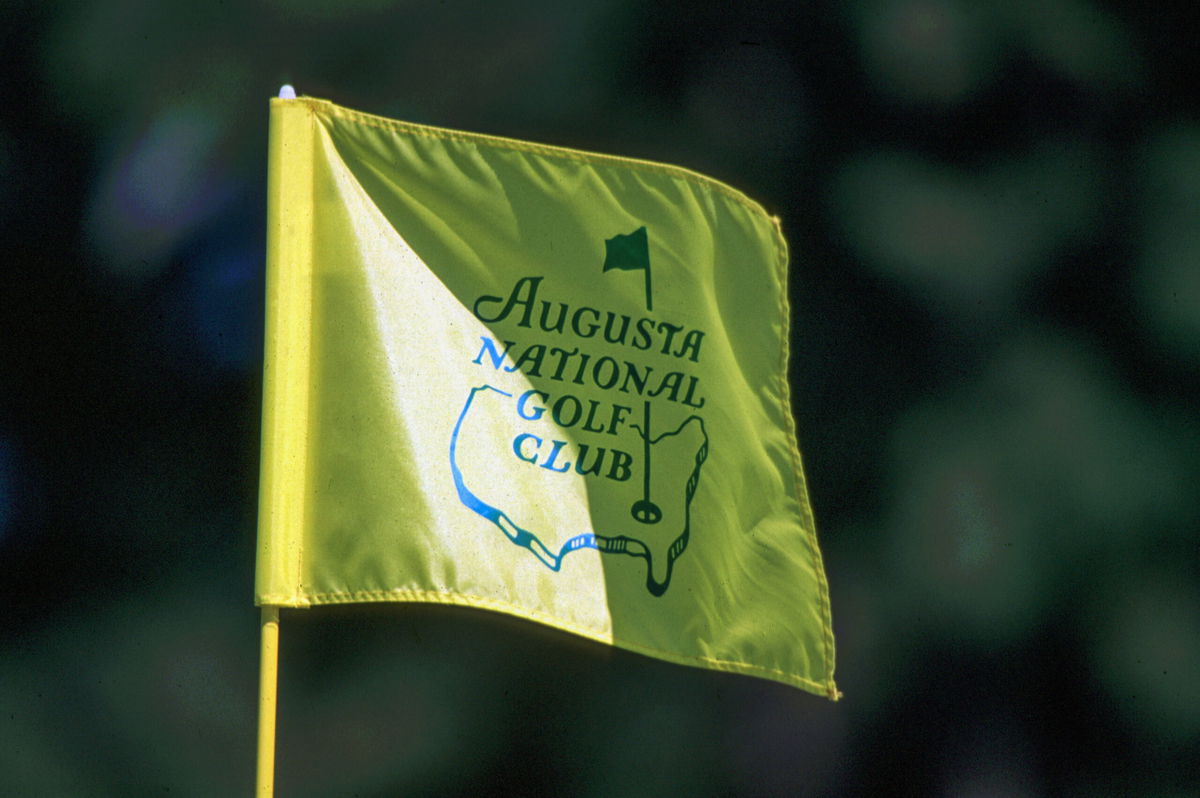
The 1994 Masters Tournament The flag for The Masters during a 1995 practice round at Augusta National Golf Club would have been the traditional yellow Masters flag, featuring the iconic tournament logo an outline of the United States with a golf hole and flagstick marking Augustas location. This flag is a cherished symbol of the tournaments history and prestige. 6th April 1994 Copyright: xMarkxNewcombex
Imago
The 1994 Masters Tournament The flag for The Masters during a 1995 practice round at Augusta National Golf Club would have been the traditional yellow Masters flag, featuring the iconic tournament logo an outline of the United States with a golf hole and flagstick marking Augustas location. This flag is a cherished symbol of the tournaments history and prestige. 6th April 1994 Copyright: xMarkxNewcombex
Before Bobby Jones and Alister MacKenzie built the Augusta National, they inspected the property previously owned by Fruitland Nurseries (owned by the Berckmans family). It hosted a ton of azaleas, dogwoods, magnolias, and peach trees. So was present Fruitland Manor, a place you now know better as the Augusta National Clubhouse. They wisely decided to keep it all, then named each hole after a plant thriving on the land. That’s one story. Here are a few others.
Watch What’s Trending Now!
Amen Corner
Amen Corner packs holes 11, 12, and 13: the 11th is a par-4, the 12th is a par-3, and the 13th is a par-5. They’re christened White Dogwood (No. 11), Golden Bell (No. 12), and Azalea (No. 13), after the blooms hugging their edges. But the “Amen Corner” moniker has nothing to do with the flowers. It sprang from Sports Illustrated reporter Herbert Warren Wind, who coined it after a stormy (not literally) day at the 1958 Masters.
Arnold Palmer won his first Masters title in the 1958 Masters, despite a controversial ruling on Golden Bell. He got to drop a second ball instead of playing his embedded one, netting a two-stroke edge that clinched the win by a single stroke. Wind borrowed “Amen Corner” from the 1933 jazz tune “Shoutin’ in That Amen Corner” by Andy Razaf and Danny Smalls, in a bid to capture that nail-biting drama.
Wind dedicated the two bridges to Ben Hogan and Byron Nelson.
Butler Cabin
Butler Cabin counts as one of Augusta National’s 12 cabins, tucked snug near the clubhouse and par-3 course. Built in 1964, it’s named for Thomas Baldwin Butler, a club member and former chairman of Mercantile Bank and Trust in Maryland. He was also a regular playing partner of President Dwight Eisenhower (who lent his name to another cabin).
The guest list at Butler Cabin is exclusive: just the winner, defending champion, Silver Cup winner, Augusta National chairman Fred Ridley, and CBS lead golf commentator Jim Nantz. Ridley traditionally runs the show before passing the mic to Nantz, who chats with the three players in turn. The defending champ then slips the Green Jacket onto the new winner. The official presentation unfolds on the 18th green, in plain view of the patrons.
There are a few more things to know about it:
- One year post-construction, Butler Cabin served as a television studio for the first time.
- A painting of co-founder Bobby Jones lords over the fireplace.
- The champ enters the cabin through an area overlooking the Par 3 course, down a small corridor, and through a hidden side door.
- Around the holidays, everyone’s invited to gather around the fire.
- For the other 51 weeks, it serves as lodging for members and guests.
Crow’s Nest
The Crow’s Nest on the second floor of the Augusta National Clubhouse is prime real estate in the famed clubhouse, reserved for amateur Masters contenders. It perches in the roughly 30-by-40-foot room topped by the clubhouse’s 11-foot-square cupola, which is where the name comes from. It’s located above the library and the champions’ locker room.
Lifelong amateur Bobby Jones insisted the Masters always tip its cap to amateur golf, so the Crow’s Nest delivers a perch like no other for top amateurs. This season, 6 amateurs will get to stay here, including Mason Howell.
The Crow’s Nest squeezes into one room, divvied up by partitions into three single-bed cubicles and one with a double bunk. It boasts a full bathroom plus an extra sink. The sitting area has a game table, sofa, chairs, phone, TV, and walls decked with golf books, photos, and artwork of past Masters and classic golf scenes.
Imagine waking up and drinking a cup of coffee at Augusta National. Nothing can beat that feeling.
Rae’s Creek
This one is pretty controversial.
Rae’s Creek honors Irish landowner John Rae, who left Ireland in the 1730s and settled in Augusta in 1734, exactly 200 years ahead of the inaugural Masters. Hitting American soil, he swiftly rose as Augusta’s top power player, buying thousands of acres, firing up multiple ventures, and erecting a trading post, grist mill, and ferry right where the Savannah River meets what folks then dubbed “Kenyon’s Creek.”
By 1763, “Rae’s Creek” popped up on maps. Rae was a deeply divisive character. He was a slave owner convicted of murder (later pardoned), yet his impact was so seismic that, a quarter-millennium on, his moniker endures.
We did warn it was controversial. But there are also interesting facts.
Rae’s Creek springs from underground rock northwest of Augusta in neighboring Columbia County, then snakes under Berckmans Road through a forest before spilling onto Augusta National turf. In 1836, a geologic survey noted that there was gold in Rae’s Creek. And as workers started constructing the course in 1931, they found gold. According to reports, several tribes settled here some 3,000 to 10,000 years ago due to its proximity to the Savannah River.
Berckman Place
Indeed, the luxurious dining area is named after the original owners of the Fruitland Nurseries, the land now known as the ANGC.
The Berckmans family hightailed it from Augusta after owner Louis Mathieu Berckmans’s son, Prosper, passed in 1910. A failed attempt by a Florida developer to transform it into a hotel left the place abandoned until 1931, nearly two years after the Wall Street Crash. Bobby Jones called the Manor “charming” on his first look, despite its disrepair, with cracks snaking through the 18-inch concrete walls from an 1886 earthquake. It proved the ideal spot to spawn the Masters’ host venue.
But Berckmans Place was established in 2013, reportedly slinging about 400 badges at $4,000 apiece, though prices have climbed like ivy since, varying by when a company or individual snapped one up.
View this post on Instagram
A Berckmans badge covers food, beverages (booze included), and gratuity; no extra tipping is allowed, though the venue’s patron pamphlet notes that “kind words of appreciation are always welcome.” This 90,000-square-foot spot, tucked just off the fifth hole, boasts five high-end dining options. It swings open at 7 a.m. and shuts at 7 p.m., or 30 minutes after the final putt drops.
Plenty of such stories abound at Augusta.
Written by

Edited by

Riya Singhal