
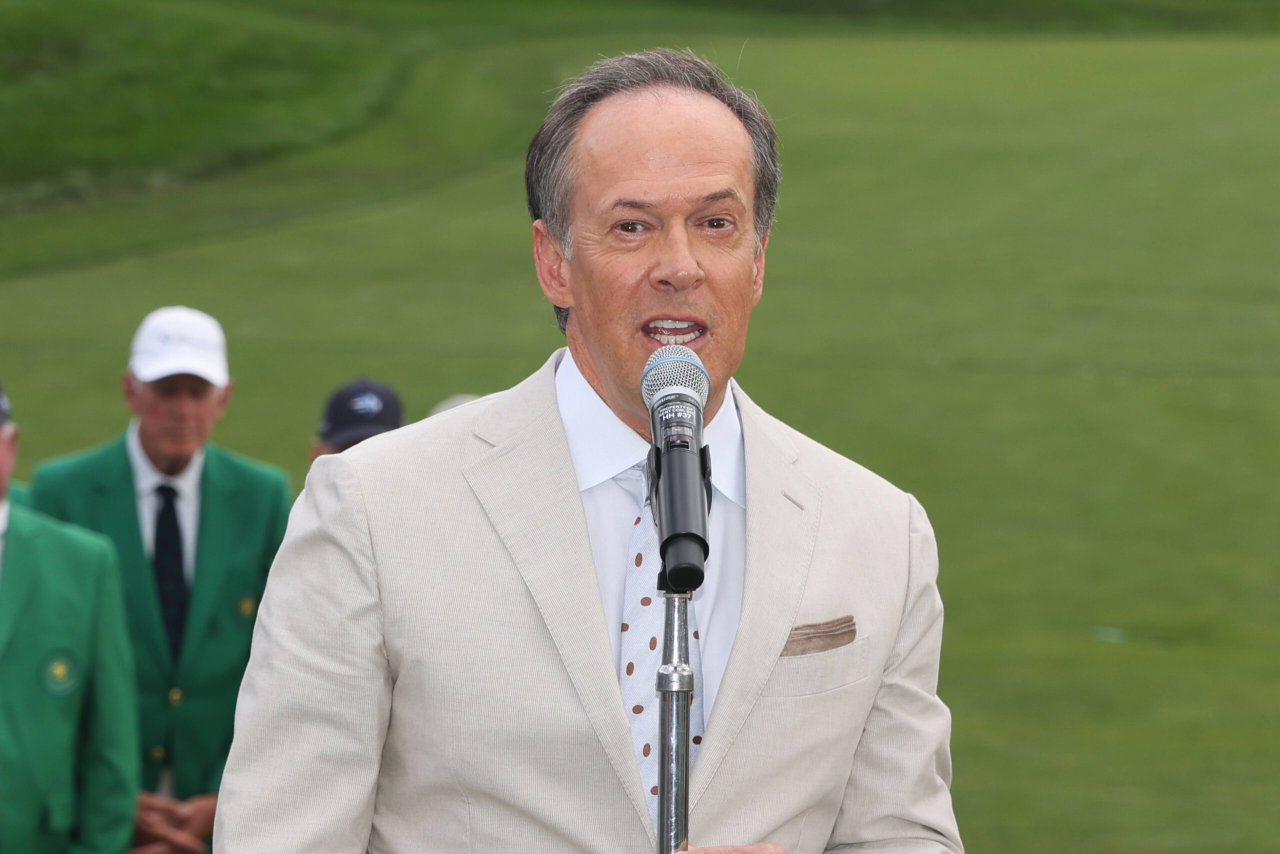
The best broadcasters know when to speak and when to let a moment do the talking. In 2008, Tiger Woods made a clutch putt on the 18th hole at Torrey Pines to force a playoff at the U.S. Open. As the crowd erupted, Dan Hicks asked a three-word question: “Expect anything different?” It was short, perfectly timed, and captured everything about Tiger’s incredible moment. That was the magic of Hicks. He didn’t need a long speech to make a moment unforgettable. Now the golf world is learning how his story ended.
Watch What’s Trending Now!
On November 12, his wife, ESPN broadcaster Hannah Storm, posted on X: “Our family is heartbroken by the sudden and unexpected passing of Dan following an acute illness.”
Six days after his death, more details began to emerge. A death certificate obtained by the California Post revealed that Dan Hicks died from multifocal pneumonia. It also listed pulmonary edema, which occurs when fluid builds up in the lungs, following an upper respiratory infection. The certificate also mentioned autoimmune hemolytic anemia, a rare condition in which the body’s immune system mistakenly destroys its own red blood cells, as explained by the Cleveland Clinic.
Dan Hicks was pronounced dead at 5:32 p.m. on November 11 at a hospital in Greenwich, Connecticut. The certificate deems the death natural. The reports do not explain how the conditions were connected.
He had been scheduled to call Notre Dame’s November 14 game against Boston College but died three days before kickoff.
Colleagues keep returning to the same trait: Hicks made the people around him better. His partnership with Johnny Miller lasted nearly two decades, and he later worked with Paul Azinger and Kevin Kisner in the booth.
Azinger said he was devastated and described Hicks as the most impactful man in every aspect of his life: “He never got cheated one day out of being happy.” Roger Maltbie, who joined NBC the fall before Dan Hicks, called him a great quarterback and point guard. Then he put the loss in simpler terms: “This is losing a pal.”
That is a different kind of tribute than viewers usually give an announcer. They rarely praise the voice. They praise the company.
The Arizona native began in local stations in 1984, worked at CNN in 1989, where he met Storm, and joined NBC in 1992. The couple were married for more than 30 years and share three daughters. He spent his early golf years as a tower announcer. At the 1999 U.S. Open, he was the reporter on the 72nd green when Payne Stewart holed his winning putts. NBC made him lead play-by-play voice in 2000, and he held that job for 26 years.
His most famous call began as a pass. Maltbie, working on the ground at Torrey Pines, said Hicks asked what the 18th was like, and Maltbie told him everyone expected Tiger to make it. That exchange led to the call.
Golf was only part of it. Hicks called Olympic swimming with Rowdy Gaines at eight Games, including Michael Phelps’ eight gold medals in Beijing and Katie Ledecky’s 14 medals across four Olympics. In Beijing, he also narrated Jason Lezak’s gold medal-winning anchor leg for the U.S. men’s 4×100 freestyle relay. He returned as lead voice of Notre Dame football in 2024.
Jason Benetti filled in for Hicks at the Notre Dame game and addressed the loss live on air. “I wish Dan was here right now, and I know everybody does,” he said. Tiger Woods wrote on X that Hicks’ kindness and warmth would be deeply missed, and NBC said he welcomed teammates with a smile, a joke or a word of encouragement. The PGA Tour said his voice filled living rooms for more than 25 years.
A cause of death answers one question. It cannot answer the quieter one that golf fans now carry: what a Sunday back nine sounds like without him.
The next time a putt drops to force a playoff, someone else will have to find the words. Dan Hicks always did.