
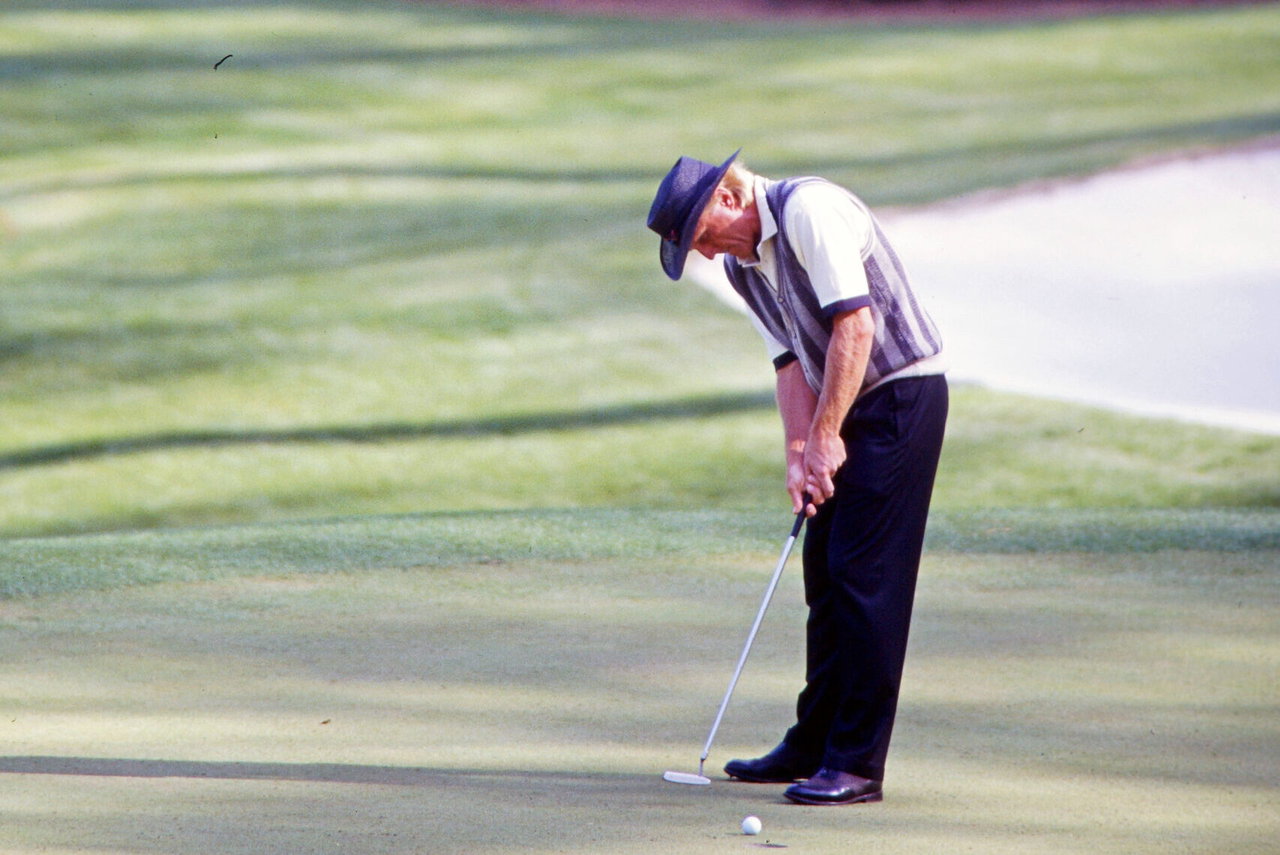
The ball stopped one inch from the hole. Greg Norman had just chipped from the edge of the 15th green. An eagle would have changed everything. Instead, the ball slid past. He dropped to his knees. Then he toppled onto his back, as if he had been shot.
Watch What’s Trending Now!
This was Masters Sunday, 1996. Millions watched from home. Many sensed the dream had already slipped away. And that image never left golf. The golf world was quick to decide what it meant. Tom McEwen of the Tampa Tribune put it plainly:
“…the 1996 Masters will be recalled simply as the one Greg Norman blew.”
Norman’s view of that day is different. For him, the story begins long before the 15th green.
A Dream Close to Heart
Growing up in Australia, he watched Jack Nicklaus play the Masters on television. He regarded Nicklaus as the ultimate golfer and Augusta as the ultimate course. Reasonably, when he made his Masters debut in 1981, he began dreaming of achieving what his idol had. He even imagined hosting the Champions Dinner one day.
But winning at Augusta proved difficult. In 1986, Norman led by a stroke going into the final round, only for Nicklaus to close with a 65 and beat him by one. A year later, Larry Mize holed a long chip in a playoff to take the title from him. Sports Illustrated counted seven times Norman had led a major entering Sunday. He won only one.
By 1996, at 41, Norman was the world’s top-ranked player, with two Open Championships to his name. Yet the Masters remained elusive, and a harsh label had begun to follow him: a great player, but one who couldn’t close.
A six-shot lead going into the final round seemed like the perfect opportunity to put that label to rest. It was the biggest 54-hole lead in Masters history, and everyone expected a coronation. The week had gone largely to plan. Only his back hurt, which was taken care of by Thursday. With that concern behind him, there seemed to be nothing standing in his way. At least, that was what everyone hoped.
The Tough Win
By Saturday night, the finish line seemed closer than ever. Norman stayed in the locker room long after everyone else had left. The attendant had switched off the lights and gone home. Unable to work out how to turn them back on, Norman sat there in the dark. He felt drained but happy.
But Sunday morning brought a different feeling. Norman woke up feeling out of sync. His feet, hips, and shoulders felt out of line. A walk around the neighborhood did little to help. At the range, he told coach Butch Harmon that the club felt stuck and his lower body was not turning through the ball. Harmon saw nothing alarming.
Norman later admitted he should have said more. Speaking to Golf Digest, he said, “I should have turned to them both and just purged.”
He knew something felt wrong but did not tell his coach and caddie how much it was affecting him. Meanwhile, friends were flying in for what everyone expected to be a victory party. He has since acknowledged that he was not fully prepared for the weight of the moment.
“I wasn’t worried about Faldo. I was worried about me.”
Faldo, by contrast, was calm. He had arrived late after watching auto racing. But he had a plan: cut the lead to three by the turn. He later said he could sense Norman’s nerves. So he simply focused on playing a little better with every shot.
On the fourth, Norman hit an iron about 15 feet off line. For him, that was a huge miss. He wrote that he knew then it would be a long day. By the turn, Faldo had cut the lead to two.
Then the back nine began to unravel. At the 9th, Norman’s wedge rolled 30 yards back down the slope. At the 10th, a poor chip left him with a short par putt, which he missed. Then, at the 11th, he missed another three-footer. He later called the 11th the turning point. Faldo’s coach, David Leadbetter, noticed that Norman was taking a few seconds longer over every shot.
Then came the 12th. It is a small par three over water, where the wind swirls. Friday saw Norman’s ball resting on the bank. On Saturday, it went into the water, and he managed to save bogey. By Sunday, it found the creek again. This time, it was a double bogey. For the first time all week, Norman was trailing.
Even then, Norman tried to fight back. He birdied the 13th and 15th, only for Faldo to match him on both holes. His caddie, Tony Navarro, had even talked him out of going for the 13th green in two. Norman had hit only five greens all day. At the 16th, he hooked another tee shot into the water. Faldo led by four. It was over.
Norman shot 78. Faldo shot 67. That was an eleven-shot swing in a single day. No major leader had ever surrendered a bigger final-round lead.
Faldo made a final birdie before walking over to Norman. He held him in a long, firm embrace. As reported by Sports Illustrated, he said:
“I don’t know what to say. I just want to give you a hug.”
Faldo later explained that the hug was not planned. He could picture himself in Norman’s shoes. “I would be scarred for life.”
Norman was deeply moved by the gesture. Asked about it later, he said, “He’s gone way up in my estimation.”
Then came the press conference. Norman faced the questions with a smile. He did not blame his back or the pressure of the victory party. “I’ll wake up tomorrow, still breathing, I hope.”
How Norman Carries It
Then the letters began arriving. By his next start, more than 7,500 handwritten letters had reached him. Fans praised the way he had handled defeat. He had lost the tournament, but the response from people around the world gave him something he had never expected. He has often spoken about how the support changed his outlook.
“so 96 changed my life… It made me far as to say, appreciate people in a different way because of the support they gave me.”
He received thousands of encouraging letters, and they have continued to arrive over the years.
Faldo has said the two have not spoken about that moment since. Norman never won a green jacket. But by 1999, David Duval, Ernie Els, and Nick Price had all said they wanted him to.
In golf’s memory, nobody forgets Norman on his knees at the 15th. But he chose not to carry that day as a wound. His 78 made him infamous, but the way he handled the defeat also made him beloved.