
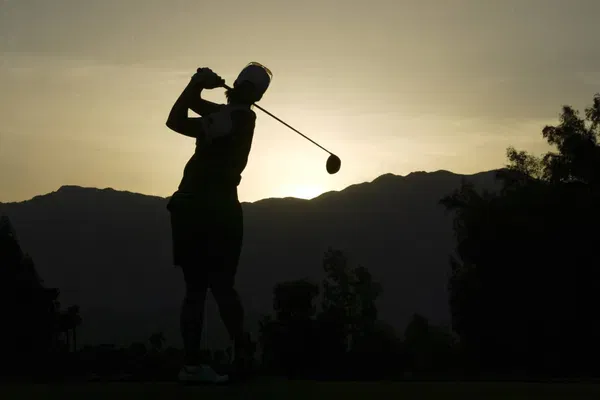
Most players spend their whole careers trying to win a major championship. Maja Stark did it at 25, but that’s when her problems began. After winning the 2025 U.S. Women’s Open at Erin Hills, she took home $2.4 million, a trophy, and a question she couldn’t answer: what comes next? She missed the cut in seven of her next nine tournaments, and at the 2026 Chevron Championship press conference on Thursday, Stark finally explained what happened.
Watch What’s Trending Now!
“I had a lot of anxiety after the U.S. Open and, you know, switching caddies, too, after the summer and then it just felt like I didn’t know what I was doing anymore. So I didn’t feel comfortable at all on the course.”
The anxiety had a clear cause. After Erin Hills, fans and followers quickly questioned what had gone wrong and why a major champion was suddenly struggling. Stark took in all the criticism.
“You get comments and stuff saying, what’s happened? You just won a major? Why do you suck all of a sudden? That does take some energy and it just makes you focus on the wrong things. Then I got even more stressed and anxious.”
Stark led from start to finish at Erin Hills, making a key birdie on the 11th to build a three-shot lead over world No. 1 Nelly Korda. She closed with two bogeys but still finished at 7-under 281. This win came after missing three cuts in her previous eight events. Whatever she fixed that week did not last once the attention moved from the tournament to her. The public expected her to celebrate, but she did not, and that created more pressure.

Imago
LPGA, Golf Damen 2025: ShopRite LPGA Classic Presented By Acer JUN 06 June 06, 2025: Maja Stark of Sweden watches her tee shot on the 11th hole during the ShopRite LPGA Classic Presented by Acer in Galloway, NJ. Mike Langish/CSM Credit Image: Ã Mike Langish/Cal Media Credit Image: Ã Mike Langish/Cal Sport Media Credit Image: Mike Langish/Cal Sport Media Galloway New Jersey United States of America EDITORIAL USE ONLY Copyright: xx ZUMA-20250606_zma_c04_015.jpg MikexLangishx csmphotothree390219
She did not spiral quietly. Stark assembled a support team and went to work: a mental coach, a sports psychologist, and a therapist. They all helped her, and she is really grateful for them. An earlier profile of Stark’s support network pointed out that caddie Hadley Trenfield had been a key part of her team since 2022.
Their partnership was built on trust and a connection that went far beyond just reading yardage books. Losing that anchor during her slump was a big deal. She eventually went back to a familiar caddie, and with him, she found the stability she had been looking for since June.
During Thursday’s press conference, someone asked if her cats had helped her during the difficult period, and she affirmed. She might also get a third cat after her next major win.
Stark’s experience is not unique. Many athletes find that achieving their biggest goal can bring unexpected challenges.
Maja Stark’s mental health struggle echoes a pattern bigger than golf
Michael Phelps, the most decorated Olympian with 23 gold medals, has stated that post-Olympic depression is a recurring issue, affecting over 80% of Olympians after each Games. After Athens, Phelps faced the same question Stark confronted after Wisconsin: what comes next?
Rory McIlroy dealt with a similar challenge for years. When he completed his career Grand Slam at the 2025 Masters, he acknowledged carrying that pressure since 2014. Upon his win, Phelps contacted him, recognizing the reality of that struggle and the possibility of moving forward.
Stark entered Memorial Park this week prepared. The 2026 Chevron Championship features a $9 million purse and a new venue, removing any historical pressure. She described the course as challenging, with difficult pins and demanding shots, fitting for a major. She started with a bogey on the first hole and continued without delay.
“Now it’s just like, well, I made bogey on my opening hole so many times before, and it doesn’t have to dictate the whole round.”
In three weeks, the U.S. Women’s Open returns, with Stark set to compete as the defending champion. The focus now is on maintaining consistency.