Imago
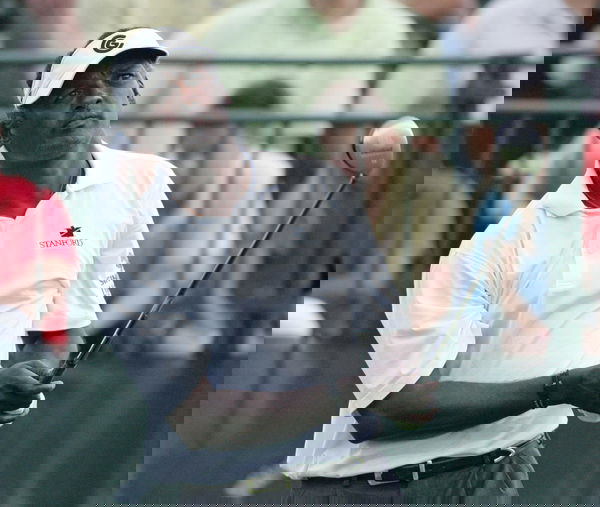
2008 World Golf Championships – CA Championship, Vijay Singh from Fiji tees off on the 10th hole during the final round of the World Golf Championships – CA Championship at Doral Resort and Spa in Doral, Florida on March 23, 2008
Imago
2008 World Golf Championships – CA Championship, Vijay Singh from Fiji tees off on the 10th hole during the final round of the World Golf Championships – CA Championship at Doral Resort and Spa in Doral, Florida on March 23, 2008
Much ink has been spilled ever since former Masters champ Vijay Singh announced his return to the PGA Tour at the Sony Open. Of course, ethical questions persist about him taking spots from younger pros (meaning, the first alternate). Yet the strongest counter is that Singh has “earned” his right to return. But how exactly?
Watch What’s Trending Now!
In simplest terms, it’s the all-time career money list exemption. Those in the top 25 and top 50 get one chance to play in any PGA Tour season. Singh ranks sixth all-time, having earned $71.2 million. In his tenure on the Tour, he won 34 titles and two major championships. Under PGA Tour bylaws, he qualifies for a one-time exemption in the top-25 category.
Now, no one knows how many events Singh will play this season. It could be just the Sony Open, or it could be 20. Singh has yet to comment. It is rare for older guys to use this exemption, but there have been cases. Like David Duval, who used his top-25 money-list exemption in 2007 and then his top-50 money-list exemption in 2009 when he fell out of the former list.
Meanwhile, Singh lacks full playing privileges, meaning the signature events are off-limits. Yet, a PGA Tour rep indicated he should qualify for the majority of full-field events in 2026. This holds despite his absence from PGA Tour play since 2021, his lack of wins on the PGA Tour Champions since 2022, and his recent injuries.
The Sony Open field for next week.
Thoughts on this? pic.twitter.com/MzWqpyXX3a
— Fore Play (@ForePlayPod) January 9, 2026
Singh might not win, but we may see him during weekends at some events. Yet, his return has divided the golf world. For the most part, the fans have shown excitement. Yet, the criticism has been just as forthcoming. Skratch‘s Dan Rappaport called the exemption an “outdated concept” and said, “I cannot imagine this continuing.” And Fried Egg Golf‘s Andy Johnson said, “62-year-old Vijay Singh takes his career money exemption, an exemption that shouldn’t exist.” Brendan Porath called Singh “hypocritical.”


They aren’t wrong, but Singh is not at fault for this exemption existing. While the major winner used his, another golfer refused to do so.
Matt Kuchar says no to the PGA Tour’s one-time exemption. For now
Matt Kuchar, 47, ended up No. 118 in FedExCup standings. This is the first time he has lost his card in his career. But that’s thanks to the PGA Tour cutting down the number of full cards allowed per season, meaning going 100 (down from 125). Yet, despite bigger prize pots available on the Tour in the last few years, Kuchar has held firm in career earnings in the top 25.
At No. 13 with $61,538,738, he’s got over $18 million on Tommy Fleetwood (No. 26). Like Vijay Singh, he could have also used the exemption. Instead, Kuchar decided to wait it out.
“This is a different PGA Tour from when I first joined in 2002. I don’t know if using an exemption will get me any different starts. It’s a tricky one,” he said back at last season’s RSM Classic.
Kuchar skipped the money-list exemption, betting on conditional status instead. He figured full status would net just three or four starts anyway, and no signature events were included. As a past Sony Open champ in Hawaii, he’s teed up for this week’s opener. Still, considering his career earnings, Kuchar can make use of the exemptions when he turns 50. So, expect a similar conversation like Singh’s to unfold in the next two years.
Related Newsletters