Imago
Credit: IMAGO
Imago
Credit: IMAGO
Imago
Credit: IMAGO
Imago
Credit: IMAGO
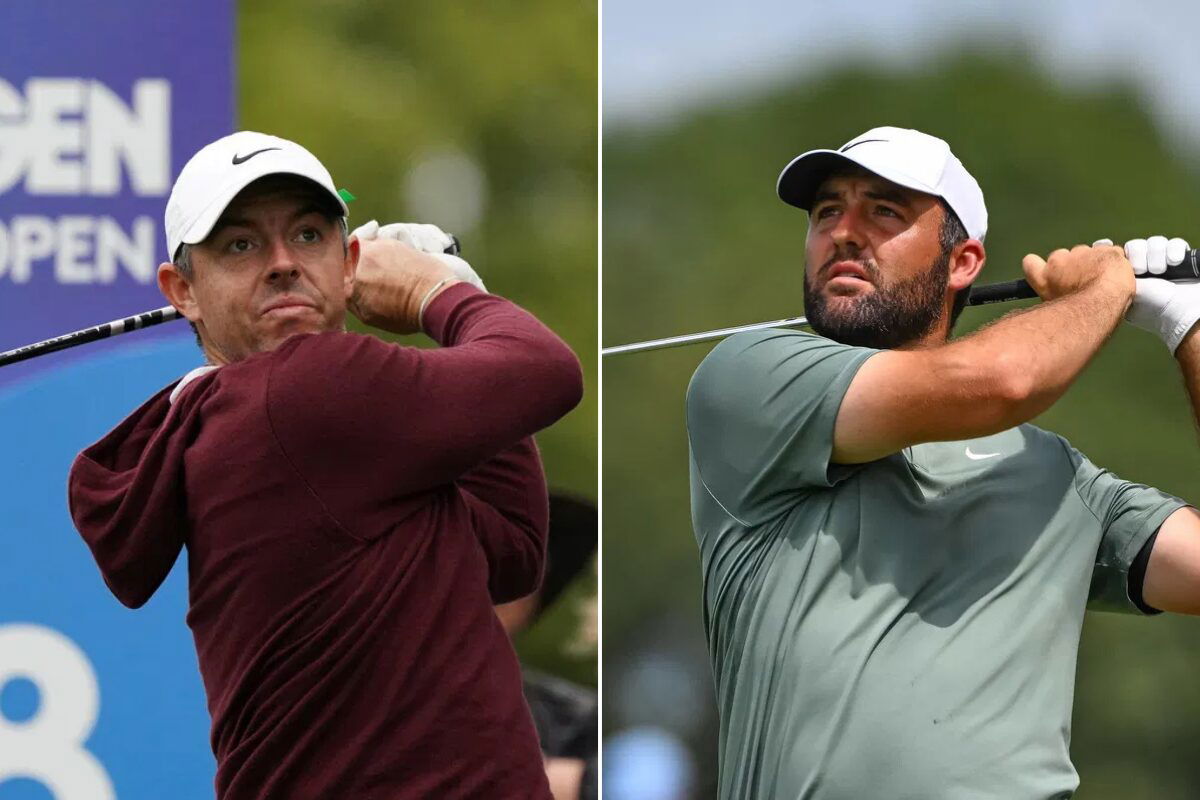
Rory McIlroy relaxes his shoulder. Scottie Scheffler rolls his forearms. Jordan Spieth shortens his swing. Same shot shape. Three different answers to three different problems. The draw, that coveted right-to-left curve, has haunted amateurs for decades. Most golfers freeze at the thought of it, trapped in an over-the-top motion that sends the ball slicing into oblivion. Yet three major champions have cracked the code, each engineering the same outcome through radically different methods. The secret? There is no single “correct” draw. Only the one that solves your specific flaw.
Watch What’s Trending Now!
Rory McIlroy’s power draw: the tee box solution
For pure distance with shape, McIlroy’s method stands alone. The five-time Major winner, regarded as one of the best drivers the game has ever produced, builds his towering draw on a deceptively simple foundation: aim right, move the ball slightly back, and let gravity do the work.
The key move happens at the top of the backswing. McIlroy relaxes his trailing shoulder, allowing the club to drop below the plane naturally. This “Sleepy Shoulder” move creates an inside-out path without conscious hand manipulation. The ball launches right, then curves back toward the target with penetrating flight and maximum roll.
A recent instructional breakdown reinforces this principle: a solid draw emerges from rotational swing mechanics rather than lateral sway. McIlroy’s shoulder drop exemplifies that philosophy—the body rotates, the path shapes itself, and the hands stay quiet.
If your draw struggles stem from an out-to-in path, McIlroy’s shoulder relaxation offers the simplest correction. Speed converts to shape with minimal conscious effort.


Jordan Spieth’s controlled iron draw: the fairway solution
Where McIlroy chases distance, Spieth chases precision. The three-time major champion approaches the draw as a scoring weapon, not a power play. His method centers on restraint. Instead of a full swing, Spieth uses a deliberate three-quarter motion—reducing speed to tighten dispersion.
“I’ve got to take a little bit off, so I’m going to do that by using a three-quarter motion,” Spieth explained in a Titleist instruction session. “Then I’m going to try to be just as aggressive with the ball as I would be on a full one.”
The second element: late delofting. Spieth keeps the clubface lean through impact, allowing loft to release at the last moment. Face stability remains intact because the adjustment happens early in the swing, not at contact. His target philosophy seals the approach. Rather than firing at pins, Spieth aims at the fat parts of greens, letting draw spin work the ball back toward the hole.
“If you start training that way, it’s so much easier to play the game, because you’re missing the fat parts of the greens,” he noted.
If your draw over-curves or your contact lacks consistency, Spieth’s shortened motion and face control offer a path to repeatability. Prioritize strike over speed.
Scottie Scheffler’s hand-driven draw: the trouble shot solution
Scheffler’s draw solves a different problem entirely—the need to shape on command. The four-time major winner, who captured five wins in his first eight starts of 2024, including the Masters and the Players Championship, has built his dominance on adaptability. When a dogleg demands a curve or a tree blocks the direct line, Scheffler’s hands take over.
The setup is straightforward: close the stance slightly and move the ball back. From there, the intention shifts to the trail forearm.
“With the ball position here, the ball is going to start way out to the right,” Scheffler explained in a Golf.com instruction feature. “And all I’m trying to do is get that ball to turn over as much as I can.”
Slingin’ it with Scottie Scheffler.
Those tricky tee shots at the 10th and 13th holes at Augusta call for certain shapes and trajectories. Here’s how the reigning champ does it. #Stealth2Fairway pic.twitter.com/RdxQAEjWdV
— TaylorMade Golf (@TaylorMadeGolf) April 5, 2023
The key difference from McIlroy’s body-driven method: Scheffler’s “Forearm Turnover” relies on active rotation of the trail forearm over the lead arm through impact. It’s a hand-driven feel, not a sequencing play — simpler to execute under pressure, easier to repeat when the margin for error shrinks.
If your face control wavers at impact, Scheffler’s forearm turnover provides a direct, feel-based solution. The hands create the shape; the body follows.
Three methods. Three contexts. Path problem? Relax your shoulder like McIlroy. Face control problem? Roll the forearms like Scheffler. Contact and dispersion problem? Shorten the swing like Spieth.
Three Major champions. Three different moves. One shot shape. The “correct” draw has always been the one that fixes your flaw — nothing more, nothing less.
Related Newsletters