
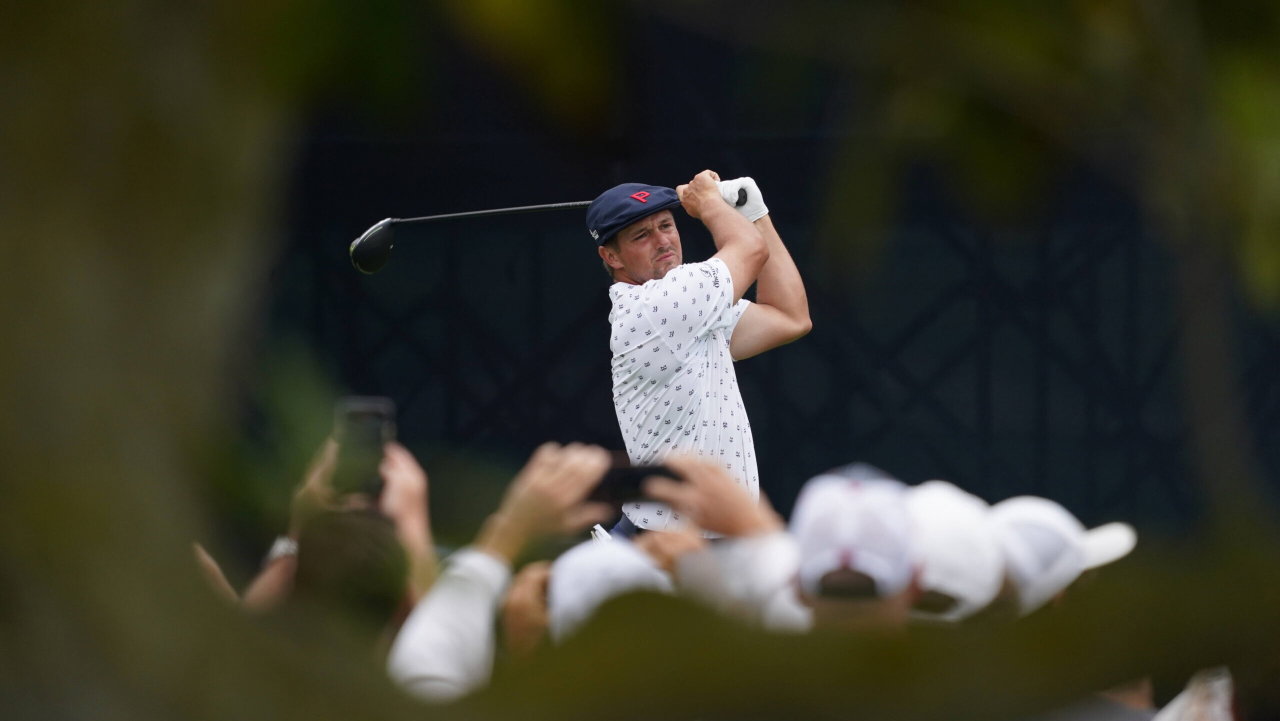
When a team captain talks up an $8 million profit for a league that has just filed for Chapter 11, someone is bound to check the math.
That is what happened on The Shotgun Start podcast, hosted by Fried Egg Golf’s Brendan Porath and Joseph LaMagna. The two broke down Bryson DeChambeau’s recent comments on Raj Shamani’s ‘Figuring Out’ podcast.
Watch What’s Trending Now!
The pushback came in a short exchange that began with Porath questioning how DeChambeau thinks the franchises actually worked.
LaMagna pointed to the source of the team’s reported earnings.
“I mean, the part you haven’t hit on is, unless I’m mistaken, $8 million in positive EBITDA. How much of that money, the revenue that he’s attributing to the team, is the earnings that the team has made on the golf course? That’s not real earnings. Those are LIV sponsorships from Saudi companies that are getting funneled through to the teams. That is what he’s crediting. That’s not real revenue.”
Porath was equally dismissive, repeating his verdict on DeChambeau’s comments: “Okay. Insane rambling. Insane rambling.”
To understand the reaction, it helps to know what DeChambeau said. On the Figuring Out podcast, the Crushers GC captain said his team generated almost $29 million in revenue last year against $21 million in costs.
In DeChambeau’s words, “We had $21 million in costs just from payment of players and expenses and travel and everything. So we made $8 million EBITDA (Earnings Before Interest, Taxes, Depreciation, and Amortization) last year… And the teams were doing well, but then all the player payments and everything got pushed down to the teams when they went bankrupt because the top company wasn’t being run effectively.”
It was not a new line. At last year’s U.S. Open, DeChambeau said Crushers GC had been EBITDA positive for two years and compared the team’s growth to TGL. This time, though, the claim came about 24 hours after the latest player commitment deadline for LIV 2.0 had passed.
The hosts’ issue was less the arithmetic than where the revenue came from. LaMagna’s argument is that team income tied to league sponsorship is not the same as a franchise earning its own way.
The filings give some context. Sponsorship made up roughly half of LIV’s revenue and reached $102 million in 2025. Four of LIV’s big six global partners were Saudi companies. The filings do not say how much of that reached individual teams, so that part remains LaMagna’s view.
Porath’s other point was about timing. DeChambeau described a healthy team inside a poorly run company, but the Crushers were part of the same structure, and he also said he did not know about the mismanagement at the time.
The Collapse Behind the Claims
The numbers around the league paint a very different picture from one profitable franchise. Saudi Arabia’s Public Investment Fund announced in April that it was ending its funding. That followed more than $5 billion in spending. The PIF then lent LIV $495 million in June to get through the 2026 season, though a New Orleans event was still canceled and the team championship was folded into the Indianapolis finale.
By early September, LIV had laid off 289 employees, roughly 90% of its staff. It filed for Chapter 11 in New Jersey on September 8 with liabilities between $500 million and $1 billion against assets between $100 million and $500 million. The filing showed about $15 million in cash left.
The broadcast side explains much of the gap. TV rights were only about 5% of LIV’s revenue, while the PGA Tour has seen as much as 67% of its core revenue come from television. LIV’s restructuring officer still said the model would have reached profitability within five to seven years with proper funding.
DeChambeau was also a creditor in the case. The petition listed LIV as owing him close to $5.8 million in unpaid fees.
LIV 2.0 now leans on the players. BC Partners’ roughly $300 million in financing is conditional, and the deal gives players a 52.5% majority stake in the league. DeChambeau described the trade-off himself, saying that unlike before, this time the players are not really getting paid up front but do get governance.
Meanwhile, more than a dozen big names, including Jon Rahm, Sergio Garcia, and Tyrrell Hatton, have announced they are leaving, with only 15-20 players reported as tentatively committed.
That is the backdrop for Porath’s doubt about whether LIV’s teams will “play at all.”