
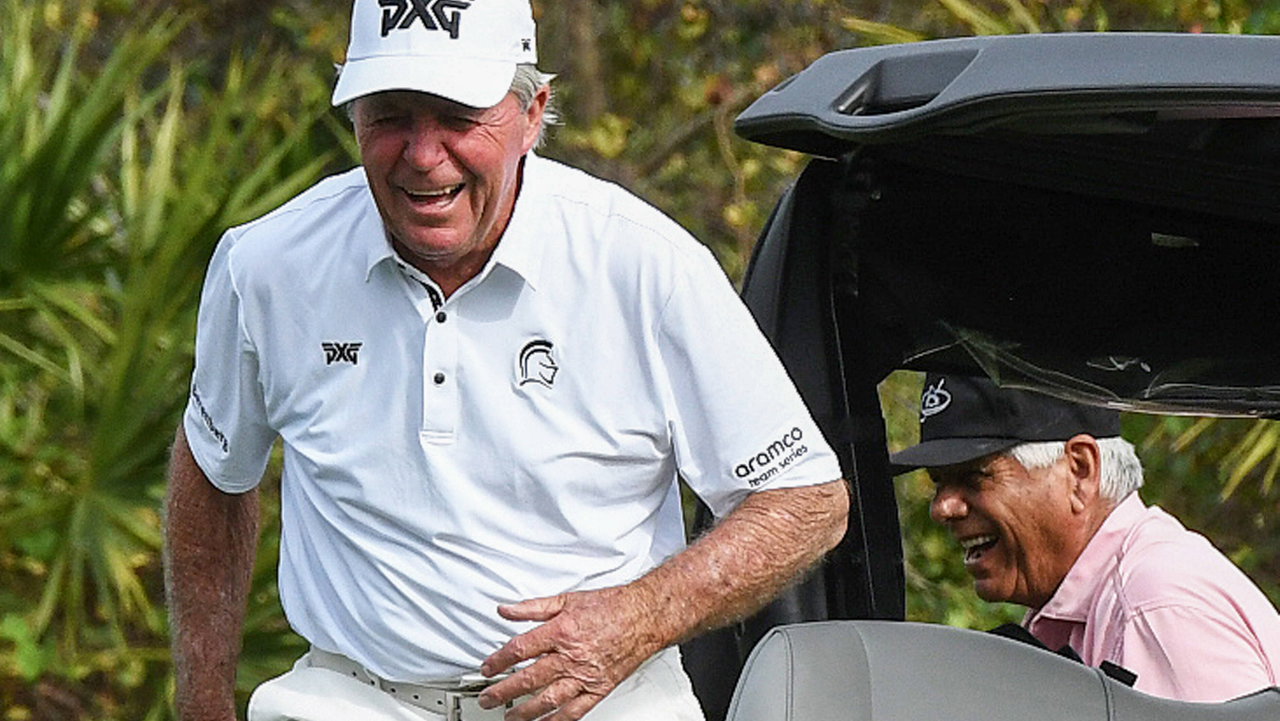
Gary Player believes golf may produce another generation of champions capable of matching the achievements of Arnold Palmer, Jack Nicklaus, and himself. However, he is convinced that the sport will never see another Big Three with the same friendship and bond they shared. And according to the South African legend, modern professional golf has a lot to do with it.
Watch What’s Trending Now!
In a conversation with Tom Coyne on Episode 221 of The Golfer’s Journal Podcast, the 91-year-old reflected on an era when three of golf’s greatest players traveled the world together and stayed close friends off the course despite fierce competition.
“We were traveling around the world not for enormous prize money. I mean, Tiger Woods wants to go to the Middle East. They got to pay him three to four million. It’s a different time. We loved golf; we wanted to promote golf; we wanted to play around the world, not just in America,” Gary Player said.
He then went on to share why he thinks having a similar trinity would be impossible.
“It was a special time, and quite honestly, you’ll never have another Big Three [Jack Nicklaus, Arnold Palmer, and Gary Player] like that again. Now, people think, well, that’s conceited to say that. On the contrary, you will have a Big Three that can play as we played, but not friends who lived with each other. Today, it’s big business. They got their jets; they do. It’s a big business. We were living together. We were in each other’s homes at my ranch, living with each other, flying with each other. It’ll never happen again. Impossible.”
Do You Think Jackson Koivun Can Win a Major Next Season?
Gary Player began his reflection by highlighting the extraordinary success he shared with Palmer and Nicklaus. According to him, the three accumulated approximately 350 tournament victories and 54 major championships between them, including senior and regular-tour majors.
The numbers reflect an extraordinary period in golf history. Nicklaus won 18 professional major championships, Palmer collected seven, and Player added nine to his tally. Their combined total of 34 regular professional majors alone illustrates the dominance they enjoyed.
However, Player was quick to point out that their achievements were not the product of a weak competitive environment. He believes the players they faced were every bit as formidable as the leading professionals competing today.
He specifically mentioned Tom Watson, Lee Trevino, Raymond Floyd, and Hale Irwin, among others, as examples of the quality of competition during their era. Watson won eight major championships, Trevino won six, Floyd won four, and Irwin won three.
In fact, they were rivals themselves.
“We made it very clear verbally that I’m going to want to beat you more than anything. But when we lost, we put our arms around each other and congratulated each other. We were great friends. We were brothers. I mean, literally brothers. I get very choked up in my heart right now as I talk,” Gary Player added.
He became visibly emotional while recalling those years, particularly when mentioning Palmer’s absence and Nicklaus’s current health.
Palmer died in September 2016 at the age of 87. Player’s comments about Nicklaus added another emotional dimension to the conversation, considering the decades they spent together.
Their friendship was also evident during the Masters’ ceremonial tee shots, where the three became familiar figures for generations of golf fans. Their appearances together represented a relationship that had survived decades of competition and changing circumstances in the sport.
Nicklaus has previously shared similar sentiments. Recalling their experiences together, he spoke about visiting Player’s South African ranch. He also stated that they stayed at one another’s homes and spent time with Palmer’s family. He described their friendship as unique.
While Player believes that level of friendship is something current golfers won’t have, he also highlighted how modern golf has become increasingly centered on money.
During the podcast, he contrasted the Big Three’s willingness to travel internationally to promote golf with the financial expectations surrounding some of today’s biggest stars.
He specifically mentioned Tiger Woods’ appearances in the Middle East, suggesting that tournament organizers needed to pay him between $3 million and $4 million to secure his participation.
Historical evidence supports the broader point. Reports in 2014 estimated Woods’ appearance fees for events such as the Abu Dhabi HSBC Golf Championship and Omega Dubai Desert Classic at approximately $2 million to $3 million. He was also reportedly offered $4 million to participate in the inaugural America’s Golf Cup in Argentina and another $4 million for two corporate appearances in China.
These figures illustrate the commercial value Woods brought to tournaments worldwide. His presence could attract international attention, sponsors, television audiences, and spectators.
The same goes for many elite professionals who play regularly today. For instance, Kevin Kisner recently said Rory McIlroy would have taken millions of dollars in appearance fees to go and play in the DP World India Championship 2026. While the Northern Irishman denied the accusations and questioned how Kisner would know, the American professional doubled down on his claims.
However, Player sees this financial arrangement as reflecting a much bigger change in professional golf.
Player himself won seven Australian Opens and 13 South African Opens, demonstrating his commitment to competing in markets beyond the United States.
He believes that today’s professionals operate in a different environment, where commercial arrangements, appearance fees, and personal business interests increasingly influence their schedules.
Gary Player’s comments also fit into a broader discussion about how much money has entered professional golf.
He recalled that Nicklaus might have earned approximately $10 million in career prize money during his playing days, while a regular professional today could potentially reach that figure. Today’s leading players operate on an entirely different financial scale.
The 2026 season illustrates this clearly. Scottie Scheffler led the PGA Tour’s official money list with approximately $30.9 million in earnings, while his career earnings reached around $130.4 million.
The broader professional landscape has changed considerably, too. The PGA Tour raised its average tournament purse to about $9.1 million for the 2021-22 season, while its total purse distribution continued to grow. Meanwhile, LIV Golf has paid out more than $3 billion in player winnings, salaries, and bonuses since its launch in 2022, according to Forbes estimates.
The financial competition between the established tours and LIV has accelerated the growth of player compensation. It has also made professional golf increasingly dependent on commercial partnerships and large financial commitments.
Gary Player’s concern is that this transformation has affected the culture surrounding the sport.