
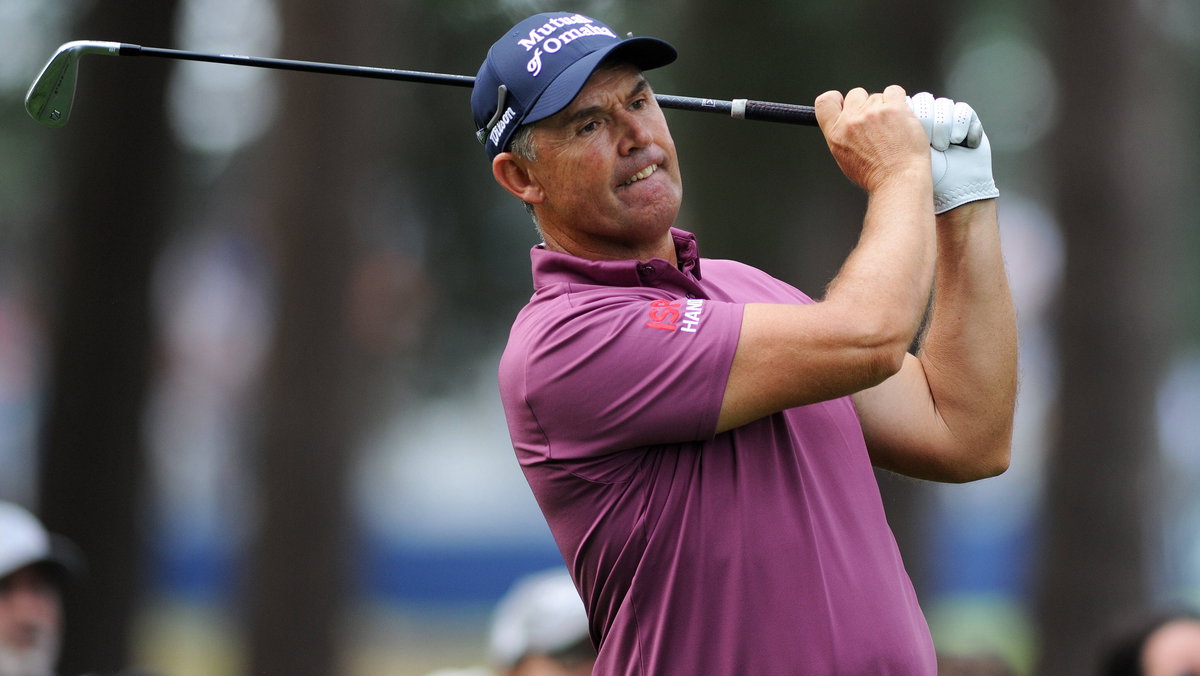
Golf’s distance debate has no finish line. Every year, the ball flies a little farther, and every year, rulemakers look for an answer. Now, a three-time major champion has joined the argument. Padraig Harrington does not want equipment to make golf any easier. He also believes dialing back distance would not spoil anyone’s fun.
Watch What’s Trending Now!
Harrington made his case on Golf Monthly’s Kick Point: The Golf Gear Podcast. He said:
“You know, you could send me back to a set of Ping Eye2s. It would not change how I physically play. You know, that’s 1980s equipment. It’s not far off what we got today. Wouldn’t have a problem playing with that. The golf ball definitely just goes so far in the heat. Yeah. So that is a thing, and it does need—look, the game needs to be… I think the best we can ask for, and this is what’s basically… there needs to be a very hard line in the sand.”
“It’s not to get any easier. It’s going to be hard to dial it back. Yes, we would love to dial it back, just so, as I said, just so the golf courses wouldn’t be defunct. It will not change the enjoyment level of golf. Zero. Zero effect on the enjoyment level of golf at all. Because it’s all relative to your expectations for golfing.”
The context of his comments is a debate that is hardly new anymore. The USGA and R&A announced in December 2023 that a golf ball rollback was in the works. The proposal involved changing how balls are tested under the Overall Distance Standard, including an adjustment to the test’s swing speed. Officials estimated that tour professionals could lose 9 to 15 yards under the change. But the plan has since evolved. On June 17, 2026, the USGA, R&A, PGA Tour and DP World Tour issued a joint statement confirming that testing would remain unchanged for everyone until January 2030. Still, the Tour has expressed concerns that the revised approach may not reduce distance enough.
Break it down, and three points emerge from Harrington’s argument.
First, the irons. Harrington says going back to older clubs would not change how he plays, and that’s a bold statement coming from a famous equipment tinkerer. He even names the Ping Eye2, and it is not a random choice. For context, Ping launched the Eye2 in 1982, and it went on to become one of the best-selling irons in golf history. Its cavity-back design distributed weight around the edges of the clubhead, making it more forgiving on mishits. Harrington even used a knockoff set of Ping Eye2 irons as a junior.
But his message is quite simple. Clubs from that era were already forgiving, and going back to them would hardly change his swing. In his view, irons are not what drove the distance boom. In 2025, he pointed to something else: the performance of the golf ball and driver has improved “significantly” over the years. Those two pieces of equipment, he believes, are where the extra yards are coming from.
Second, Harrington wants a “hard line.” He is not necessarily asking for a massive cut in distance. He wants a firm limit on any further gains, and he explained why in an interview in 2023. A small rollback, he said, would be wiped out within five years as players get stronger and equipment continues to improve. So the line has to hold, or distance will simply keep creeping back up. He even argued that the five percent cut being discussed at the time was too soft.
That said, Harrington knows the task will not be easy. Even with a rollback, he believes the effect on golfers’ enjoyment would be negligible.
The third point is the survival of golf courses. At the K Club in Ireland, Harrington noted that holes are now 40 yards longer than they were in the 1990s, yet players are hitting four clubs less. Older course designs lose their challenge when players can hit the ball that far.
But ultimately, Harrington believes golfers judge distance against their expectations. As he has explained previously, if he outdrives a playing partner by five yards, he feels good. If he falls five yards short, he feels bad. And that holds whether he is hitting it 270 or 300 yards. So, if everyone loses 10 yards, that new distance simply becomes the norm. The enjoyment stays the same. That is why he believes a golf ball rollback would not take away from anyone’s enjoyment of the game.
Harrington has the credentials to make that argument. He won The Open Championship in 2007 and 2008 before adding the PGA Championship in 2008. He was also inducted into the World Golf Hall of Fame in 2024. Moreover, he has experienced the distance debate from both sides. He was never a bomber in his prime. In 1997, he averaged 273 yards across three PGA Tour starts.
But later, he began chasing speed more aggressively. By 2022, he led the PGA Tour Champions with an average driving distance of 308.7 yards. He once described that pursuit as an “addiction,” but his stance on the rollback has remained consistent. In December 2023, he told Golf Digest that the rollback was “for the greater good of the game.”
Distance keeps climbing
The numbers are backing up his concerns. The PGA Tour has reported that average driving distance has reached 306 yards in 2026. That’s more than three yards higher than in 2025 and 16 yards more than a decade ago. For the first time, two players have crossed the 330-yard mark: Aldrich Potgieter and Rory McIlroy.
Meanwhile, the Tour is exploring other options. On September 21, the USGA and R&A sent equipment manufacturers a notice outlining three possible Model Local Rules requested by the PGA Tour and DP World Tour. One would require golf balls to meet a distance limit of 317 yards, with no tolerance. Another would cap driver face flex at 239 microseconds. The third would reduce the maximum permitted club length to below 46 inches.
The comment period closed on October 21, and the rules could come into effect in January 2028. Importantly, they would not apply to everyday golfers.
For now, Harrington’s hard line remains a wish, and the distance debate is far from settled.