
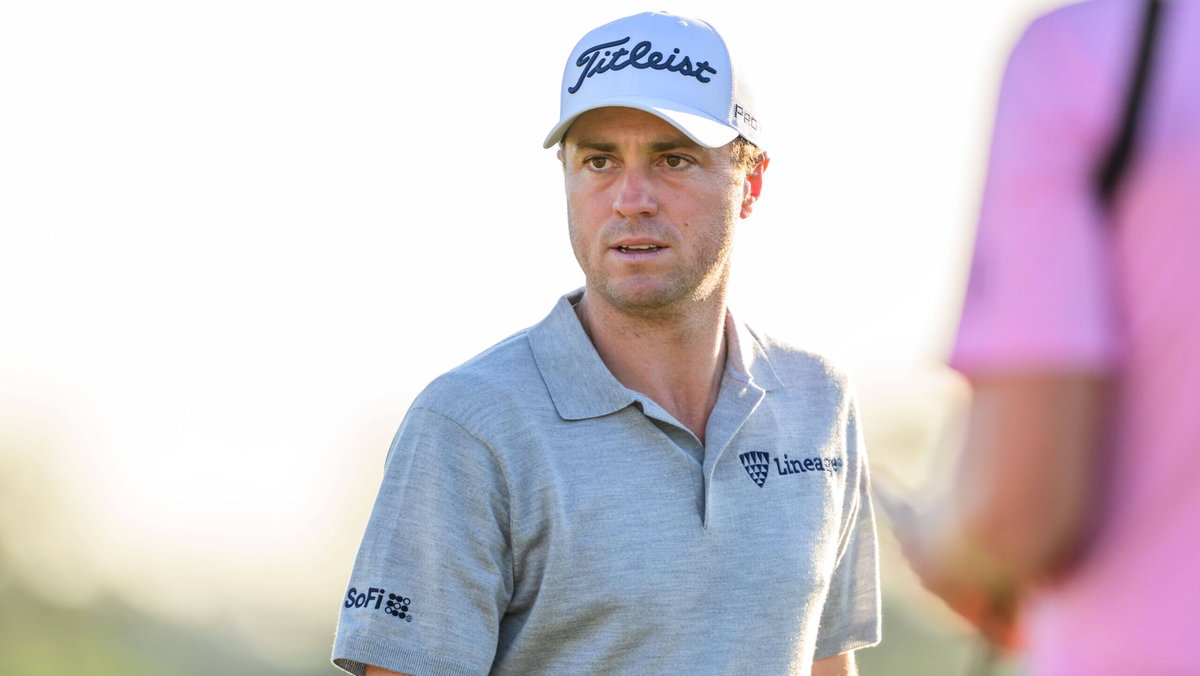
At Aronimink, the pace issue had been building long before Justin Thomas found himself explaining it after Round 2. The course was already playing slow, with difficult pins, wind, crowded traffic points, and enough waiting around to test even the most patient groups. And if that wasn’t trouble enough, Thomas was put on the clock for pace of play and ended up in a tense exchange with a rules official over it. For the two-time PGA champion, it felt like his group, which included Keegan Bradley and Cameron Young as well, was being singled out for a problem that had been shaping the championship all week, and he made that clear when he discussed the matter with the press.
Watch What’s Trending Now!
“We were, yeah. We just didn’t really agree with it. It’s hard because it’s kind of the whole time par thing. What is time par? How can time par on this course be the same when it’s blowing 25 and the pins are tough than if it’s not? And does time par change every day? There’s just so many factors that go into it. We weren’t holding up the group behind us. They were about , it seemed like every time we were on the green, they were on the tee and so on and so forth,” he said.
Thomas then expanded on why he thought the call was difficult to justify. To him, pace of play was not just about a number on a timing sheet. It depended on the hole, the shot, the wind, the pin, and whether a group was actually delaying anyone behind it.
“The hard part to me with the whole pace-of-play thing is that there’s so much that goes into golf and there’s so much that goes into hole to hole,” Thomas said. “Are you hitting it close? Are you able to tap it in, or you have to mark it? Stuff like that — are you holding the group up or are you not — to where it’s very hard to make that call. And we just didn’t agree with it, to be honest.”
During Round 2 of the 2026 PGA Championship, Thomas was playing alongside former PGA champion Keegan Bradley and Cameron Young when, early in their round, a rules official’s vehicle pulled up alongside the group on the fourth hole. The group hadn’t committed a foul until then. The official, however, felt that they were taking too long and determined that they were out of position.
Thomas, Bradley, and Young had to play on a timer from that moment. They stayed on the clock for one hole, and once they caught up to the group ahead, officials confirmed they were back in position and removed the timer. Thomas made his case to the officials during that stretch, but the call was not reversed while it was in place.

⏰😳⛳️ #DISAGREEMENT — Justin Thomas commented on his group being put on the clock during Round 2 "We just didn't agree with it to be honest... a hole later, we were caught up. So it kind of goes to our point of why we didn't think we should've."
For context, here’s how pace-of-play enforcement actually works on the Tour, and what the rules have to say about each scenario.
- Out of position: When a group is out of position, it means they have fallen behind the group ahead. If this happens, officials can issue a formal warning.
- On the clock: If the playing group does not recover after a warning, it is timed on every shot it plays afterward. The first player to play has 60 seconds per shot. Each player, after that, has 40 seconds.
- Bad time: If a player exceeds their allotted time while on the clock, that is recorded as a bad time. Under revised policies being tested on PGA TOUR Americas and the Korn Ferry Tour, the first bad time can now bring a one-stroke penalty, followed by a two-stroke penalty for a second bad time and disqualification for a third. On the main PGA Tour and in major championship settings, pace-of-play enforcement still depends on the committee’s policy for that event.
- Stroke penalty: In a severe case, officials can charge a one-stroke penalty after giving a warning, the clock, and two bad times. This rarely happens. The last recorded instance was at the 2021 PGA Championship at Kiawah Island.
Thomas’s point was straightforward: his group was not causing a backup, and the group behind them was keeping up, so why were they being penalized? He also opened up about refusing to let the clock change how he played. When asked if he rushed his play at all, he was direct.
“No. I backed off on my first shot, being on the clock even. That’s the last thing I’m going to do, make a mistake because I feel like I’m rushing.”
He added that if the situation had escalated and his group had started receiving bad times, he would have continued pressing officials.
“If we were, for some reason, to get in a position where I was getting, we were getting bad times and we were continuing to be on, I would have had more discussions with the rules officials to kind of plead my case,” Thomas said.
Thomas’s issue was with the very first step of the process. Officials flagged his group for being out of position, but the group behind them was not being held up. Another question that comes up is: why were they put on timing immediately? Officials likely went straight to the clock because the group had already significantly fallen behind. It could have been a miscalculation, but that is what the group faced.
The broadcast also appeared to capture Thomas and Bradley pointing toward the group in front of them, making the same argument visually that Thomas later made verbally: they believed they were being held up, not holding others up.
Aronimink’s course structure also fuels speculation, as it creates bottlenecks around major holes. The 10th tee box overlaps with the first tee. Players leaving the eighth hole also have to cross through the No. 11 tee complex to reach the ninth tee, while other areas of the property bring greens and tees into close contact. These are physical restraints that no clock enforcement can fix.
Rory McIlroy, who shot a bogey-free 67 to move five shots off the pace, pointed to that same logistical issue after his round.
“There is a few bottlenecks on this course anyway, with the eighth green, the 10th green beside each other, you’ve got like 16 green and 9 tee and 17 tee right there. So there’s a few little parts of the course that you can sort of get jammed on,” McIlroy said. “But it’s fine.”
And then there’s, of course, the field size. With 156 players starting off both the first and 10th tees, the first two days were always going to carry the risk of long rounds. A record 97 of the top 100 players in the world teed it up at Aronimink on Thursday, making it the highest concentration of elite players at any event this season. In fact, Thomas himself called the practice round at Aronimink “unbearably slow” during the week’s preparation days.
So yes, the course is large, but it also has sloping greens that demand extra deliberation and more precise shot-making, only adding to the time each hole requires.
Bradley and Young were part of it, too, and it is not their first time
Frustrated, Bradley and Thomas gestured toward the group in front of them to make their point, stating that the pace issue was not from them. But Bradley’s relationship with slow-play scrutiny runs deeper than one incident. At the 2025 Tour Championship at East Lake, he drew widespread criticism for a putting routine on a short putt that ran well over the 40-second limit.
Meanwhile, Young stayed quieter through it all. However, he has been one of the form players of the 2026 season, with two wins and a string of top-10 finishes. Young had little to gain from a public back-and-forth with officials and largely let Thomas lead the on-course conversation.
Young recovered from a sluggish opening 71 to shoot a 3-under 67 on Friday, capping his round with an eagle on his final hole to move into the top 10 at 2-under for the tournament. Thomas also closed with a second-round 69, joining Young at 2 under heading into the weekend.
They were not the only ones dealing with the clock, either. Morning clubhouse leader Alex Smalley and his group were also timed during the second round, and Smalley admitted it can be unsettling even when a player tries not to let it affect him.
“It’s always a little disconcerting when you feel like you kind of have to rush a little bit, so I tried not to feel like I was rushed,” Smalley said. “I really don’t attribute those things [three bogeys] to being on the clock, just kind of comes with playing out here.”
Moreover, that showed up across the field. For the second straight day, rounds frequently went past five hours and, in some cases, stretched close to five and a half. Scottie Scheffler, Justin Rose, and Matt Fitzpatrick teed off around 8:40 a.m. local time and were not finishing until shortly after 2:10 p.m.
Scheffler, who carded a 1-over 71 to sit at 2 under for the championship, pointed directly to the PGA of America’s pin locations as one reason players were taking longer.
“You just got to continue to try to hit good shots, and most of the pins today were, I mean, kind of absurd,” Scheffler said.
He singled out the 14th as one of the most demanding hole locations he had seen in a long time.
“There’s literally just like a spine [in the green] and they’re like, ‘Oh, we’ll just put the pin right on top of it.’ And you’re like, ‘All right, well, I’ll see what I can do,'” Scheffler said.
Chris Gotterup, who still managed a 5-under 65, did not call the setup unfair, but he agreed that it was contributing to the slow pace.
“I don’t think it’s unfair, but I do think for pace of play and certain aspects, there have been a couple — you know, 14 today is probably aggressive, I will say,” Gotterup said. “You’re hitting a 4-iron to a 10-foot circle, and if it doesn’t go there, it’s off the green, and if you hit it 40 feet left, you have a very hard 2-putt.”
That was the larger problem Thomas was trying to get at. Aronimink was not simply playing long; it was asking players to be exact. Miss by a few feet and a birdie chance could turn into a defensive two-putt or worse. On a course like that, every extra look at the wind, slope, yardage, or line felt less like delay and more like survival.
The PGA Championship is full of storylines, and two rounds remain to be played. The leaderboard is tight, and the focus now has to shift entirely to what comes next. With 83 players making the cut, the pace was expected to ease over the weekend, something McIlroy said is often the natural rhythm of major championship golf.
“It seems like the first two days of major championship golf are always going to be like that,” McIlroy said. “But it will, obviously over the weekend, it will speed up.”