Imago
Source Credit: IMAGO
Imago
Source Credit: IMAGO
Imago
Source Credit: IMAGO
Imago
Source Credit: IMAGO
Jon Rahm walked up to Grant Horvat at Silverleaf, Arizona — their first meeting — and opened with five words: “So, why did you leave?” Not swing tips. Not Masters memories. Not Ryder Cup war stories. The two-time major champion wanted to talk about YouTube drama. Specifically, Horvat’s December 2022 departure from Good Good, the creator collective that has since attracted $45 million in investment from Peyton Manning’s Omaha Productions and others.
Watch What’s Trending Now!
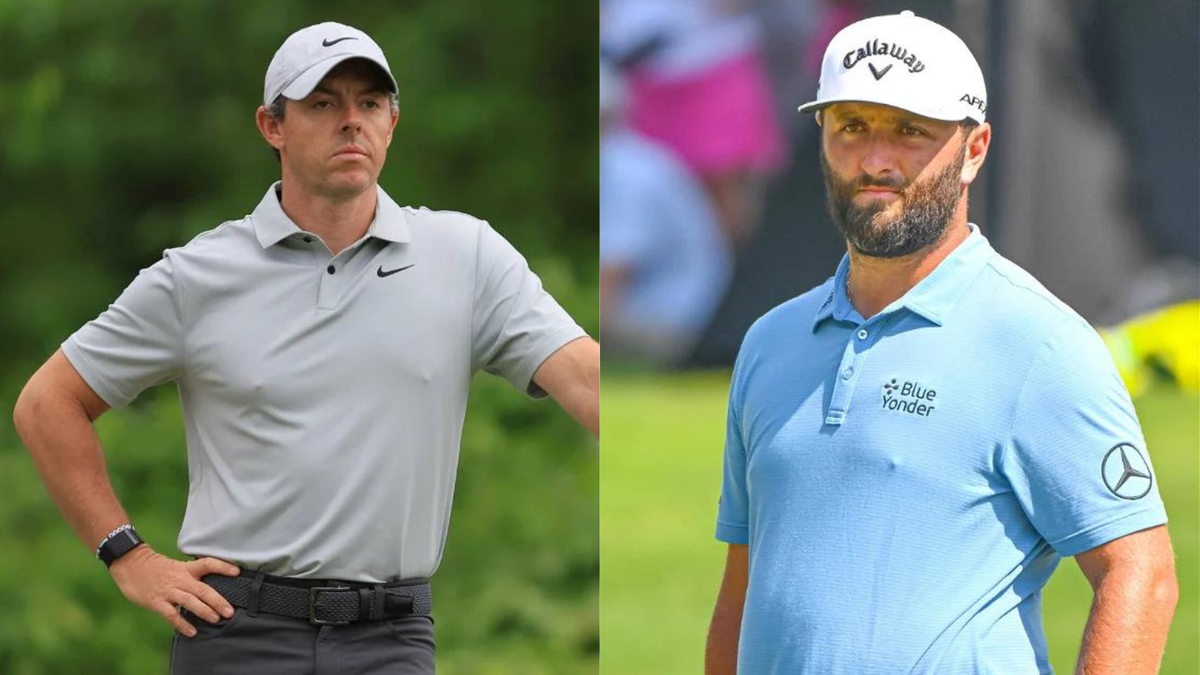
The moment revealed something the traditional golf world has been slow to grasp: Jon Rahm isn’t just appearing in YouTube golf content. He’s consuming it. He tracks the storylines. He knows the drama. And that puts him on the opposite side of a cultural divide from Rory McIlroy, who recently dismissed creator golf as something for a different generation.
Horvat, recounting the exchange on his recent match against Brad Dalke, admitted he was blindsided. “I had no idea you even watched YouTube,” he said. “First time I meet him, he’s like, ‘Grant, what’s up, man?’ And then he just starts off with a hard-hitting question right away.”
The revelation landed like a wedge shot from tight range — precise, unexpected, and impossible to ignore.
“He really does watch YouTube golf,” Horvat confirmed. “The way he talks, he knows what he’s doing.”


Rahm’s fandom extends beyond passive viewing. His recent collaboration with NFL MVP Josh Allen and Phil Mickelson — “Me and Phil versus Josh Allen and Jon Rahm,” Horvat recalled — signals that cross-sport legitimacy has arrived for creator golf.
Yet even Rahm has drawn a boundary. In a conversation with Bob Does Sports, he admitted he wouldn’t launch his own channel despite his enthusiasm. “Knowing my personality, it would probably consume too much of my time that I should actually focus on being a better golfer,” he explained. The distinction matters: Rahm consumes the content without feeling compelled to create it.
View this post on Instagram
McIlroy, by contrast, has planted his flag firmly on the other side. At The Players Championship in March 2025, the World No. 2 was asked about YouTube golf personalities like Fat Perez and Grant Horvat. His response was diplomatic but unmistakable.
“Not really. I’m not of that generation,” McIlroy said. “I’d much rather watch pure competitive — I’d much rather watch this tournament on Saturday and Sunday than watch YouTube golf.”
When pressed about the massive viewership these creators generate, he remained unmoved. “I’m happy for the people that enjoy it, but I enjoy something else.”
The timing was striking. Hours later, TPC Sawgrass hosted its second Creator Classic — the PGA Tour’s own acknowledgment that YouTube golf commands attention, the traditional broadcast model struggles to capture. But the contrast between Rahm and McIlroy extends beyond personal taste. It reflects competing visions of where golf’s future revenue — and relevance — actually lives.
YouTube Golf’s business model challenges traditional Tour economics
The demographic math explains the institutional anxiety. Traditional PGA Tour television attracts a median viewer age of 64. YouTube golf creators reach audiences with a median age of 33. The Tour’s official channel averages 85,000 views per video. Good Good pulls 545,000.
That’s not a gap — it’s a generational fracture with financial consequences.
The PGA Tour’s revenue model depends on media rights deals worth approximately $750 million annually — broadcasting windows sold to networks in exchange for players’ collective media image. Creators operate differently. YouTube ad revenue, merchandise sales, sponsorship deals, and live events form a direct-to-fan pipeline that bypasses traditional gatekeepers entirely.
Good Good’s $45 million investment validates creator golf as a legitimate business infrastructure, not novelty content. The PGA Tour has responded by launching its Creator Council — names like Paige Spiranac and Bob Does Sports now consult with Tour executives on fan engagement strategies. Creator Classic events have appeared at iconic venues.
The institution has conceded, even if some of its ambassadors haven’t, that younger fans are discovering the sport through Grant Horvat and Bryson DeChambeau rather than Saturday afternoon broadcasts.
McIlroy isn’t wrong to prefer “pure competitive” golf. That preference reflects the traditional values that built the sport’s prestige. But preference and relevance aren’t the same thing.
Rahm’s five-word question at Silverleaf wasn’t small talk. It was a signal. The legitimacy of YouTube golf no longer depends on what the traditionalists think — not when the game’s best players are already tuned in.
Related Newsletters