
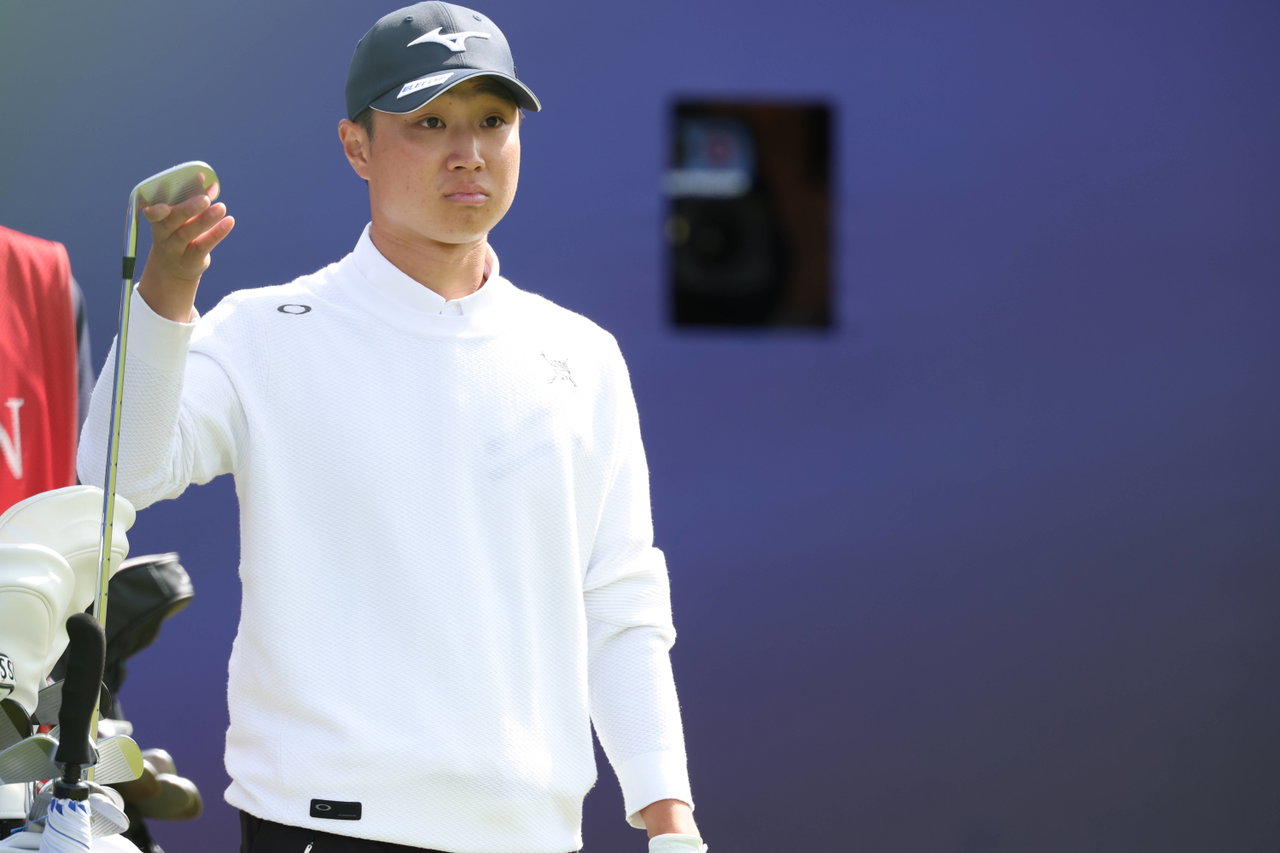
The Sony Open in Hawaii was not Kensei Hirata’s best week on a golf course. Four wins in a single JGTO season show what he is capable of. Still, his T24 finish at 7-under in January 2026 was a sign that he is settling in. The way he played at Waialae made his intentions clear.
Watch What’s Trending Now!
His equipment setup says a lot. TaylorMade clubs cover the long shots, Mizuno takes care of the irons, and the scoring clubs show careful customization that comes from knowing exactly what each club should do. Every club has its purpose.
Kensei Hirata’s long game: TaylorMade woods and Mizuno irons
Hirata uses a TaylorMade Qi4D driver set at 10.5 degrees, paired with a Fujikura Ventus TR Blue 6 X shaft. Its head is designed for high-MOI performance, so shots that miss the center keep more ball speed than smaller heads. The Ventus TR Blue is a mid-launch, low-spin shaft, making it a good fit for players who swing aggressively and want to keep their shots straight, even under pressure.
He uses the same Ventus TR Blue 6 X shaft in his TaylorMade Qi10 3-wood, which is set at 15 degrees. The reason is simple: using the same shaft profile in both the driver and 3-wood helps keep the launch and spin numbers similar for each club. For someone who likes to shape shots, having that level of consistency between clubs is a deliberate choice.
View this post on Instagram
The 7-wood uses a Ventus TR Blue 7 X shaft, which is heavier and pairs with the Qi35’s 21° head to give higher shots and softer landings. This is just what you need for long approaches into firm greens. After that, the bag changes not only in club type but also in feel. Hirata bridges the gap with a Mizuno MP Fli-Hi 4-iron, a hollow utility iron that is easier to launch and more forgiving than a standard long iron, but still offers enough control for courses where greens are hard to hold. The 5- through 9-irons are Mizuno JPX Tour models, sometimes listed as JPX 923 Tour in some catalogs, though the difference is small. These irons are compact, forged, and designed for players who value precision over raw distance. These qualities stay the same, no matter which name is on the club.
Kensei Hirata’s short game: Mizuno wedges and a Scotty Cameron Tour prototype
Hirata’s wedge setup is straightforward: four clubs, two brands, each with a clear role. The Mizuno T22 covers the 46° and 52° spots, built for full swings and reliable spin on approach shots. These clubs show tournament use, with lead tape added, so they are well dialed in. At 54°, the Mizuno Pro T1 offers more flexibility around the green and does not require perfect turf to be effective.
For the lob wedge, Hirata uses a Titleist Vokey SM10 at 60°, focused on high spin and control for bunker shots and tight pin positions. Shaft details for the irons and wedges are not confirmed, so they are not listed. The putter is a Scotty Cameron Phantom 9.2 Tour Prototype with a SuperStroke Pistol Tour grip, a modern mallet design with a single alignment line and a matte finish for a clean look and stable setup.
The Phantom is a modern mallet. The Tour Prototype label indicates it is custom-built, not off-the-rack. Hirata’s game is built on precision and consistency. The choice of putter shows that focus runs through every part of his game.
This bag is made for players who want to attack with control. TaylorMade gives speed and stability up top. Mizuno irons deliver feel and control. The wedges are picked for their purpose, not just to fill out the set. Hirata arrived on the PGA Tour as a proven winner from the JGTO. His equipment proves he understands what separates a bag that looks ready from one that actually is.