

Most rivalries in sports end at the final whistle, but not Palmer and Jack Nicklaus. They were still needling each other decades after 1962, still traveling together, still competing. And somewhere in between all of that, Palmer found time to spot a subtle but crucial flaw in Nicklaus’ setup off the tee.
Watch What’s Trending Now!
In one of his final and most candid interviews, recorded in 2016 with Graham Bensinger shortly before his passing that September, Arnold Palmer opened up about what their relationship genuinely looked like away from the galleries. Over a beer at the bar, between rounds, Palmer told Nicklaus straight: “You’ve got the ball too far forward in your stance. Move it back a little, you’ll hit the driver better.” Nicklaus took that advice.
The advice holds up technically, as moving the ball back from a too-far-forward position helps compact the strike, improving the launch angle and spin rate for a more consistent drive. Moving it back compacts the strike. This advice was more important than most people think. Even for one of the PGA Tour’s longest drivers, Jack Nicklaus, whose persimmon wood driver averaged 276 yards in 1968. He also won the 1963 PGA long drive contest with a 341-yard drive. Palmer was not fixing a weakness; he was sharpening an already dangerous weapon.
The rivalry’s origin story began when an 18-year-old Nicklaus first met Palmer in 1958. However, it truly ignited four years later at the 1962 U.S. Open, where the 22-year-old challenger famously beat the established king in a playoff. This was the start of their competitive relationship. Palmer’s fans never really forgave Nicklaus for it, but Palmer himself never held it against him.
Imago
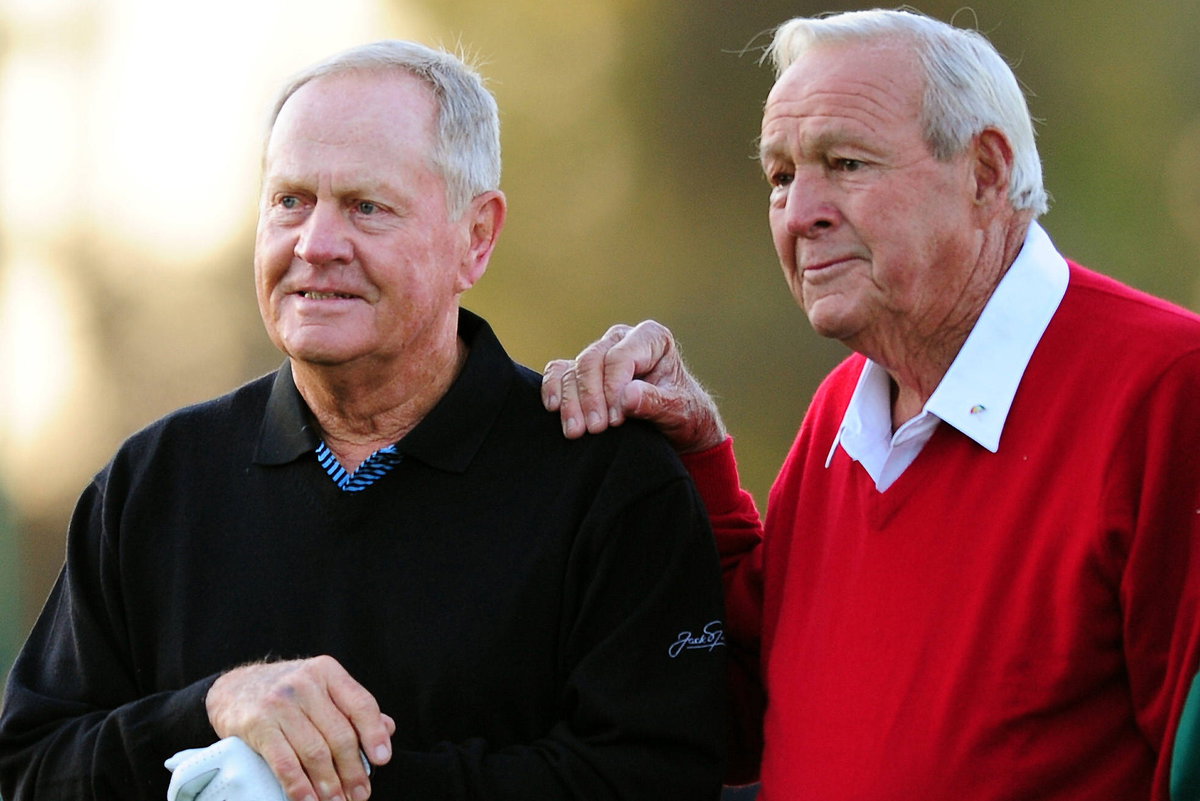
GLF-MASTERS Jack Nicklaus and Arnold Palmer pose together following their ceremonial first tee shots to open the 2011 Masters at Augusta National Golf Club in Augusta, Georgia, Thursday, April 7, 2011. Jeff Siner/Charlotte Observer/MCT Augusta GA USA EDITORIAL USE ONLY Copyright: xx 1103747 JeffxSinerx krtphotoslive480116
That distinction mattered, a point Nicklaus made to Hannah Storm on ESPN SportsCenter in 2016, following Palmer’s death, when he said, “I never had to fight him. I always had to fight his fans, but I never had to fight him.”
Their rivalry had a functional side most people never saw. They were Ryder Cup and World Cup partners, traveled together to the British Open, and by Nicklaus’s own account, regularly played bridge on transatlantic flights with their wives. The locker room needling, the dinner plans after rounds, and the willingness to flag a flaw in each other’s swing were the actual texture of how they operated.
Palmer, in that same 2016 interview, put it plainly: “We helped each other, and that was a big part of our friendship.”
But their dynamic stretched far beyond what the 1962 U.S. Open started, a fact best symbolized when Palmer placed the Green Jacket on Nicklaus after his first Masters win.
The rivalry that never got in the way
He later recalled: “From the very beginning, from the day he turned pro, Jack and I were friends.” That friendship never needed the rivalry to end first.
What made it genuine was that neither man pretended the competition did not exist. Palmer was direct about it: “When we played against each other, we competed as hard as we possibly could.” Winning mattered to both of them, and they respected each other for it.
But Palmer also clarified that results never defined the relationship. “He beat me, I beat him,” he said, “and that’s what makes the game of golf so great.” The scoreboard was just one part of a much larger picture between the two men.
Though he was not well enough to hit a tee shot that day, Palmer still stood on the first tee with his friends, Nicklaus and Gary Player. It was a poignant last appearance; just five months later, in September 2016, he was gone, making that morning at Augusta the final, quiet chapter for the Big Three.