
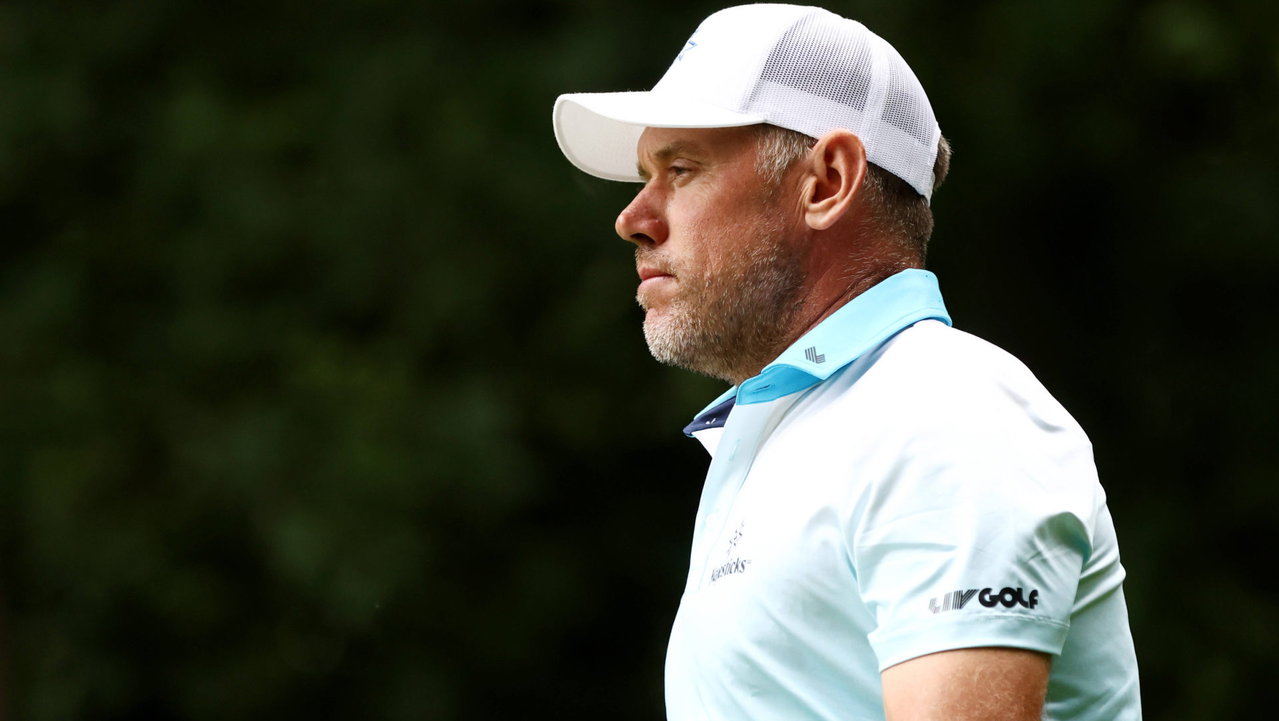
August 2026 isn’t the first time Lee Westwood has used a handful of words and emojis to land a sharp jab at the PGA Tour or its CEO, Brian Rolapp, and the timing keeps landing on the same sore spot: whether the Tour’s talk of unity and reform is actually credible to the players it left behind. Back in February, when the Players Championship ad prompted talk of turning the event into a fifth major, Westwood didn’t engage with the marketing pitch. Instead, his reply turned into a dig at the Tour’s stance on LIV: he asked the Tour to invite LIV’s top 15 players to the Players Championship as a test run and see how that went. Jabs like this have set the tone for how Westwood treats almost everything the Tour CEO says publicly. So when Golf Digest’s Joel Beall covered Rolapp’s take on player equity in a new interview, and went so far as to call him the man saving pro golf, Westwood couldn’t hold back.
Watch What’s Trending Now!
Lee Westwood replied on X, quick with his jab, and said, “Saving pro golf? Good one.”
So what is Rolapp’s actual take on the private equity accusations, specifically that the tenure overhaul and the Tour’s outside investment are cover for private equity payoffs? The PGA Tour CEO is quick to push back.
“That gets muddled with, we only care about economic return, or it’s private equity, or we are going to ban the charitable mission. None of that is true.”
This friction didn’t come out of nowhere. Back in 2024, the PGA Tour restructured through Strategic Sports Group, a consortium of North American sports owners led by Fenway Sports Group. The group put up to $3 billion into a new for-profit arm called PGA Tour Enterprises, and for the first time, players became equity owners in their own league. The program has only grown from there.
More than 213 players now hold a combined $1.3 billion in equity grants, with the larger shares tied to career achievement and recent form. Unsurprisingly, Rory McIlroy and world No. 1 Scottie Scheffler sit near the top of that list, while well over 200 players in total, active and retired, hold some stake in the Tour’s future value.
Not everyone agrees with him. Viktor Hovland has come right out and said the Tour treats players as labor, not partners. That kind of complaint already changed one thing: players brought it up at the Rocket Classic, the board took notice, and the equity pool grew to cover the top 50 in the FedEx Cup. Rolapp points to that as proof he’s paying attention.
None of this is surprising coming from Westwood. He left for LIV in 2022 and lost a 14-year sponsorship with UPS over the move, and he’s remained one of the league’s loudest defenders since. Player pathways, access, all of it, he and Rolapp have gone back and forth on it repeatedly online.
Ironically, his own league has spent this year losing ground on the money front. Saudi Arabia’s Public Investment Fund pulled its financial backing from LIV, leaving the league searching for new investors to replace it.
LIV’s own equity story took a turn just days before this profile ran. On August 5th, LIV announced a new lead investor after months of faltering attempts, along with a plan to make players majority equity holders in the league. The timing looks less like a response to the Tour’s equity push and more like a scramble to survive. LIV had been hunting for financial backing for months, bankruptcy was reportedly on the table, and the league still owes money to some of its own stars. Handing players majority ownership now reads as much like an attempt to keep them from bolting as it does a real shift in how the league is run. All this while the league struggles to pay off vendors and employees. What that ownership will actually look like remains undisclosed: no confirmed voting rights, no vesting schedule, no breakdown of who gets what.
Westwood, meanwhile, already has a taste of that kind of ownership at the team level. He co-owns Majesticks GC with two other players, which gives him a real say in how the team handles sponsorship and merchandising. Whether LIV ever extends that same setup to players individually is still an open question, one the league hasn’t touched.
Rolapp, for his part, believes the economic and financial returns are only part of the business. The more important question, he argues, is how the product itself is built.
PGA Tour’s CEO Take on the Product
Speaking to Golf Digest, Rolapp also addressed the gap between the millions of Americans who play golf and the far smaller number who actually follow the Tour. His answer has nothing to do with money, equity, or ownership structure. For him, it comes down to a simple test he applies to nearly every decision: would a fan actually want to watch this? In other words, he tries to view every decision from a fan’s perspective.
He puts it simply, as he shares, “You’ve got to get the product right. I don’t care how good you think your business model is. If the product isn’t, none of it matters.”
The Tour’s biggest structural change is coming next year: a new two-tier system. At the top is the Championship Series, a tighter, richer field of just 23 or 24 events from February through August. It’s built around a $20 million prize purse and includes the marquee stuff, the majors, the Players, the postseason, the Ryder Cup, the Presidents Cup. Beneath it is the Challenger Series, over 20 events with 144-player fields and a $4 million floor. Getting up to the top tier will come down to wins, not status.
The goal is to make the product easier for audiences to follow. Rolapp has made other changes too. Sponsor exemptions, the mechanism that guaranteed tournament slots regardless of form, are now almost entirely gone. The calendar is being rebuilt around cities the Tour has largely ignored, including Boston, Denver, Seattle, and Washington, D.C. Even the season finale is changing, moving from 72-hole stroke play at East Lake to a match play format with relegation stakes attached.
Whether these changes pan out the way the PGA Tour envisions remains to be seen.