
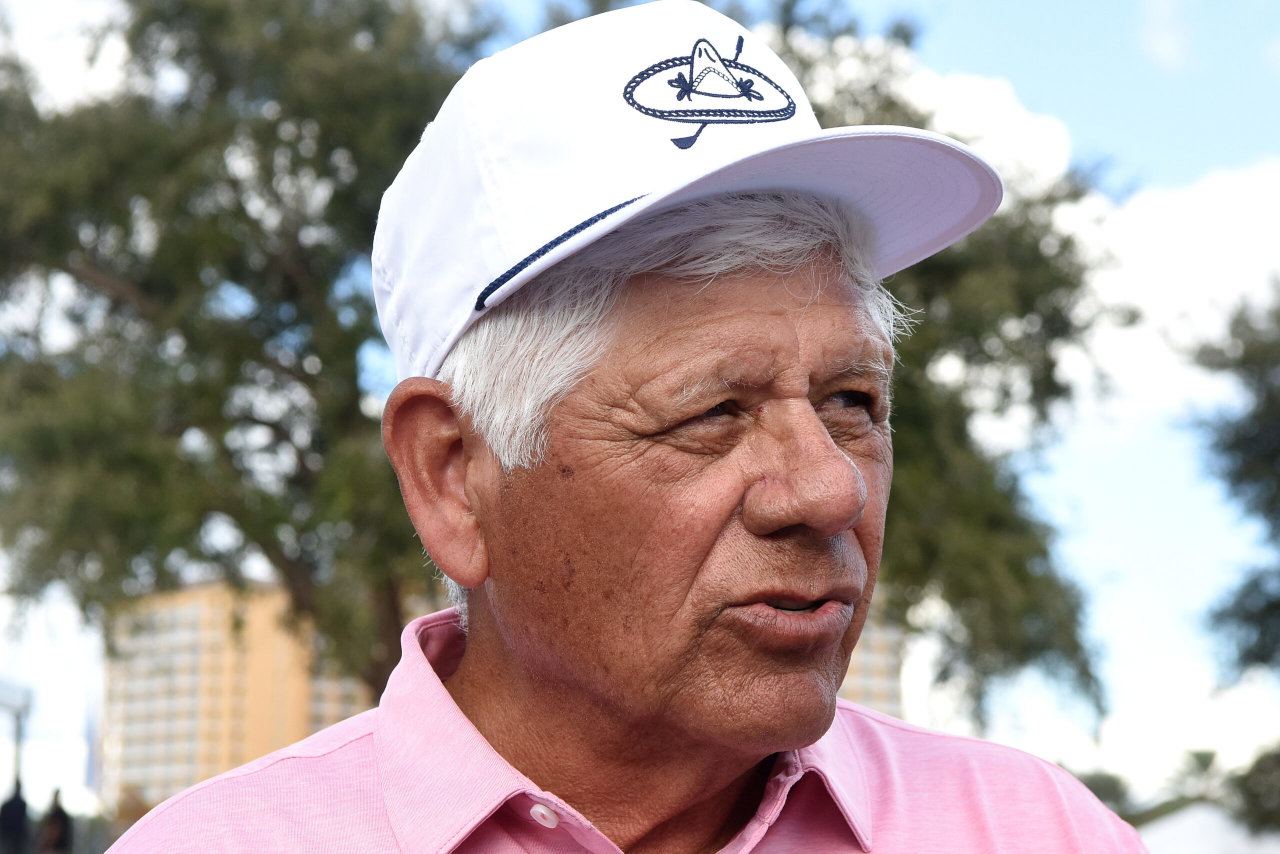
Lee Trevino has accomplished nearly everything one could dream of. From serving in the U.S. Marine Corps to being inducted into the World Golf Hall of Fame in 1981, the 29-time PGA Tour winner and six-time major champion has enjoyed a remarkable career. Yet, among his many achievements, one extraordinary experience stands apart: he survived a lightning strike that could easily have cost him his life.
Watch What’s Trending Now!
The incident occurred in 1975, when Trevino was competing in the Western Open at Butler National Golf Club. He stood near the 13th hole with fellow golfers Jerry Heard and Bobby Nichols, waiting for play to resume after the tournament officials suspended it because of a storm. Suddenly, a bolt of lightning struck nearby, traveled through the marsh, crossed the banks, and reached the three golfers through the metal spikes in their shoes.
In that terrifying instant, Trevino came face-to-face with death. Reflecting on the experience, he recalled seeing his life flash before his eyes. “When people say that everything flashes in front of you … your whole life … it really does,” he said. He began thinking about his wife and family before losing consciousness.
Trevino later described the sensation of being struck in vivid detail. “It was comfortable. It was a very, very quiet sensation. I couldn’t hear a thing. There was a whining noise in my ears. I know it (lightning) had me when I started shaking.”
He continued, “Then it started stretching out and picked me up off the ground. I couldn’t breathe and I remember gasping for air. Everything looked orange to me.”
The lightning caused severe injuries to all three golfers. Trevino suffered burns on his back, lost consciousness, and his spinal discs took damage. Heard sustained burns to his upper right leg and was admitted to a Hinsdale hospital overnight, while Nichols fell down, suffered burns to his head, and doctors kept him for observation.
The consequences extended far beyond the initial shock. Trevino eventually underwent two back operations to repair a ruptured disc. Heard also underwent back surgery, but it did not restore his ability to play. Trevino returned to the highest level of professional golf, but Heard could not recapture his previous form. Nichols, meanwhile, survived the incident and continued his golfing career.
Recalling his hospital admission, Trevino explained that even the doctors were uncertain how to treat him. “The doctor told me, ‘I don’t know what to do for you. I’ve never had anybody struck by lightning. They’ve always gone right by this place and straight to the morgue.’ He said one of the reasons I survived is because my heart is so strong,” Trevino recalled.
Although the experience left lasting physical consequences, it did not end Trevino’s remarkable career. His back operations forced him to make significant adjustments to his swing, changing both his posture and the way he approached the ball.
“I now stand more upright and I don’t cut the ball like I used to,” he explained. “I had to learn to play completely over. I couldn’t make the same movement into the ball and now, I’m coming out of my swing quicker. It makes me draw the ball more.”
Trevino’s ability to adapt and return to competitive golf demonstrated the resilience that had defined his career. However, his terrifying experience also underscored a critical lesson for the sport: even a routine pause in play during a thunderstorm can expose golfers to potentially fatal danger.
In the decades since the 1975 incident, lightning detection and weather-monitoring technology have become increasingly important to golf tournament safety. Systems such as Campbell Scientific’s CS110 electric field mills can measure changes in atmospheric electric fields, helping meteorologists identify conditions associated with approaching lightning. By monitoring electrical activity and charge buildup, these instruments can provide warnings before a nearby strike occurs.
For broader storm monitoring, organizations and weather-service providers use lightning-detection networks, including the National Lightning Detection Network, alongside advanced weather-tracking platforms. These technologies help officials monitor storm development and lightning activity over large areas, including both cloud-to-ground and intra-cloud lightning.
Tournament safety procedures also emphasize suspending play and moving players, officials, and spectators to appropriate shelter when dangerous thunderstorms approach. The precise warning thresholds and restart procedures vary by event and governing body, but a common rule is to wait at least 30 minutes after the last lightning strike in the designated area before resuming play.
Ultimately, Trevino’s survival remains a sobering reminder of nature’s unpredictable power. His return to golf after serious injuries demonstrated his determination, but his experience also highlights why people must never take lightning safety lightly. In golf, where open courses often expose players, recognising the danger and seeking shelter promptly can save lives. Trevino survived to build an even greater legacy, but his story serves as a lasting warning that no sporting achievement is worth risking a life.