
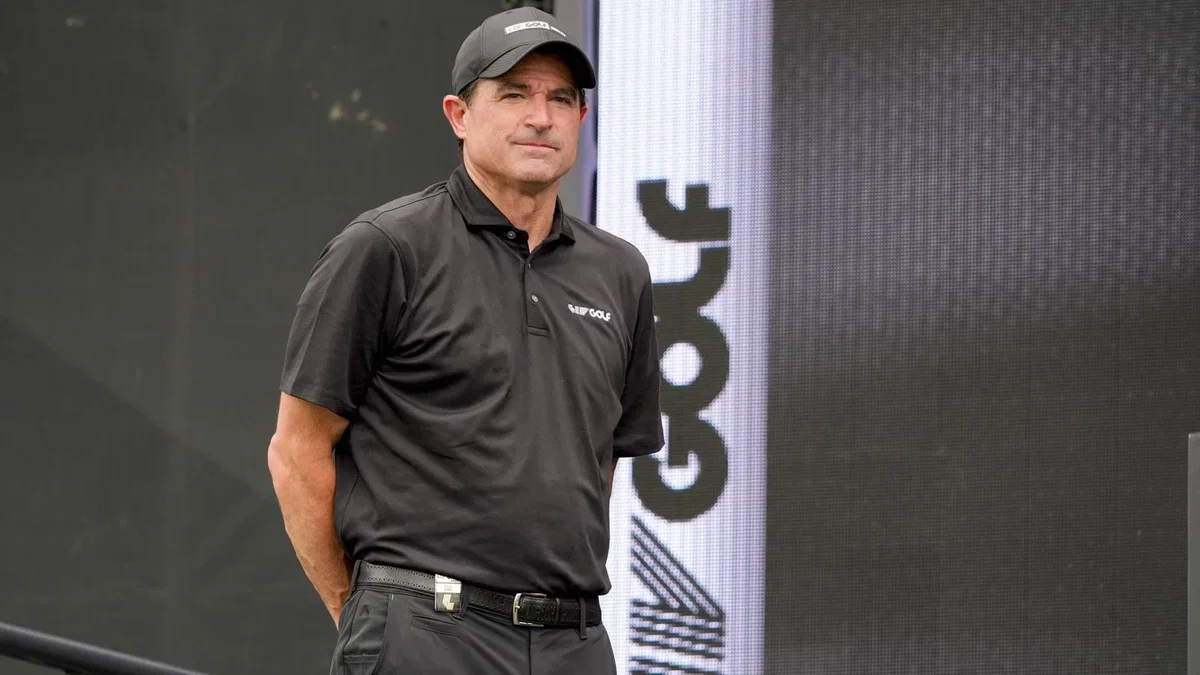
LIV Golf CEO Scott O’Neil had described private equity investor BC Partners as the league’s “white knight” just weeks ago. He was confident that a new business model could give the breakaway league a sustainable future beyond its original financial structure. However, that optimism has now given way to a very different message. The league is now preparing to wind down its operations after its proposed rescue deal collapsed.
Watch What’s Trending Now!
It has confirmed that its restructuring support agreement (RSA) with BC Partners Credit had been terminated. The proposed transaction, which was expected to provide up to $300 million in financing for a revamped LIV Golf 2.0, is no longer expected to proceed. After the announcement, O’Neil issued a lengthy statement reflecting on the league’s achievements and thanking its players, partners, investors, employees, and supporters.
“Building a global platform designed to bring new, younger, and more diverse fans to the sport of golf has been the round of a lifetime for all of us. LIV Golf was fun, demanding, inspiring, at times challenging — but always rewarding,” said Scott O’Neil, CEO of LIV Golf, in the statement shared by Front Office Sports’ David Rumsey on X.
“Together, our team delivered world-class individual and team competitions across five continents, built a global business, secured pathways to The Open and U.S. Open, earned Official World Golf Ranking points, engaged with stakeholders focused on the health and future of the game, created value in our teams, attracted premier sponsors, brought investors to the table around a next-generation business plan, and built a league capable of attracting both elite and rising talent from around the world.”
According to the announcement, the parties could not reach an agreement on certain outstanding terms of the proposed recapitalization transaction. Consequently, the parties terminated the restructuring support agreement, leaving LIV Golf without the financing arrangement it had hoped would secure its next phase.
The CEO further acknowledged the league’s entertainment-focused approach, which combined professional golf with live music, local food and beverage experiences, family entertainment, and technology-driven fan engagement.
He credited the players, representing more than 20 countries, for helping establish the league’s identity. He also thanked host governments, communities, golf courses, corporate partners, and the Public Investment Fund of Saudi Arabia (PIF) for their contributions.
O’Neil concluded his remarks by expressing gratitude to everyone involved in the project and sharing his hopes for the future of professional golf.
“Golf has given so much to so many, and my hope is that those entrusted with its future will lead with the generosity, perspective, and shared purpose this extraordinary game deserves,” he added.
During the Sportico Invest conference in London on October 6, the LIV Golf CEO spoke confidently about the league’s proposed business transformation. He described the shift as a move away from the original Saudi-funded approach toward a more commercially disciplined operation.
“We’re moving from a Saudi-type business plan to a—as I like to say—a ‘business’ business plan,” O’Neil said.
O’Neil also expressed confidence in the restructuring strategy. The league’s CEO suggested LIV Golf had a workable plan for its future.
The collapse of LIV Golf’s restructuring effort was not simply a matter of BC Partners deciding not to invest.
The proposed arrangement required agreement among several stakeholders, including investors, players, creditors, and the league’s existing financial backers. Securing sufficient financial support and convincing enough players to join the new structure proved difficult.
The agreement also included a financing framework targeting $300 million, with BC Partners expected to contribute up to $150 million.
The initial announcement appeared to provide LIV Golf with a potential path forward. PIF also agreed to provide $49.6 million in debtor-in-possession financing, subject to court approval, to support the restructuring proceedings.
However, the proposed transaction remained dependent on securing the necessary stakeholder commitments and satisfying the agreed conditions.
An amended restructuring agreement disclosed on October 5 provided more detail on the financing framework. It included an initial $4 million commitment.
By November 4, reports emerged that BC Partners was withdrawing from the proposed financing arrangement.
Front Office Sports reported that a source familiar with BC Partners’ operations had confirmed the proposed deal would not be signed.
“This version is not going to be signed,” the source told Rumsey.
The report also suggested that BC Partners had not necessarily ruled out every possible involvement with LIV Golf. Another source indicated that the firm was “not out completely,” but not under the existing proposal.
Player commitments became the biggest obstacle for LIV Golf 2.0
Financial backing was only one part of the challenge facing LIV Golf.
The proposed relaunch required sufficient player participation to make the new business model commercially attractive. However, several prominent LIV Golf players were unwilling to commit to the proposed arrangement.
Jon Rahm, Tyrrell Hatton, Tom McKibbin, Ian Poulter, David Puig, Adrian Meronk, Sergio Garcia, Louis Oosthuizen, and Graeme McDowell were among those who had announced they would not return under the proposed structure.
Rahm was particularly direct about his position, saying that returning “wasn’t really ever much of a consideration.”
Reports also suggested interest from other players. Some LIV-connected sources suggested that a critical mass of players had been reached, while other reporting indicated that the league still lacked the necessary commitments from important names.
Although the proposed rescue transaction failed, LIV Golf’s board did not publicly place the responsibility on O’Neil or his leadership team.
Instead, Gene Davis and Jon Zinman, members of the league’s board special committee, acknowledged the work undertaken by the CEO and his colleagues during the restructuring process.
“Scott and his leadership team ran a disciplined process and brought credible options to the table in pursuit of a complex transaction that would secure the League’s future,” they said.
The committee also described an orderly wind-down as the most responsible option under the circumstances.
LIV Golf has faced significant doubts about its future since its creation.
In February 2022, Rory McIlroy dismissed the proposed Saudi-backed circuit. He questioned whether it could attract enough players to become a credible competitor to established professional tours.
“It’s dead in the water in my opinion. I just can’t see any reason why anyone would go,” McIlroy said at the time.
The doubts in 2022 centered on whether LIV Golf could successfully launch and attract established players. This time, the circuit has already built an international operation, recruited prominent golfers, secured sponsorship agreements, and hosted tournaments across five continents.
Its challenge in 2026 was different.
The failure of the BC Partners transaction has pushed the league beyond another period of speculation about its prospects and into an officially announced wind-down.