
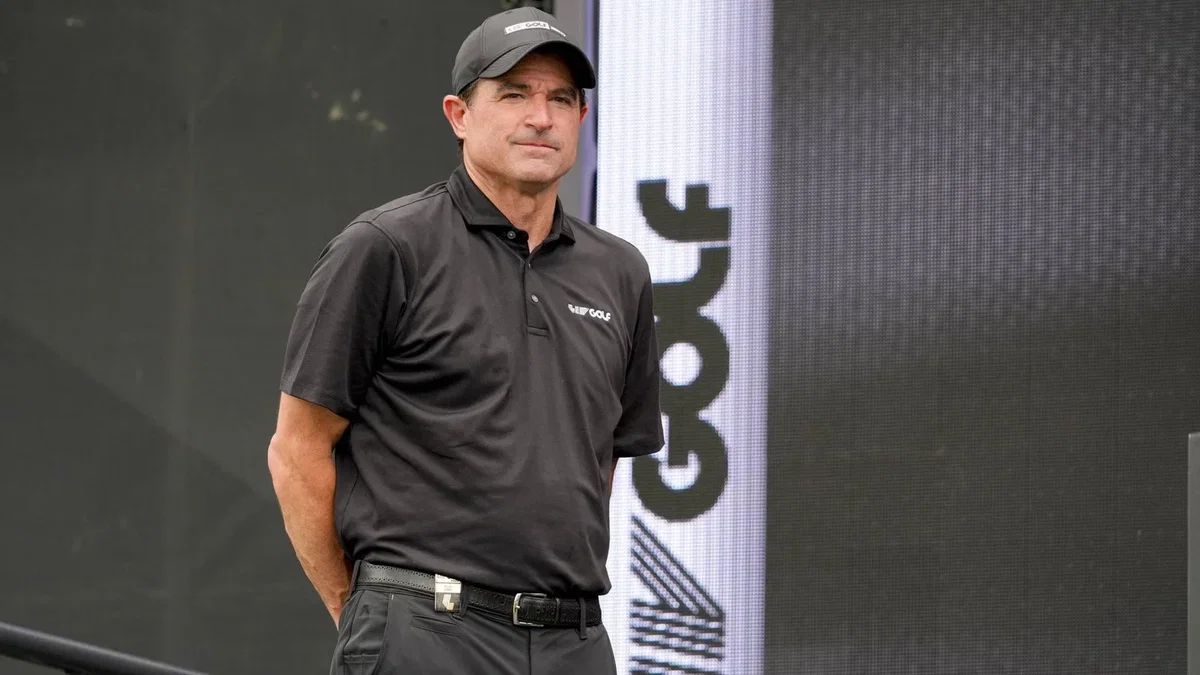
Sponsorships are up 40%, ticket sales have grown over 130%, and broadcasts reach nearly a billion households. Yet LIV Golf still could not keep PIF’s funding. With the financial backing gone, the league now has to prove those numbers mean something to an entirely new set of investors.
Watch What’s Trending Now!
The league announced it has retained New York-based Ducera Partners as its investment banking advisor. The news was first flagged by David Rumsey on X. The elite boutique investment bank has offices in New York, Los Angeles, San Francisco, and Stamford, Connecticut, and a transaction history exceeding $850 billion across multiple industries. LIV Golf CEO Scott O’Neil kept his thoughts on the partnership direct.
“Mike and the Ducera team bring deep transaction experience and a track record of delivering in complex, high-stakes situations. They are the right partner for this process.”
Ducera founder Michael Kramer, who brings over 30 years of experience advising on NHL and MLB franchise deals alongside Fortune 500 restructurings, will lead the process. His firm has been specifically tasked with transitioning LIV Golf from a single-backer model to a diversified, multi-partner investment structure.
A deal of this kind does not happen overnight until the situation is serious. The PIF has bankrolled LIV Golf since its 2022 launch and has confirmed it will stop funding the league after the 2026 season. PIF governor Yasir Al-Rumayyan, who was central to LIV’s creation and sat on its board, is also departing. The Saudi entity cited the high investment level as no longer aligned with its current strategy.


New this morning: LIV Golf has hired Ducera Partners as its investment banking advisor. Ducera describes itself as an "elite boutique investment bank" with offices in NYC, LA, SF, and Stamford, Conn., and over $850 billion in transactions across various industries.

LIV Golf has also overhauled its board, bringing in Gene Davis of Pirinate Consulting Group as chair of the independent directors committee alongside Jon Zinman. Davis described the Ducera hire as a direct reflection of the board’s conviction in the league’s future.
Kramer echoed that, pointing to the league’s growth numbers as proof there is something real to work with, calling what LIV has built hard to replicate. The challenge for Ducera is convincing new investors to see past the $5 billion the Saudis spent without a return and focus on what the league looks like from here.
The PIF’s exit, though, goes beyond a single business decision about golf.
Not only LIV Golf, but Saudi Arabia is also pulling back from other global sports
The PIF’s exit from LIV Golf is not an isolated decision. Its new 2026-30 strategy explicitly prioritizes internal investment and financial returns over global sports expansion, directly reflecting Crown Prince Mohammed bin Salman’s Vision 2030. It is primarily focused on overhauling Saudi infrastructure and reducing oil dependency.
LIV Golf is actually the smallest casualty of this pullback. The Saudis recently scaled back the $500 billion Neom city project, lost the 2029 Asian Winter Games host status, and sold 70% of Al-Hilal, one of their top soccer clubs.
Oil economics have also complicated the picture. Earlier in 2026, crude was trading around $60 per barrel, creating budget pressure across Saudi projects. The ongoing US-Iran conflict over the Strait of Hormuz, through which 25% of global oil passes, has added uncertainty as prices temporarily spiked above $100.
As Saudi Arabia gets closer to hosting the 2034 World Cup, it requires 10 to 11 new stadiums. So, it becomes harder to justify an unprofitable golf league. As Rice University’s Middle East expert Kristian Ulrichsen put it, there is simply no appetite for losses for another five to ten years.